What you will learn
- All four are SBA programs and all start with being small under the SBA size standard for your NAICS codes.
- 8(a) is a nine-year business development program for socially and economically disadvantaged owners; it allows sole-source awards and dedicated competitions.
- HUBZone turns on where your principal office is and where your employees live; it can move as you grow or as maps change.
- SDVOSB and WOSB require majority ownership and control by the qualifying person; both are certified through the SBA, not self-certified.
- Certification opens doors; it does not win contracts. Past performance and a compliant proposal still decide the award.
Chapter 01of 071 min
Why certifications matter
The government has statutory goals for the share of contract dollars awarded to small businesses and to specific categories of them: 23 percent to small businesses overall, and sub-goals for small disadvantaged, women-owned, service-disabled veteran-owned and HUBZone businesses. Contracting officers meet those goals with set-asides and sole-source awards, and FAR Part 19 gives them the authority to restrict a competition to a category. If you hold the certification, you compete against a much smaller field; if you do not, that competition does not exist for you.
Certification is not a marketing badge. Each one is a legal status with eligibility rules, an application process, and ongoing obligations, and misrepresenting one carries serious penalties. Treat it as a strategic decision with a compliance cost.
Chapter 02of 071 min
The four programs compared
| 8(a) | HUBZone | SDVOSB | WOSB / EDWOSB | |
|---|---|---|---|---|
| Core test | At least 51% owned and controlled by socially and economically disadvantaged US citizens; personal net worth, income and asset limits apply. | Principal office in a HUBZone and at least 35% of employees living in HUBZones. | At least 51% owned and controlled by one or more service-disabled veterans. | At least 51% owned and controlled by women; EDWOSB adds economic disadvantage tests. |
| Certified by | SBA, with a two-year-in-business expectation (waivers possible). | SBA. | SBA (since 2023; previously the VA). | SBA, or an SBA-approved third-party certifier. |
| What it unlocks | Sole-source awards up to statutory thresholds, 8(a) competitions, mentor-protégé, and business development help for nine years. | HUBZone set-asides and sole source; a 10% price evaluation preference in full and open competitions. | SDVOSB set-asides and sole source government-wide; VA gives SDVOSBs priority under its Vets First program. | WOSB and EDWOSB set-asides and sole source in industries where women are underrepresented. |
| Term | Nine years total, once per person. | Ongoing, recertified annually; eligibility can change with maps and hiring. | Ongoing, recertified periodically. | Ongoing, recertified periodically. |
| Main risk | Losing eligibility through net worth growth or control changes; program graduation planning. | Falling below 35% resident employees as you hire; map redesignations. | Control tests: the veteran must manage day to day and hold the highest position. | Control tests: the woman owner must run the business, not lend her name. |
Chapter 03of 071 min
8(a) Business Development
The 8(a) program is the most powerful and the most demanding. It is aimed at companies owned by people who are socially and economically disadvantaged, and it runs for nine years from admission. During that time an 8(a) firm can receive sole-source awards up to the program's thresholds, compete in competitions limited to 8(a) firms, enter the SBA mentor-protégé program with a large business, and receive counseling. The trade-off is scrutiny: annual reviews, limits on the owner's personal wealth, and a plan to graduate into open competition.
- Apply through the SBA's certification portal with ownership, control, financial and narrative evidence; expect several months.
- Use the sole-source authority deliberately: it is how 8(a) firms build past performance quickly with a sympathetic agency.
- Plan for year nine from year one. Firms that rely only on 8(a) awards struggle when the program ends.
Chapter 04of 071 min
HUBZone
The Historically Underutilized Business Zone program rewards companies that locate in and hire from designated areas: certain census tracts, counties, Indian reservations, base closure areas and disaster areas. The tests are about place: your principal office must be in a HUBZone, and at least 35 percent of your employees must live in one. Certification brings HUBZone set-asides, sole-source authority, and a price evaluation preference in full and open competitions.
- Check the HUBZone map before choosing an office; redesignations happen and a "legacy" employee rule softens some changes.
- Track employee residency continuously. Hiring outside the zone can silently break the 35 percent test.
- Combine with another certification where eligible; HUBZone plus SDVOSB or 8(a) widens the set-asides you can chase.
Chapter 05of 071 min
Service-Disabled Veteran-Owned Small Business
SDVOSB status requires that one or more service-disabled veterans own at least 51 percent of the company and control it: the veteran holds the highest officer position, manages day-to-day operations and makes long-term decisions. Since 2023 the SBA certifies SDVOSBs for all agencies through its Veteran Small Business Certification program. Certified firms are eligible for SDVOSB set-asides and sole-source awards government-wide, and the Department of Veterans Affairs gives them first priority under its own Vets First rules.
Chapter 06of 071 min
Women-Owned Small Business
WOSB certification requires 51 percent ownership and control by women who are US citizens; the Economically Disadvantaged WOSB tier adds personal net worth, income and asset limits. Set-asides for WOSBs are available in NAICS codes the SBA has designated as underrepresented, and EDWOSB set-asides in a further list, with sole-source authority under thresholds. Certification is through the SBA or an approved third-party certifier.
Chapter 07of 071 min
Choosing what to pursue
- 1
Confirm you are small first
Every program starts with size under your NAICS codes. See the NAICS guide.
- 2
List every certification you plausibly qualify for
Ownership, control, residency and disadvantage tests. Many firms qualify for two; the combination is what makes set-aside competition thin.
- 3
Look at your target agencies' spending
Agencies differ: the VA is SDVOSB-heavy; some civilian agencies lean on 8(a) sole source; DoD buys large volumes through HUBZone and WOSB set-asides in certain codes. Award data by set-aside type tells you which certification will actually produce opportunities in your market.
- 4
Weigh the maintenance cost
Annual recertification, residency tracking, control documentation, and for 8(a) the wealth limits and graduation planning. Certifications that you cannot maintain become liabilities.
- 5
Apply, then market it
Update SAM.gov, your capability statement and your website the day certification arrives, and tell the small business specialists at your target agencies.
Before you certify
- Ownership and control documents match the program's tests exactly, including operating agreements and bylaws.
- Size verified under every NAICS code you intend to bid.
- Personal financial statements prepared where the program requires them.
- HUBZone: office address and employee residency checked against the current map.
- A named owner for annual recertification and for monitoring changes that affect eligibility.
- Counsel consulted on any question of control, affiliation or joint ventures.
Before you go
Questions people ask
- Can a company hold more than one certification?
- Yes, if it meets each program's tests independently. An SDVOSB in a HUBZone with a service-disabled veteran owner is common, and the combination lets the company compete in both kinds of set-aside.
- Is self-certification still allowed?
- For small business status generally, you represent size in SAM. For SDVOSB and WOSB set-asides, SBA certification is now required; self-certification alone does not make you eligible for those set-asides.
- How long does certification take?
- It varies by program and by the completeness of the application: weeks for some WOSB and SDVOSB cases, several months for 8(a). Complete documentation is the biggest factor you control.
- What happens if we grow past the size standard?
- You remain eligible for contracts already awarded under most rules, but you must recertify on long-term contracts and you cannot win new set-asides under that code. Plan the transition to full and open competition before it happens.
- Do joint ventures qualify for set-asides?
- A joint venture can qualify if it meets SBA's joint venture rules, including for mentor-protégé JVs. The rules on ownership, control and work share are specific; get them reviewed before forming the JV.
Set-aside filters matched to the certifications you hold
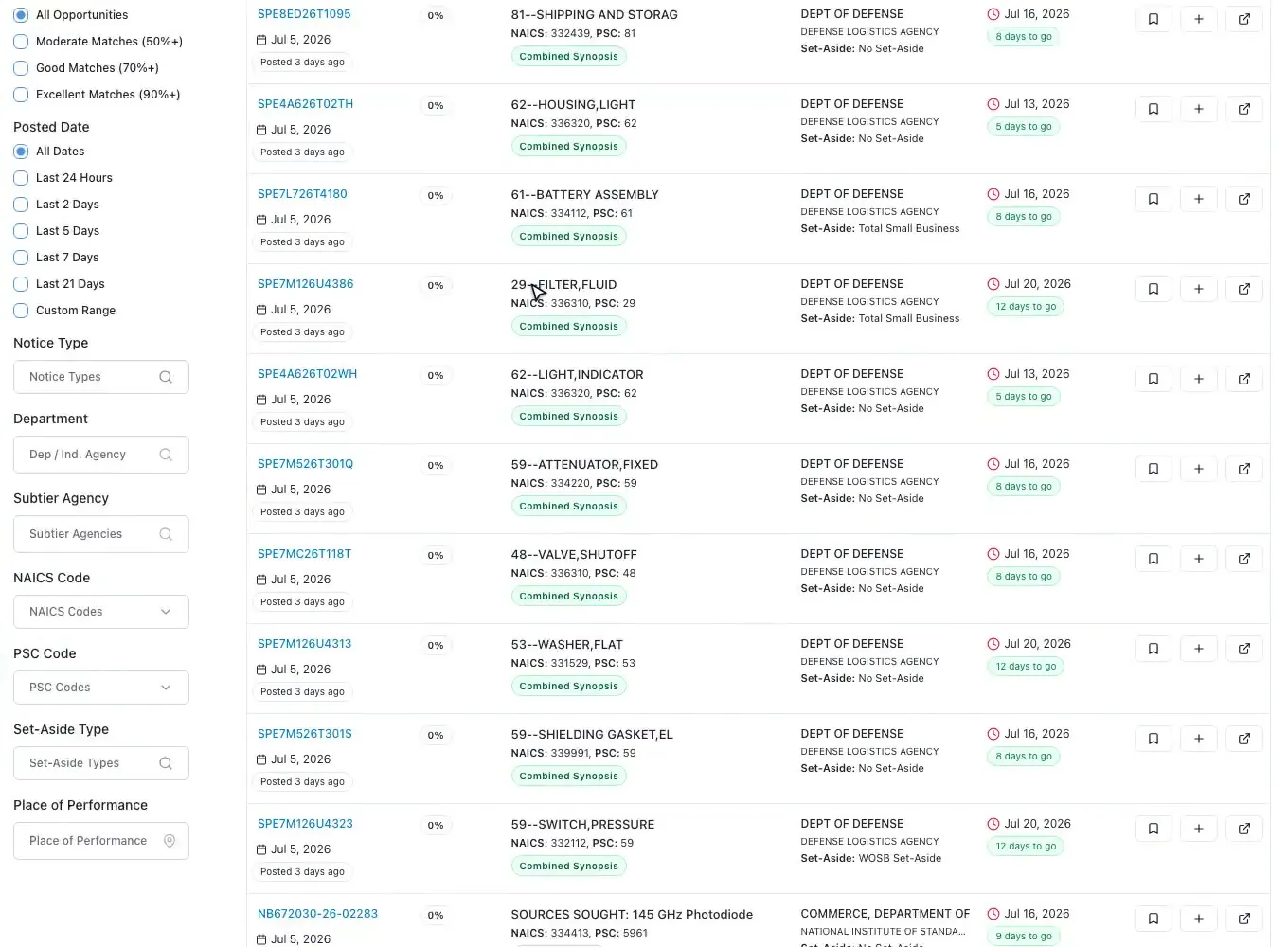
Record your certifications once in the ProposalWorkspace company profile and filter SAM.gov opportunities by the set-asides you are eligible for, with the match score weighing set-aside fit alongside NAICS, PSC, agency and place of performance, so a HUBZone or SDVOSB notice in your codes is never buried under full-and-open buys you cannot win.
Up next
How to find federal contract opportunities on SAM.gov
SAM.gov publishes every federal opportunity above the micro-purchase threshold. Most contractors search it badly. This guide shows how to search it like a capture manager: by code, by set-aside, by buying office, and early enough to shape the requirement.
7 min
New proposal guides, by email
One email when we publish a new proposal guide for companies that bid to federal and state agencies, and the occasional product update. No drip campaigns, no sharing your address, unsubscribe with one click.
This guide is general information for federal contractors drawn from the FAR and standard capture and proposal practice. It is not legal advice; always read the specific solicitation and consult counsel on protests, contract terms and compliance questions.