What you will learn
- A negotiated federal proposal is a set of volumes defined by Section L: typically administrative, technical, management, past performance and price, plus any small business plan.
- Section L always wins. Use this template for what each volume should contain; use the solicitation for the order, the names and the page limits.
- Evaluators score against Section M. Each volume's headings should carry the factor and subfactor language so the score is easy to find.
- The cover letter is not evaluated, but it is where you acknowledge amendments, state your size status and name the person who can negotiate.
- Price lives in its own volume. Putting price anywhere else, unless Section L says so, is a common way to be found non-compliant.
Chapter 01of 081 min
What a federal contract proposal is
A federal contract proposal is your formal offer in response to a solicitation: a Request for Proposal under FAR Part 15, a Request for Quotation, or a combined synopsis and solicitation for commercial items under FAR Part 12. Unlike a commercial pitch, it is written to a prescribed structure, evaluated against published factors, and, once accepted, becomes part of a binding contract. That last point is why the template below is disciplined: everything you promise in the technical and management volumes is something you will be held to.
The structure comes from the solicitation itself. Section L (Instructions to Offerors) names the volumes, their order, their page limits and their required contents. Section M (Evaluation Factors) says how each will be scored. This template describes the volumes almost every negotiated solicitation asks for; when a specific Section L differs, Section L wins.
Chapter 02of 081 min
The volumes, and what each one is for
| Volume | What it contains | What the evaluator is looking for |
|---|---|---|
| Cover letter | One page: solicitation number, offer validity period, amendments acknowledged, UEI and CAGE, size and socio-economic status, the person authorized to negotiate, signature. | Not scored. Read by the contracting officer for completeness and authority. |
| Administrative or contract documents | The signed SF 33 or SF 1449, Section K representations and certifications (or a SAM reference), amendment acknowledgements, subcontracting plan if required, any permitted exceptions. | Compliance. Missing or unsigned forms can make the offer unacceptable before evaluation starts. |
| Technical | Understanding of the requirement, the technical approach to each PWS task, risks and mitigations, and anything else Section L lists for this volume. | Understanding, soundness, feasibility, and the strengths that exceed the requirement. |
| Management | Organization and authority, staffing plan and key personnel, quality control, transition-in, communication with the government. | Whether the plan is realistic, resourced, measurable and low-risk. |
| Past performance | The permitted number of references with contract data, scope, a relevance statement and results; questionnaires sent to customers. | Recency, relevance and quality of your record on similar work. |
| Price or cost | Pricing by line item and period on the government template, basis of estimate, assumptions, labor categories and rates where required. | Reasonableness, realism against the technical approach, and completeness. |
Included with ProposalWorkspace
Federal proposal template (Word)
The volumes above as a ready skeleton: cover letter, administrative checklist, technical, management, past performance and price, with placeholder guidance under every heading and federal-style numbering that matches the outline pane and the exports.
Sign up and the template is yours to use - the 14-day trial includes every feature, no credit card.
Chapter 03of 081 min
The cover letter
One page, on letterhead, addressed to the contracting officer. It is rarely evaluated, so keep it administrative: the solicitation number and title, a statement that the offer is valid for the period Section L requires, the amendments you acknowledge, your UEI and CAGE code, your size and socio-economic status under the assigned NAICS, and the name and contact details of the person authorized to negotiate and bind the company. Sign it. A cover letter that reads like a sales letter wastes the contracting officer's time; one that is missing an amendment acknowledgement can cost you the competition.
Chapter 04of 081 min
The technical volume
The technical volume answers the question "do they understand the work and can they do it". Open with a short statement of understanding: the mission, the users, the current state and what success looks like for the government. Then address the work in the order Section M evaluates it, which is usually by PWS task. For each task, say what you will do, how, with what tools and standards, and the measurable result. Close with the risks you see and how you will manage them; evaluators trust offerors who name risks over those who claim there are none.
- Use Section L's numbering for the top level and Section M's words in the headings.
- Answer the evaluation factor in the first sentence under each heading, then support it.
- Prefer one clear diagram to a page of prose where a process or architecture is involved, and count the figure against the page limit.
- Every claim of capability should point to a proof: a past performance, a named person, a tool you already run.
Chapter 05of 081 min
The management volume
The management volume answers "will the work actually get done, by whom, and how will we know". It usually contains the organization and lines of authority, the staffing plan and key personnel, the quality control approach tied to the government's surveillance plan, the transition-in plan with a schedule, and how you will communicate with the contracting officer's representative. Evaluators look for realism: a transition schedule that accounts for clearances, a staffing plan whose numbers match the price volume, a quality plan that measures what the PWS says will be measured.
Chapter 06of 081 min
The past performance volume
Submit exactly the number of references Section L allows, each chosen to meet Section M's definitions of recency and relevance. For each reference give the customer, contract number and type, value, period of performance, your role, a scope description in the PWS's vocabulary, a relevance statement that argues scope, size and complexity explicitly, measured results and ratings, and verified points of contact. Send any required questionnaires to your customers on day one and confirm they were returned. The detail is in the past performance guide.
Chapter 07of 081 min
The price or cost volume
Price is submitted separately so the technical evaluators never see it. Use the government's pricing template from Section J if one is provided, price every contract line item for every period including options, and state your assumptions. Where cost or pricing data is required, include the basis of estimate: labor categories, hours, rates and the build-up. The single most common price-volume failure is inconsistency with the management volume: hours that do not match the staffing plan, or labor categories that do not match the key personnel. Reconcile them before Gold Team.
Chapter 08of 081 min
The order of work, from release to submission
- 1
Read Sections L, M and C and decide to bid
Confirm eligibility, run the bid/no-bid review and assign the proposal manager within days of release. See the bid/no-bid worksheet.
- 2
Build the outline and the compliance matrix
Section L gives the volumes and order, Section M the heading language, Section C the tasks. Every requirement gets an owner. See the outline guide and the compliance matrix guide.
- 3
Draft each volume against its page budget
Writers work from the annotated outline; the proposal manager guards the page limits and the Section L order.
- 4
Review in color teams
Pink Team for structure and coverage, Red Team scored as the evaluator would, Gold Team for the executive sign-off. See the color team guide.
- 5
Produce, check and submit a day early
Final PDFs checked against every Section L instruction, forms signed, amendments acknowledged, cross-reference matrix regenerated, submission method tested.
Compliance checks before submission
- Volumes named and ordered exactly as Section L requires, in the required file formats.
- Page limits, fonts, margins and spacing verified in the final PDFs.
- Every Section L content item and every Section M factor addressed under a matching heading.
- All amendments acknowledged; SF 33 or SF 1449 signed; representations and certifications complete.
- Price only in the price volume; staffing and hours consistent between management and price.
- Key personnel resumes and letters of commitment included as Section L directs.
- Submitted before the deadline, in the stated time zone, by the stated method, with receipt confirmed.
Before you go
Questions people ask
- Can I reuse a proposal template from a previous bid?
- Reuse the discipline and the boilerplate that is genuinely stable, such as company data and quality processes. Rebuild the outline for every solicitation from its own Section L and M; a reused structure is the most common cause of content that does not match the scoring sheet.
- How long should each volume be?
- As long as Section L allows and no longer. When Section L gives a total page limit for a volume, divide it among sections in proportion to Section M's weights, so the most important factor gets the most pages.
- What is the difference between an RFP, an RFQ and an IFB?
- An RFP invites proposals evaluated on technical and price factors under FAR Part 15. An RFQ requests quotations, often for commercial items or simplified acquisitions, and a quotation is not an offer until the government accepts it. An IFB is a sealed bid under FAR Part 14, awarded to the lowest responsive, responsible bidder with no negotiations.
- Do I need an executive summary?
- Only if Section L asks for one or permits it outside the page count. When allowed, keep it to a page that states your understanding, your approach in three sentences and the two or three strengths you most want the evaluators to remember.
- Where do resumes and letters of commitment go?
- Wherever Section L says, usually an appendix to the management or technical volume. Confirm whether they count against the page limit during the Q&A period if Section L is silent.
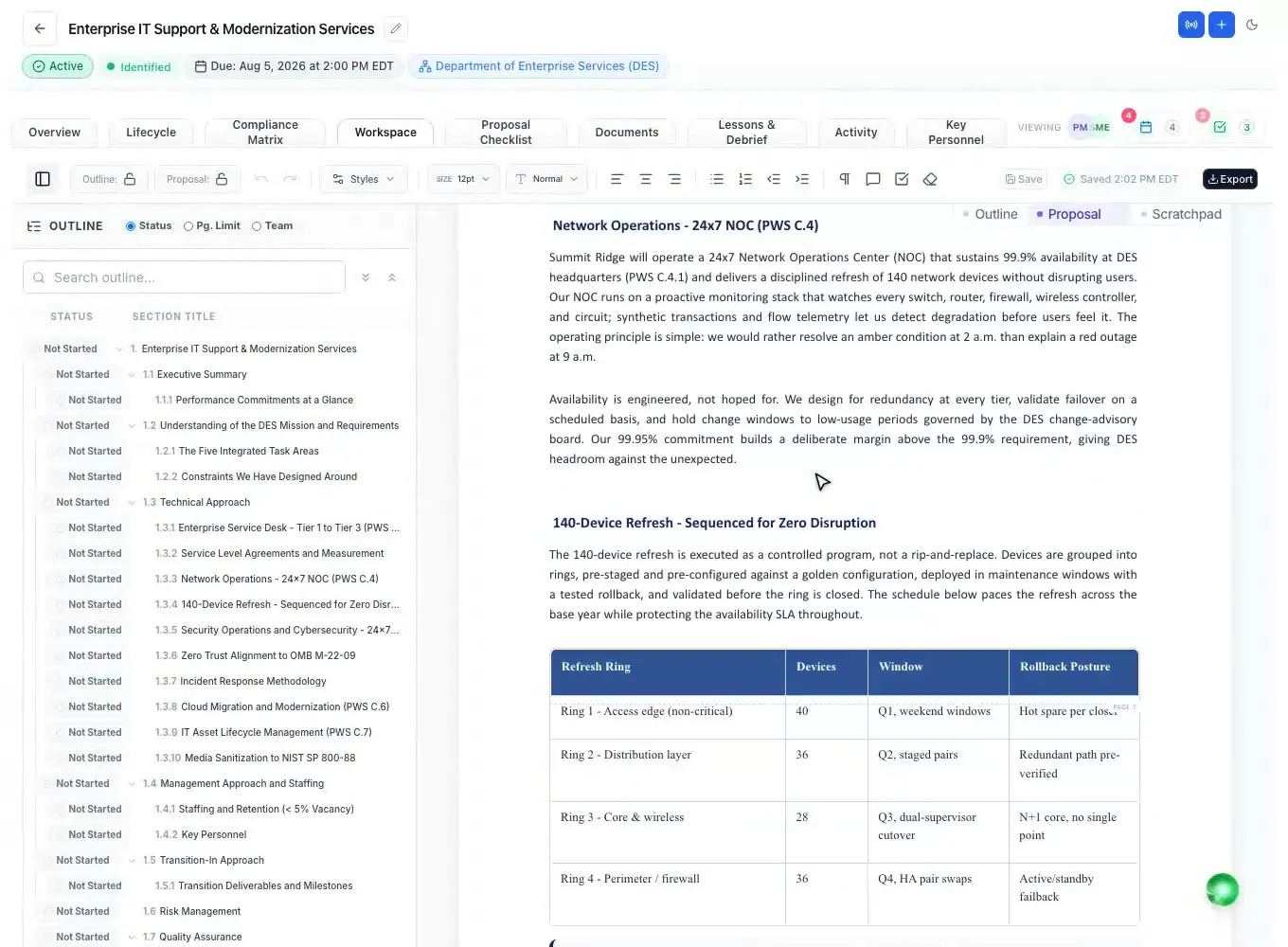
A workspace that generates the outline and every volume from the RFP
ProposalWorkspace turns the solicitation into a compliant Section L and M outline with writer guidance and placeholders for resumes, letters and reps and certs, then drafts inside a multi-page editor with federal heading numbering, tracked changes and true Word and PDF export. The compliance matrix, the checklist and the key personnel package are generated from the same solicitation, so the volumes agree with each other.
Up next
Win themes and discriminators: how to write them and where they go
A win theme is the sentence an evaluator writes down as a strength. Most proposals have slogans instead: "customer-focused", "proven", "innovative". This guide gives a formula for themes that connect what the customer worries about to something only you can prove, and shows where they belong so evaluators actually meet them.
6 min
New proposal guides, by email
One email when we publish a new proposal guide for companies that bid to federal and state agencies, and the occasional product update. No drip campaigns, no sharing your address, unsubscribe with one click.
This guide is general information for federal contractors drawn from the FAR and standard capture and proposal practice. It is not legal advice; always read the specific solicitation and consult counsel on protests, contract terms and compliance questions.