What you will learn
- A compliance matrix tracks the requirements in Section L (instructions), Section M (evaluation factors) and Section C (the work) so nothing is missed or answered in the wrong place.
- Evaluators check compliance before quality. A missing Section L item or a breached page limit can make a proposal unscoreable however good the writing is.
- Requirements should be tracked in the solicitation's own words, with the source, so reviewers can verify them against the original.
- The matrix is a living review tool: coverage at Pink Team, compliance at Red Team, a final check against the submitted files.
- The cross-reference matrix you submit with the proposal is a short by-product of the internal matrix, not the same document.
Chapter 01of 051 min
What a compliance matrix is, and what it is not
A compliance matrix is an internal working document: a table with one line for each requirement the solicitation places on your proposal, and columns that track how, where and by whom the proposal satisfies it. It exists because federal solicitations spread their requirements across several places. Section L says what to submit and how. Section M says what will be scored and how heavily. Section C, usually a Statement of Work or Performance Work Statement in an attachment, says what the work is. A matrix is where all three meet.
It is not the same as a cross-reference matrix, the short table some solicitations ask you to include in the proposal that maps their instructions to your page numbers. That submitted table is a by-product: once your internal matrix knows where every requirement is answered, the cross-reference matrix is a filtered view of it. The internal matrix also carries owners, progress and candid notes that are not for the customer.
Chapter 02of 051 min
Why proposals fail without one
Most compliance failures are not carelessness. They are structural: the solicitation was read by one person and written by five; the amendment that changed a page limit arrived after the outline was frozen; a requirement that lived in Section H rather than the PWS never reached the writer. A matrix defeats each of these in the same way, by giving every requirement one line that someone owns.
- Scattered requirements. Instructions in L, scoring in M, work in C, constraints in F, G and H, and more in the Section J attachments. Without a single list, each writer works from the part they read.
- Paraphrase drift. A requirement summarized in a kickoff slide loses its qualifier. Tracking the solicitation's own words keeps "shall" from quietly becoming "should".
- Amendments. Requirements change mid-stream. A matrix that notes which amendment changed which line is the only way to know the draft still matches the current solicitation.
- Unowned gaps. The requirement nobody was assigned is the one that is missing at Red Team.
Chapter 03of 051 min
What a good matrix tracks
Layouts vary between companies and tools, but a useful matrix answers six questions about every requirement. If yours answers all six, it will carry you through the reviews; if it answers only the first two, it is a list, not a matrix.
The six questions
- What is required?
- The requirement in the solicitation's own words, so reviewers can verify it and writers answer the real thing.
- Where does it come from?
- Section, paragraph and page. This is how a reviewer confirms the line in seconds and how the team finds it again after an amendment.
- How binding is it?
- Whether the requirement is mandatory, conditional or a preference. A missed "shall" is a deficiency; a missed "should" is at most a weakness.
- Where is it answered?
- The volume and section of the proposal that responds. This becomes the cross-reference matrix.
- Who owns it?
- One person accountable for the answer. Unowned lines are the ones that go missing.
- Where does it stand?
- Progress and a compliance judgment that reviewers update at each color team review.
Included with ProposalWorkspace
Compliance matrix template
A ready layout built around the six questions, with owners, a compliance call and a live summary, and Excel and Word import and export so it travels with your team.
Sign up and the template is yours to use - the 14-day trial includes every feature, no credit card.
Chapter 04of 051 min
Using the matrix through the reviews
The matrix is most valuable as a review instrument. At each color team review the reviewers work from the matrix rather than from the prose, because the matrix is the list of things the evaluator will check.
- 1
Kickoff: baseline it
Build the matrix from the complete solicitation, including every attachment, and freeze it as version one before writing starts. Assign owners and target sections. Any requirement without a home is a gap in the outline; fix the outline.
- 2
Pink Team: check coverage
Reviewers confirm every line has an owner and a section, and that the outline covers every Section L item and Section M factor. Nobody is judging quality yet, only whether the shape of the proposal can be compliant.
- 3
Red Team: check compliance
Reviewers read the section named on each line and judge it as an evaluator would: does it meet the requirement, partly meet it, or miss it. Every shortfall becomes an assigned action with a date.
- 4
Amendments: revise the matrix first
When an amendment arrives, update the matrix before touching the drafts, and note the amendment number on every line it changed. Then update the outline, then the prose.
- 5
Final check: verify against the submitted files
Re-verify every mandatory line against the final PDFs, not the working documents. Page numbers shift, sections get cut, and a matrix last updated at Red Team is a false comfort. Regenerate the cross-reference matrix from the final page numbers.
Chapter 05of 051 min
Where compliance matrices go wrong
- Paraphrasing. Writers answer the paraphrase and miss the qualifier in the original sentence.
- Compound lines. One line holding three requirements gets marked compliant when two of the three are met.
- Starting with Section C only. Section L and M lines are the ones that make a proposal unscoreable when missed.
- Nobody owns the matrix. The proposal manager owns it; writers own lines. Both are needed.
- Treating it as a one-time deliverable. A matrix that stops at kickoff cannot catch the amendment that changed the page limit.
Matrix quality check
- Every attachment and amendment has been covered, not just the base RFP.
- Every line is one requirement, in the solicitation's words, with source and page.
- Every mandatory line has an owner and a target section.
- Status uses a fixed vocabulary, so the counts on the summary are reliable.
- The cross-reference matrix in the proposal is generated from the matrix, not typed by hand.
- Version history shows which amendment changed which lines.
Before you go
Questions people ask
- How many lines should a compliance matrix have?
- It depends on the solicitation. A services RFP with a 40-page PWS commonly produces a few hundred. If yours has 30, you are summarizing; if it has thousands, you have turned background text into requirements. The right level is the one at which one person can say yes or no to each line.
- Do we submit the compliance matrix with the proposal?
- No. Submit a cross-reference matrix only if Section L asks for one or permits it without counting against page limits. The internal compliance matrix contains owners, progress and candid notes that are not for the customer.
- Should the matrix live in Excel or in a proposal tool?
- Excel works for a small team on one bid. A shared tool earns its keep when several writers update lines at once, when amendments change requirements mid-stream, or when you want the matrix to drive the outline and the reviews instead of being copied between them.
- What is the difference between "shall" and "should" in a requirement?
- In federal solicitations, "shall" and "must" state mandatory requirements; "should" states a preference; "may" states an option. Treat them differently in the matrix, because a missed shall is a deficiency while a missed should is at most a weakness.
- How do we handle a requirement we cannot meet?
- Decide early whether to take an exception (only if Section L allows it, and knowing it may make the offer unacceptable), propose an alternative that meets the intent, or no-bid. Record the decision on the line so the whole team answers consistently.
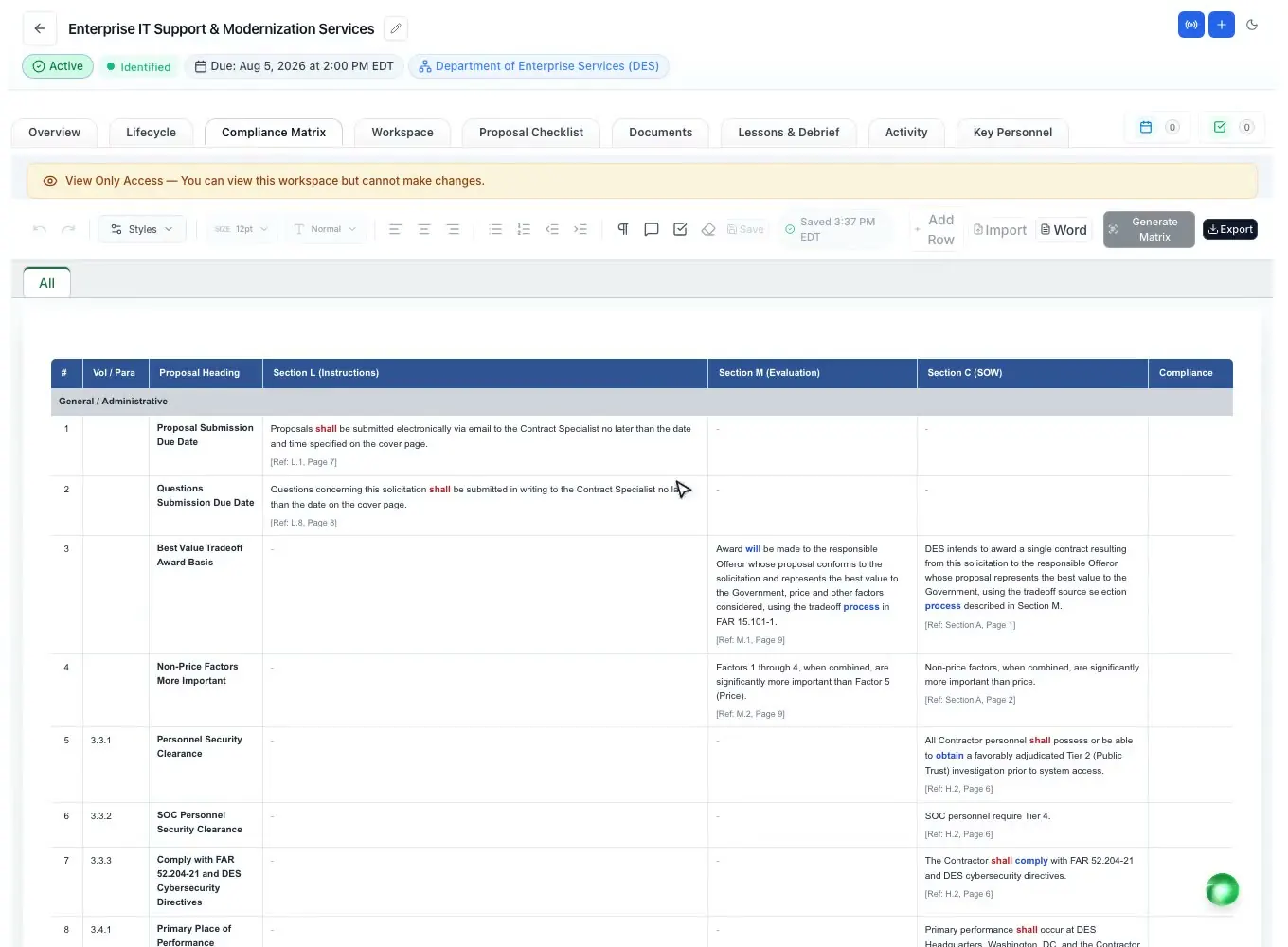
A compliance matrix generated from the RFP, with page references
ProposalWorkspace reads Sections L, M and the PWS and builds the matrix for you, each row tied back to the page it came from, so the team spends its time assigning owners and answering requirements instead of copying sentences out of a PDF. Owners and the compliance call are set per cell with a live summary, the matrix moves in and out of Excel and Word, and an AI evaluator can score a drafted section against its row before the human reviewers do.
Up next
Solicitation amendments and Q&A: what changes and what you must acknowledge
Between release and submission the solicitation keeps moving: questions are answered, dates shift, page limits change, whole sections are replaced. Teams that treat the base RFP as fixed submit against a document that no longer exists. This guide covers the Q&A period, amendments, acknowledgement and the discipline of tracking change.
6 min
New proposal guides, by email
One email when we publish a new proposal guide for companies that bid to federal and state agencies, and the occasional product update. No drip campaigns, no sharing your address, unsubscribe with one click.
This guide is general information for federal contractors drawn from the FAR and standard capture and proposal practice. It is not legal advice; always read the specific solicitation and consult counsel on protests, contract terms and compliance questions.