What you will learn
- The Uniform Contract Format (
FAR 15.204-1) puts the Statement of Work in Section C, instructions to offerors in Section L and evaluation factors in Section M. - Follow L, answer M, prove C. The outline follows Section L's order; every heading answers a Section M factor; the content proves you can do Section C.
- Conflicts between the sections are common. Ask about them before the Q&A deadline; if unresolved, the order of precedence clause (
FAR 52.215-8) decides. - Section M often names the factors but not the weights in detail. Words like "significantly more important than" are the weights.
- Commercial-item and simplified buys may not use the UCF. The same three questions still apply: what is the work, how do I submit, how am I scored.
Chapter 01of 061 min
The Uniform Contract Format in one table
Negotiated solicitations under FAR Part 15 are organized in the Uniform Contract Format described in FAR 15.204-1. It is a fixed set of sections, A through M, grouped into four parts. Knowing the map means you always know where to look.
| Part | Sections | What lives there |
|---|---|---|
| Part I - The Schedule | A to H | Cover sheet (SF 33 or 1449), supplies or services and prices (B), description or specifications or Statement of Work (C), packaging (D), inspection and acceptance (E), deliveries or performance (F), contract administration (G), special contract requirements (H). |
| Part II - Contract clauses | I | The FAR and agency clauses that will govern the contract, in full text or by reference. |
| Part III - Documents, exhibits, attachments | J | Attachments: the PWS or SOW itself is often here, along with CDRLs, wage determinations, past performance questionnaires and the pricing template. |
| Part IV - Representations and instructions | K, L, M | Representations and certifications (K), instructions, conditions and notices to offerors (L), evaluation factors for award (M). |
Chapter 02of 061 min
Section C: what the work is
Section C describes the requirement. It may be a Statement of Work (SOW) that says how the work is to be done, a Performance Work Statement (PWS) that states outcomes and lets you propose the how, or a Statement of Objectives (SOO) that states only the government's goals and expects you to write the PWS. In many solicitations Section C is a single paragraph pointing to an attachment in Section J; the attachment is the real Section C.
- Read every shall and must. Each one is a requirement you will have to prove you meet, and each one belongs in your compliance matrix.
- Note the performance standards and the surveillance method (often a Quality Assurance Surveillance Plan in Section J). Evaluators score your understanding of how they will measure you.
- Note deliverables and their due dates. Contract Data Requirements Lists and reporting requirements drive staffing.
- Read Sections F and H alongside C: place of performance, hours, transition periods, key personnel clauses and security requirements often hide there.
Chapter 03of 061 min
Section L: how to write and submit
Section L incorporates the provision at FAR 52.215-1, Instructions to Offerors - Competitive Acquisition, and then adds the agency's specific instructions. This is the section evaluators use to decide whether your proposal is compliant enough to be read at all. It tells you the volumes to submit, their order, their page limits, fonts and margins, file formats, how to mark proprietary data, where and when to deliver, and what each volume must contain.
What to extract from Section L
- Volumes and order
- Typically Technical, Management, Past Performance, Price or Cost, and sometimes Small Business Participation and Contract Documents. Your proposal should be organized in this exact order.
- Page limits and formatting
- Pages, font size, margins, line spacing, whether tables and figures count, and what happens to pages over the limit (usually "will not be evaluated").
- Required content per volume
- Section L usually lists what each volume must address, often numbered. Those numbers become your headings.
- Submission mechanics
- Portal, email or hard copy; file naming; file size caps; number of copies; due date and time with time zone; whether late proposals are accepted (
FAR 15.208says generally not). - Questions and amendments
- The Q&A deadline, how to submit questions, and the requirement to acknowledge amendments.
- Assumptions and exceptions
- Whether you may take exception to terms, and how. Unrequested exceptions can make an offer non-compliant.
Chapter 04of 061 min
Section M: how you will be scored
Section M states the basis for award and the evaluation factors and subfactors. FAR 15.304 requires the agency to disclose the factors and significant subfactors, their relative importance, and the importance of all non-cost factors combined relative to cost or price. Two phrases tell you the source selection approach: best value tradeoff (FAR 15.101-1), where the government may pay more for a better proposal, and lowest price technically acceptable (FAR 15.101-2), where any acceptable proposal competes on price alone.
Section M is written in the evaluator's language. When it says the government will evaluate "the extent to which the offeror's approach demonstrates an understanding of the transition risks", your proposal must contain a section that visibly demonstrates understanding of transition risks, using those words. Evaluators are trained to score against the factor text, and a proposal that mirrors it makes their job, and your score, easier.
| Section M says | What it means |
|---|---|
| "Technical is significantly more important than price" | Tradeoff. A strong technical volume can win at a higher price; invest there. |
| "Factors are listed in descending order of importance" | Factor 1 carries the most weight; do not under-invest in it because it is short in Section L. |
| "Past performance will be evaluated for recency, relevancy and quality" | Choose references by those three tests, and define each term the way Section M defines it. |
| "All non-price factors, when combined, are approximately equal to price" | Price discipline matters as much as the technical story; every gold-plated feature costs you. |
| "Technically acceptable" with no adjectival ratings | LPTA. Meet every requirement clearly and stop; extra features earn nothing. |
Chapter 05of 061 min
Putting the three together: a worked example
Suppose Section L says the Technical Volume is limited to 25 pages and must address (1) Technical Approach, (2) Staffing Plan and (3) Transition Plan. Section M says Technical Approach is the most important factor and will be evaluated for "understanding of the PWS tasks in paragraphs 3.1 through 3.6 and the soundness of the proposed approach to each". Section C (the PWS) has six tasks in paragraphs 3.1 to 3.6.
1.0 Technical Approach (L item 1; M factor 1, most important) 1.1 Understanding of the Requirement 1.2 Approach to Task 3.1 - Service Desk Operations 1.3 Approach to Task 3.2 - Network Operations ... one subsection per PWS task through 3.6 ... 1.8 Risks and Mitigations 2.0 Staffing Plan (L item 2; M factor 2) 3.0 Transition Plan (L item 3; M factor 3) Page budget: 14 pages to Section 1.0 (the most important factor), 6 to 2.0, 5 to 3.0.
The numbering follows Section L. The subsections under 1.0 follow Section C, because Section M says the evaluators will look for each PWS task. The page budget follows Section M's weights. Every choice is traceable to the solicitation, which is exactly what a compliance-minded evaluator wants to see.
Chapter 06of 061 min
When the sections disagree
Solicitations are assembled by several people and conflicts happen: Section L asks for a volume Section M never evaluates; Section M weighs a subfactor Section L never asks you to address; the PWS mentions a deliverable no CDRL covers. Submit a written question before the Q&A deadline quoting both passages. If the agency does not resolve it, the order of precedence in FAR 52.215-8 governs the resulting contract (Schedule, then clauses, then attachments, then specifications), but for the competition itself the safest course is to comply with the more demanding reading and say which reading you followed.
Reading the three sections: a checklist
- Section C: every shall, must and deliverable captured with its paragraph number.
- Section L: volumes, order, page limits, fonts, file formats, submission method and deadline recorded.
- Section M: basis for award (tradeoff or LPTA), factors, subfactors and stated weights recorded.
- Outline drafted in Section L order with Section M language in the headings.
- Page budget allocated by Section M weight.
- Conflicts listed and submitted as questions before the Q&A deadline.
- Every amendment read for changes to L, M or C, and acknowledged.
Before you go
Questions people ask
- What if the solicitation has no Section L or Section M?
- Commercial-item solicitations under FAR Part 12 and simplified acquisitions under Part 13 often skip the Uniform Contract Format. Look for "Instructions to Offerors" and "Evaluation" headings or the provisions at FAR 52.212-1 and 52.212-2, which carry the same content.
- Should my headings use Section L numbering or Section M numbering?
- Section L numbering, because that is the order evaluators are told to expect. Put the Section M factor name in or under the heading so the evaluator sees both.
- Do evaluators really read the whole proposal?
- Evaluators are assigned factors and read the sections for their factors closely, usually in the order Section L requires. Content placed outside its expected section is often missed, so cross-reference rather than relocate.
- What is a cross-reference matrix and is it required?
- A table, usually placed at the front of a volume, that maps each Section L instruction and Section M factor to the page where you address it. Some solicitations require one; when they do not, it is still a courtesy evaluators notice, provided it does not count against a page limit.
- How do adjectival ratings work?
- Many agencies score non-price factors with ratings such as Outstanding, Good, Acceptable, Marginal and Unacceptable, defined in Section M or in agency source selection procedures. Strengths raise a rating, weaknesses and deficiencies lower it, and a single deficiency can make a proposal unawardable.
Page-cited RFP analysis
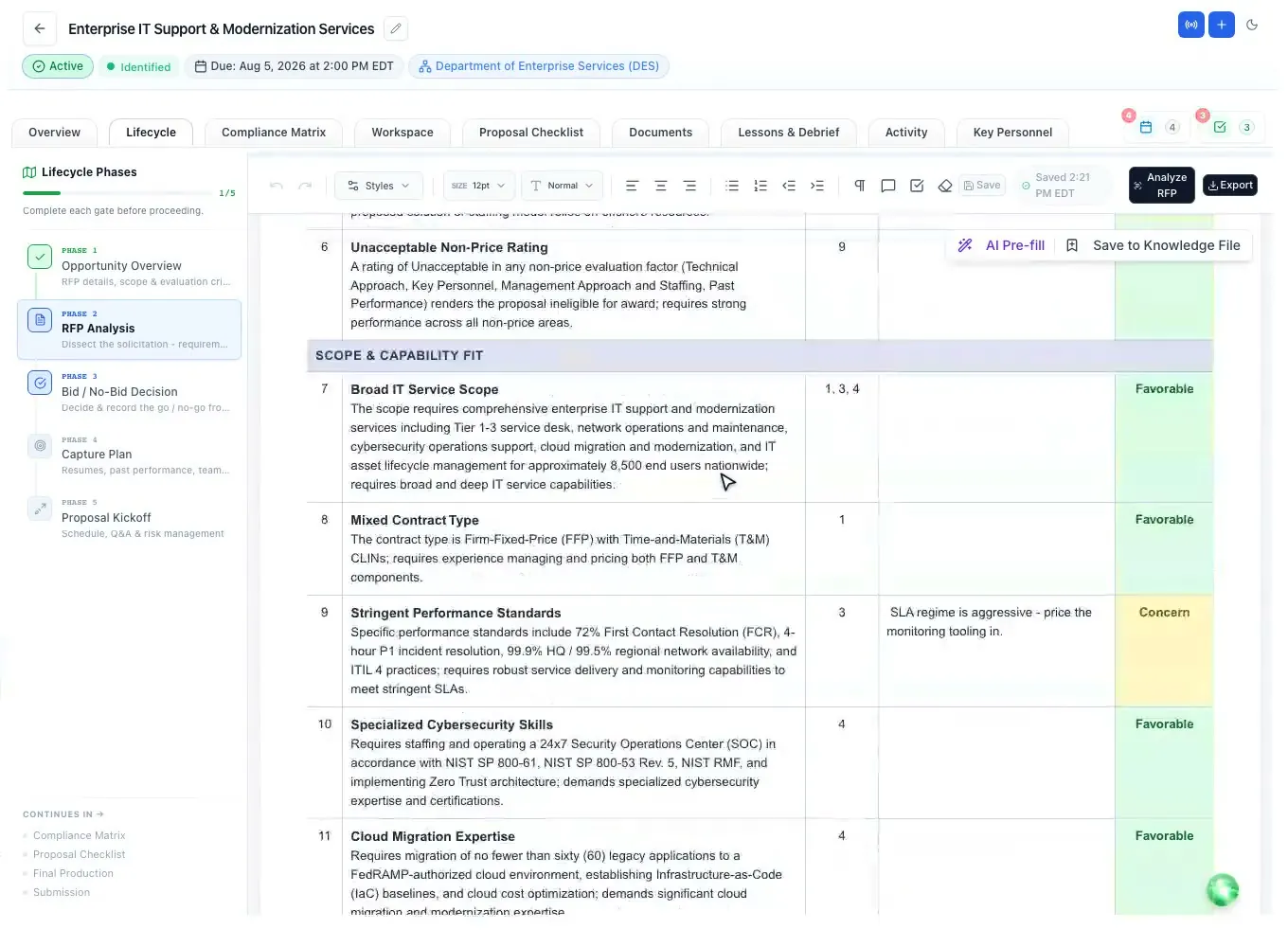
ProposalWorkspace reads the native solicitation files and extracts every instruction, evaluation factor and requirement with a page or section citation, then builds the Section L and M outline and the compliance matrix from them. When the AI cannot read a source, it says so instead of inventing an answer.
Up next
Proposal compliance matrix: what it is and why bids fail without one
The compliance matrix is the one document that keeps a federal proposal honest. It tracks every requirement the solicitation imposes, who owns it, where it is answered and whether the answer complies. Teams that keep one do not get surprised by an evaluator; teams that skip it usually do.
7 min
New proposal guides, by email
One email when we publish a new proposal guide for companies that bid to federal and state agencies, and the occasional product update. No drip campaigns, no sharing your address, unsubscribe with one click.
This guide is general information for federal contractors drawn from the FAR and standard capture and proposal practice. It is not legal advice; always read the specific solicitation and consult counsel on protests, contract terms and compliance questions.