What you will learn
- Terms are grouped alphabetically; use the chapter list to jump to a letter.
- Where a term has a regulatory home, the FAR or CFR reference is given so you can read the source.
- Proposal-process terms (color teams, win themes, ghosting) are industry practice, not regulation; definitions reflect common usage.
- State and local procurement uses different words for similar ideas; the state guide covers those.
Chapter 01of 071 min
A to B
- 8(a) Business Development
- A nine-year SBA program for small businesses owned and controlled by socially and economically disadvantaged individuals; allows sole-source and 8(a)-limited competitions (
13 CFR Part 124). - Acquisition
- The government's process of buying supplies or services, from need identification through contract closeout.
- Adjectival rating
- A word-based evaluation score (for example Outstanding, Good, Acceptable, Marginal, Unacceptable) assigned to a factor based on strengths, weaknesses and deficiencies.
- Amendment
- A formal change to a solicitation, usually on Standard Form 30, which offerors must acknowledge.
- Award
- The government's acceptance of an offer, creating a contract.
- BAFO
- Best and Final Offer: the older term for the final proposal revision requested after discussions; the FAR now uses "final proposal revision" (
FAR 15.307). - Basis of estimate (BOE)
- The documented reasoning behind proposed hours, materials and costs, showing how the price was built.
- Best value
- The expected outcome of an acquisition that provides the greatest overall benefit in response to the requirement; achieved through tradeoff or LPTA (
FAR 2.101,FAR 15.101). - Bid
- An offer submitted in response to an Invitation for Bids under sealed bidding (
FAR Part 14); often used loosely for any offer. - Bid protest
- A written objection to a solicitation, award or proposed award, filed with the agency, the GAO or the Court of Federal Claims (
FAR Part 33). - Bid/no-bid
- The decision whether to pursue an opportunity, made against eligibility gates, weighted factors and showstoppers.
- Blanket purchase agreement (BPA)
- A simplified method for filling repetitive needs by establishing charge accounts with qualified sources (
FAR 13.303). - Blue Team
- The pre-proposal strategy review: is the win strategy right and can we win.
- BPA call
- An individual order placed against a blanket purchase agreement.
- Brand name or equal
- A purchase description that names a brand as an example of the required characteristics while allowing equivalents (
FAR 11.104).
Chapter 02of 072 min
C to D
- CAGE code
- Commercial and Government Entity code: a five-character identifier for a contractor facility, assigned during SAM registration.
- Capability statement
- A one-page summary of a company's core competencies, past performance, differentiators and company data used in market research and introductions.
- Capture
- The work done before an RFP is released to position a company to win: customer engagement, competitor analysis, teaming and solution shaping.
- CICA
- Competition in Contracting Act of 1984, the statute requiring full and open competition unless an exception applies; also the source of the automatic stay of award during a timely GAO protest.
- CLIN
- Contract Line Item Number: a separately identified and priced item of supply or service in a contract (
FAR 4.10). - Color team review
- The structured review series for a proposal: Blue (strategy), Pink (structure), Red (evaluator scoring), Gold (executive), Green (price), White (production).
- Combined synopsis/solicitation
- A single notice that both announces and issues a solicitation, common for commercial items (
FAR 12.603). - Competitive range
- The proposals with the most highly rated evaluations, with which the government holds discussions (
FAR 15.306(c)). - Compliance matrix
- An internal table tracking every requirement in a solicitation, its source, where the proposal answers it, its owner and its status.
- Contracting officer (CO)
- The government official with the authority to enter into, administer and terminate contracts (
FAR 1.602). - Contracting officer's representative (COR)
- A person designated by the CO to perform specific technical or administrative functions on a contract, without authority to change its terms.
- Cost-reimbursement contract
- A contract type that pays allowable incurred costs up to a ceiling; includes cost-plus-fixed-fee, cost-plus-incentive-fee and cost-plus-award-fee (
FAR 16.3). - CPARS
- Contractor Performance Assessment Reporting System: the government-wide database of contractor performance evaluations used in past performance assessments.
- Cross-reference matrix
- A short table submitted with a proposal mapping Section L and M items to the pages that address them.
- Debriefing
- The government's explanation of its evaluation of an offeror's proposal, preaward (
FAR 15.505) or postaward (FAR 15.506), on timely request. - Deficiency
- A material failure of a proposal to meet a requirement, or a combination of significant weaknesses that increases the risk of unsuccessful performance to an unacceptable level (
FAR 15.001). - DFARS
- Defense Federal Acquisition Regulation Supplement: the Department of Defense's supplement to the FAR.
- Discriminator
- A feature or benefit of your offer that competitors cannot honestly claim for the requirement.
- Discussions
- Negotiations conducted after establishing the competitive range, in which the government may point out weaknesses and deficiencies (
FAR 15.306(d)).
Chapter 03of 071 min
E to H
- EDWOSB
- Economically Disadvantaged Women-Owned Small Business: a WOSB whose owners also meet personal net worth, income and asset limits.
- Evaluation factors
- The criteria in Section M against which proposals are evaluated, with their relative importance (
FAR 15.304). - Exception
- A stated departure from a solicitation's terms in an offer; allowed only where the solicitation permits it, and often a route to being found unacceptable.
- FAR
- Federal Acquisition Regulation: the primary regulation governing federal executive agency acquisitions, codified at 48 CFR Chapter 1.
- Fair opportunity
- The requirement that each awardee under a multiple-award IDIQ be given a fair chance to be considered for orders (
FAR 16.505(b)). - Final proposal revision
- The revised proposal submitted at the close of discussions (
FAR 15.307); the successor to BAFO. - Firm-fixed-price (FFP)
- A contract type with a price not subject to adjustment based on the contractor's costs (
FAR 16.202). - FOIA
- Freedom of Information Act: the statute under which the public may request government records, subject to exemptions that protect proposals and trade secrets.
- Full and open competition
- A competition in which all responsible sources may compete (
FAR 6.1). - GAO
- Government Accountability Office: the legislative-branch agency that hears most bid protests (
4 CFR Part 21). - Ghosting
- Writing a proposal so that it highlights a competitor's weakness without naming the competitor.
- Gold Team
- The executive review of the final proposal before submission.
- Green Team
- The price and cost review, run in parallel with Red Team.
- GSA Schedule (MAS)
- The General Services Administration's Multiple Award Schedule: long-term government-wide contracts with commercial firms from which agencies order.
- GWAC
- Government-Wide Acquisition Contract: a multiple-award IDIQ for IT that any agency can use, such as NASA SEWP or NIH CIO-SP.
- Hot button
- A concern the customer holds strongly enough to influence evaluation, whether or not Section M names it.
- HUBZone
- Historically Underutilized Business Zone: an SBA program for small businesses located in and hiring from designated areas (
13 CFR Part 126).
Chapter 04of 072 min
I to O
- IDIQ
- Indefinite-Delivery, Indefinite-Quantity contract: a contract that sets terms for an unspecified quantity of supplies or services ordered over time (
FAR 16.504). - IFB
- Invitation for Bids: the solicitation used in sealed bidding, awarded to the lowest responsive, responsible bidder (
FAR Part 14). - Incumbent
- The contractor currently performing the work being recompeted.
- Industry day
- A government-hosted event where an agency briefs prospective offerors on an upcoming requirement and answers questions.
- ITB
- Invitation to Bid: the state and local equivalent of an IFB.
- ITN
- Invitation to Negotiate: a Florida solicitation type in which the agency evaluates, shortlists and negotiates before selecting best value.
- J&A
- Justification and Approval: the document authorizing other than full and open competition (
FAR 6.303). - Key personnel
- Positions the government considers essential to performance, evaluated in the proposal and controlled by a key personnel clause after award.
- Labor category (LCAT)
- A defined job classification with qualifications and a rate, used in services contracts and price proposals.
- Letter of commitment
- A signed statement from a proposed individual that they will accept a position if the contract is awarded.
- LPTA
- Lowest Price Technically Acceptable: a source selection process in which award goes to the lowest-priced proposal that meets the acceptability standards (
FAR 15.101-2). - Market research
- The government's collection and analysis of information about the market to shape an acquisition (
FAR Part 10). - Mentor-protégé
- SBA program pairing a small business with an experienced firm; mentor-protégé joint ventures can compete for set-asides under SBA rules (
13 CFR 125.9). - Micro-purchase threshold
- The dollar level below which purchases may be made without competitive quotations (
FAR 2.101). - NAICS
- North American Industry Classification System: the six-digit industry code assigned to a requirement, which sets the small business size standard.
- NIGP code
- A commodity and service coding system used by many state and local governments to classify purchases.
- Offer
- A response to a solicitation that, if accepted, would bind the offeror to perform (
FAR 2.101). - Option
- A unilateral right in a contract by which the government may extend the term or increase the quantity (
FAR 17.2). - Oral presentation
- A proposal element delivered in person or virtually to evaluators, sometimes scored, governed by
FAR 15.102. - OSDBU / OSBP
- Office of Small and Disadvantaged Business Utilization (civilian) or Office of Small Business Programs (DoD): the agency office that helps small businesses engage.
Chapter 05of 072 min
P to R
- Past performance
- An offeror's record of performance on prior contracts, evaluated for recency, relevance and quality (
FAR 15.305(a)(2)). - Past performance questionnaire (PPQ)
- A form the offeror's references complete and return to the contracting officer describing the offeror's performance.
- Performance work statement (PWS)
- A statement of work that describes required results and standards rather than how the work is to be done (
FAR 37.6). - Pink Team
- The early review of a proposal's structure, outline and coverage before most writing is done.
- Presolicitation notice
- A notice that the agency intends to issue a solicitation, giving advance warning to industry (
FAR 5.204). - Price realism
- An evaluation of whether a proposed price is too low to perform the work as proposed; applied where the solicitation says so.
- Price reasonableness
- The determination that a price is fair to the government, often by comparison with competing offers (
FAR 15.404-1). - Prime contractor
- The contractor with the direct contract with the government, responsible for subcontractors' performance.
- Product Service Code (PSC)
- A four-character code classifying the product or service being bought; services start with a letter, products with a number.
- Protest
- See bid protest.
- Quality assurance surveillance plan (QASP)
- The government's plan for monitoring contractor performance against PWS standards (
FAR 46.4). - Recompete
- The competition for a follow-on contract when the current contract expires.
- Red Team
- The review that scores a complete draft as the evaluator will, using Section M.
- Representations and certifications
- The statements about size, status, ownership and compliance an offeror makes in SAM and in each offer (
FAR 4.12,FAR 52.204-8). - Request for Information (RFI)
- A market research request for information such as capability, price or delivery when the government does not yet intend to award (
FAR 15.201(e)). - Request for Proposal (RFP)
- The solicitation used in negotiated procurements under
FAR Part 15. - Request for Quotation (RFQ)
- A solicitation for quotations, usually for simplified acquisitions or commercial items; a quotation is not an offer (
FAR 13.004). - Responsibility
- The determination that a prospective contractor has the resources, record and integrity to perform (
FAR 9.104). - Responsiveness
- In sealed bidding, whether a bid conforms to the essential requirements of the IFB.
- Rule of two
- The requirement to set aside an acquisition for small business when there is a reasonable expectation of offers from at least two responsible small businesses at fair market prices (
FAR 19.502-2).
Chapter 06of 072 min
S to T
- SAM.gov
- System for Award Management: the government-wide entity registration system and the public site for contract opportunities.
- SDVOSB
- Service-Disabled Veteran-Owned Small Business: an SBA-certified status enabling set-asides and sole-source awards (
13 CFR Part 128). - Sealed bidding
- A procurement method using an IFB, public bid opening and award on price to the lowest responsive, responsible bidder (
FAR Part 14). - Section C
- The description, specifications or statement of work in the Uniform Contract Format.
- Section L
- Instructions, conditions and notices to offerors in the Uniform Contract Format.
- Section M
- Evaluation factors for award in the Uniform Contract Format.
- Set-aside
- A competition restricted to a category of small business (
FAR Part 19). - Showstopper
- In bid/no-bid, a single fact that makes a pursuit a no-bid regardless of its other merits.
- Significant weakness
- A flaw in a proposal that appreciably increases the risk of unsuccessful performance (
FAR 15.001). - Simplified acquisition threshold
- The dollar level below which simplified acquisition procedures may be used (
FAR 2.101,FAR Part 13). - Size standard
- The SBA ceiling on receipts or employees under a NAICS code below which a business is small (
13 CFR 121.201). - Sole source
- An award made without competition under an authorized exception (
FAR 6.302). - Source selection
- The process of evaluating proposals and selecting the awardee in a negotiated procurement (
FAR 15.3). - Sources Sought
- A market research notice asking industry to identify its capability and interest in a prospective requirement.
- Statement of objectives (SOO)
- A government statement of goals that lets offerors propose the approach and write the PWS.
- Statement of work (SOW)
- The description of the work to be performed, often prescribing how it is done.
- Strength
- An aspect of a proposal that has merit or exceeds requirements in a way that benefits the government.
- Subcontracting plan
- A plan required of large business offerors describing goals and methods for subcontracting with small businesses (
FAR 19.7). - Task order
- An order for services placed against an established contract such as an IDIQ (
FAR 16.501-1). - Teaming agreement
- An agreement between companies to pursue a contract together, typically as prime and subcontractor or as a joint venture (
FAR 9.6). - Tradeoff process
- A source selection process that allows award to other than the lowest-priced or highest-rated proposal when the tradeoff is justified (
FAR 15.101-1).
Chapter 07of 071 min
U to Z
- UEI
- Unique Entity ID: the 12-character identifier issued by SAM.gov to a registered entity; replaced DUNS in 2022.
- Uniform Contract Format (UCF)
- The standard structure for solicitations and contracts in negotiated acquisitions, Sections A through M (
FAR 15.204-1). - Unsolicited proposal
- A written proposal submitted on the offeror's initiative rather than in response to a solicitation (
FAR 15.6). - Weakness
- A flaw in a proposal that increases the risk of unsuccessful performance (
FAR 15.001). - White Team
- The production and compliance check of the final submission package.
- Win probability (Pwin)
- The estimated likelihood of winning a pursuit, used in bid decisions and pipeline management.
- Win theme
- A sentence linking a customer hot button to a discriminator, a proof and a benefit, placed where evaluators score.
- WOSB
- Women-Owned Small Business: an SBA-certified status enabling set-asides in designated industries (
13 CFR Part 127).
Before you go
Questions people ask
- What is the difference between an RFP, an RFQ and an IFB?
- An RFP is the solicitation for a negotiated procurement evaluated on factors; an RFQ asks for quotations, usually under simplified procedures, and a quotation is not an offer; an IFB is a sealed bid awarded on price to the lowest responsive, responsible bidder.
- What does "technically acceptable" mean?
- That a proposal meets the minimum requirements for each non-price factor. Under LPTA, award goes to the lowest-priced technically acceptable proposal; strengths beyond acceptability earn nothing.
- What is the difference between a weakness and a deficiency?
- A weakness increases the risk of unsuccessful performance; a deficiency is a failure to meet a requirement or a combination of significant weaknesses that makes the risk unacceptable. A deficiency can make a proposal unawardable.
- What is a Section J attachment?
- Part III of the Uniform Contract Format lists the documents, exhibits and attachments that form part of the solicitation, such as the PWS, wage determinations and pricing templates. Requirements in Section J are as binding as those in the body.
- Where can I read the FAR?
- The official text is at acquisition.gov, maintained by the FAR Council. Agency supplements such as the DFARS are published alongside it.
A workspace that speaks the vocabulary
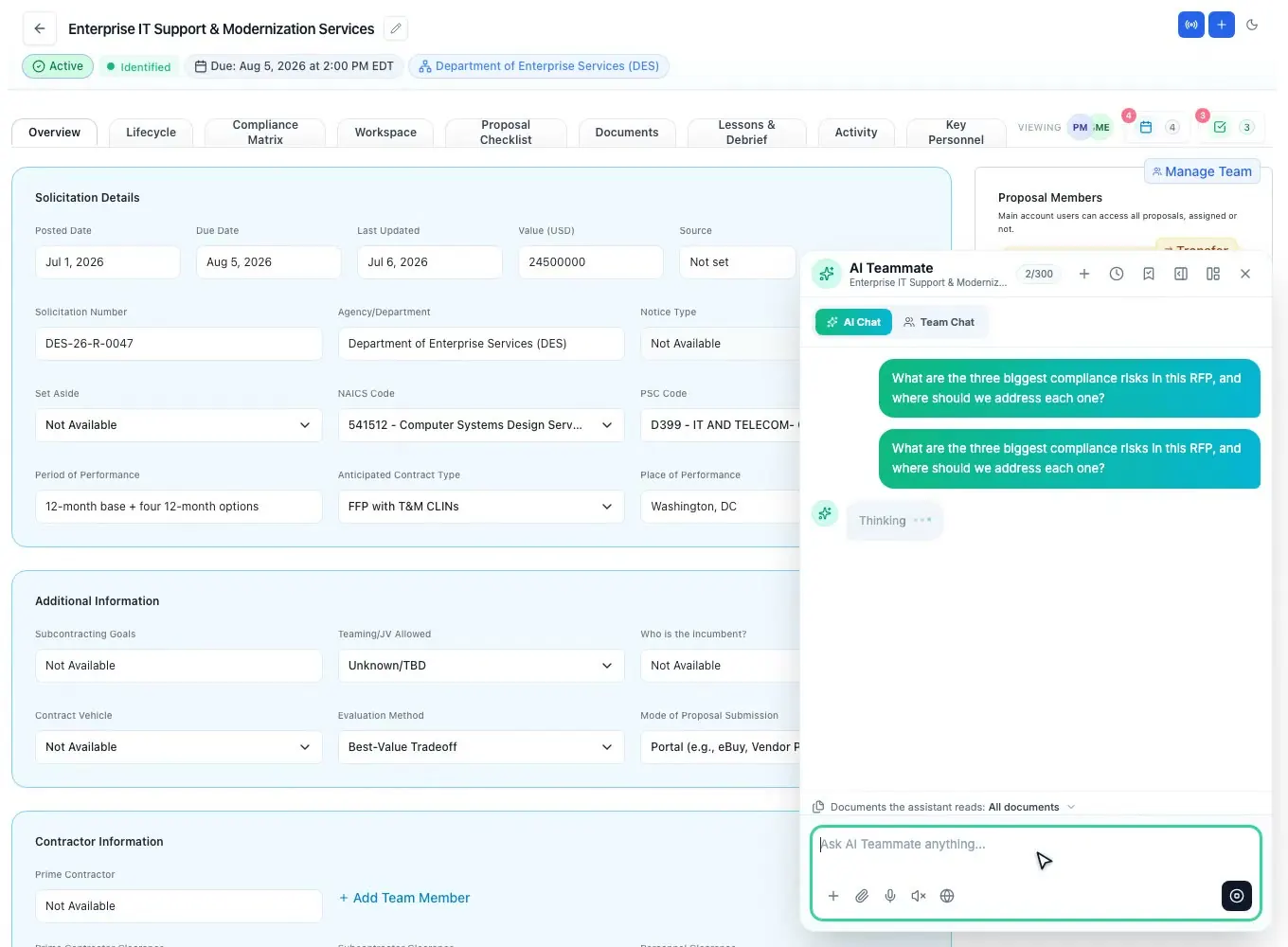
ProposalWorkspace reads solicitations in this vocabulary: it extracts Section L, M and C requirements with citations, builds outlines that follow the UCF, tracks Pink, Red and Gold Team milestones, and its AI teammate answers questions about a specific RFP with page references, so the terms on this page are the terms you work in.
Up next
Capture planning before the RFP drops: customer calls, industry days and draft RFP comments
By the time an RFP is published, the shape of the requirement, the evaluation factors and often the winner have been influenced by the companies that showed up early. Capture is that early work. This guide explains what it is, what is allowed, and how a small team can do it well.
8 min
New proposal guides, by email
One email when we publish a new proposal guide for companies that bid to federal and state agencies, and the occasional product update. No drip campaigns, no sharing your address, unsubscribe with one click.
This guide is general information for federal contractors drawn from the FAR and standard capture and proposal practice. It is not legal advice; always read the specific solicitation and consult counsel on protests, contract terms and compliance questions.