What you will learn
- There is no SAM.gov for the states. Each state runs its own portal, and counties, cities, transit agencies and school districts add thousands more. Registration and the right commodity codes are what put you on their notification lists.
- State procurement follows state law, not the
FAR. Expect different notice names (RFP, RFQ, IFB, ITB, ITN), public bid openings, local-preference rules, and proposals that become public records. - The evaluation discipline is the same: read the whole solicitation, build the compliance list, follow the instructions, price to the format.
- Cooperative contracts (state term contracts, NASPO ValuePoint, Sourcewell, OMNIA Partners) let many agencies buy from one award; winning one can replace dozens of bids.
- Track state and federal pursuits in one pipeline. The bid decision, the outline and the reviews do not care which government issued the solicitation.
Chapter 01of 071 min
The market: bigger, closer and more fragmented
State and local governments together spend more on goods and services than the federal government does, and the buying is spread across roughly 90,000 units of government: fifty states, their agencies and universities, counties, cities, special districts, transit authorities and school districts. For a contractor that is both the opportunity and the problem. The work is everywhere and it is often closer to home than a federal contract, but there is no single place to look and no single set of rules.
The practical answer most successful firms reach is to pick a small number of jurisdictions deliberately, register properly in each, learn their calendars and vocabulary, and treat the rest as opportunistic. Three states done well beat thirty states watched badly.
Chapter 02of 071 min
Where opportunities are published
Every state runs a central procurement portal where state agency solicitations are posted and where vendors register. Many also require or allow local governments to post there, but most counties and cities also run their own bid pages or use a regional bid site. The portal names below are the state-level systems as of this writing; the list changes as states re-platform, so verify the current name with the state procurement office.
| State | Portal | Worth knowing |
|---|---|---|
| Virginia | eVA | One of the most complete state systems; many localities post there too. SWaM certification (small, women- and minority-owned) matters for set-asides. |
| Texas | Electronic State Business Daily (ESBD) | Statewide postings above a threshold; HUB certification (Historically Underutilized Business) is the state's diversity program. |
| California | Cal eProcure | Registration plus certifications (Small Business, DVBE) unlock preferences; many agencies and the UC system also post separately. |
| Florida | MyFloridaMarketPlace and the Vendor Bid System | Florida uses the Invitation to Negotiate (ITN) alongside RFP and ITB; public meetings are common. |
| New York | New York State Contract Reporter | State agencies must advertise here; New York City runs its own system (PASSPort). |
| Maryland | eMaryland Marketplace Advantage (eMMA) | Central registration and solicitations; strong MBE participation goals on many contracts. |
| Massachusetts | COMMBUYS | Statewide contracts that municipalities can use; check whether a statewide contract already covers your service. |
| Pennsylvania | PA eMarketplace | State agency bids; counties and school districts post on their own sites or regional platforms. |
Chapter 03of 071 min
Registrations and commodity codes
Federal registration in SAM does not register you with any state. Each state portal has its own vendor registration, and many also require a certificate of authority to do business in the state, a state tax registration, and for some services a state license. Registration is usually free and takes days rather than weeks, but it must be complete before you can be awarded and often before you can even see attachments.
- Commodity codes. Most state and local systems classify buys with NIGP codes (a five-digit commodity and service coding system used by public procurement) or UNSPSC, not NAICS. Register under every code that fits your services; the portal's email notifications are driven by the codes you select.
- Certifications. Each state runs its own small, minority, women, veteran and disadvantaged business programs with their own names and rules. Certification is separate from federal 8(a) or HUBZone status, though some states accept federal certifications as evidence.
- Insurance and bonding. Public works and construction bids require bid bonds and performance bonds; services bids commonly require specific insurance limits with the state named as additional insured. Have the certificates ready before the deadline.
- Cooperative eligibility. Confirm whether the agency can buy through a cooperative contract you hold. It is often the fastest route to an award.
Chapter 04of 071 min
How state procurement differs from federal
Federal contractors moving into state work usually underestimate how different the rules are, and state contractors moving up usually underestimate the FAR. The evaluation discipline transfers; the mechanics do not.
| Topic | Federal | State and local |
|---|---|---|
| Governing rules | The FAR and agency supplements, uniform across agencies. | State procurement code and agency rules; each state differs, and local governments follow their own ordinances. |
| Notice names | Sources Sought, Presolicitation, Solicitation, Combined Synopsis. | RFP, RFQ, IFB or ITB, RFI, ITN, Request for Qualifications, plus informal quotes below thresholds. |
| Where published | SAM.gov, plus contract-vehicle portals. | State portal, agency sites, county and city pages, regional bid sites, newspapers of record. |
| Registration | SAM with UEI and CAGE. | Separate vendor registration per state, often per locality, with NIGP or UNSPSC codes. |
| Small business programs | 8(a), HUBZone, SDVOSB, WOSB under SBA rules. | State-specific programs (SWaM, HUB, DBE, MBE and WBE) with their own certification. |
| Price transparency | Prices are not disclosed until award, and then partially. | Sealed bids are opened publicly; RFP price proposals are often public after award. |
| Your proposal | Protected as source selection information; FOIA exemptions apply. | A public record once the procurement closes, subject to trade-secret exemptions you must mark and claim. |
| Debriefs and protests | FAR 15.505 and 15.506; GAO, agency or Court of Federal Claims. | Varies by state; typically a short protest window to the procurement officer, then an administrative appeal. |
| Local preference | Not generally applicable. | Many states and cities give in-state or local bidders a scoring or price preference. |
Chapter 05of 071 min
Reading a state solicitation
- 1
Identify the notice type and what it commits you to
An IFB or ITB is a sealed bid awarded on price to a responsive, responsible bidder; there is no negotiation. An RFP is evaluated on criteria and may include negotiation. An ITN, used in Florida, is explicitly a negotiation process. An RFQ may be a formal quote or an informal one. The type determines how much you can shape the outcome after submission.
- 2
Find the mandatory requirements and the scoring rubric
State RFPs usually list "minimum qualifications" or "mandatory requirements" that are pass or fail, then an evaluation section with points per criterion. Treat the minimums as gates and build your outline around the criteria and their point values, exactly as you would around Section L and M.
- 3
Check the forms and the terms
State bids come with required forms: bid form, non-collusion affidavit, references form, certifications, sometimes a signed copy of the standard terms. Missing or altered forms are the most common reason a state bid is rejected as non-responsive. Exceptions to standard terms are often prohibited or must be stated on a specific form.
- 4
Calendar the whole sequence
Pre-bid conferences (sometimes mandatory), question deadlines, addenda acknowledgements, submission deadline with the local time zone, public opening, and evaluation and award dates. Attend the pre-bid meeting when it is mandatory; you cannot bid otherwise.
- 5
Decide what is confidential before you submit
Because the proposal becomes a public record, mark trade secrets exactly the way the state's rules require and only where the claim is genuine. Over-marking can get the whole proposal rejected in some states; under-marking hands your pricing approach to competitors.
Chapter 06of 071 min
Cooperative contracts: one award, many buyers
Cooperative purchasing lets an agency buy from a contract another entity competed, without running its own solicitation. State term contracts, multi-state agreements through NASPO ValuePoint, and national cooperatives such as Sourcewell, OMNIA Partners and the Texas DIR contracts all work this way. For a vendor, winning a cooperative contract is a route to market rather than a single sale: the solicitation is larger and more formal, but every eligible agency can then order without a new competition.
- Check whether your service is already on a state term contract before bidding an agency RFP; the agency may be required to use it.
- If you hold a cooperative contract, market it. Agencies do not know you are on it unless you tell them.
- Cooperative awards usually carry administrative fees and reporting obligations; price them in.
Chapter 07of 071 min
Running state and federal bids in one pipeline
The mistake is to build a second process for state work. The bid decision, the compliance list, the outline, the writing and the reviews are the same discipline whatever the jurisdiction; only the inputs differ. Keep one pipeline and one calendar, and let the solicitation type change the checklist rather than the process.
A state pursuit, from notice to submission
- Registered in the state portal with current NIGP or UNSPSC codes, and in the locality if it runs its own system.
- Notice type identified; minimum qualifications checked as gates; scoring rubric captured.
- Pre-bid conference attended if mandatory; questions submitted by the deadline; every addendum acknowledged.
- All required forms completed exactly as issued; exceptions stated only where and how the solicitation allows.
- Proposal organized by the RFP's question numbering, using the rubric's words in headings.
- Confidential material marked per the state's public records rules.
- Insurance certificates and bonds ready; price form unaltered.
- Submitted by the local-time deadline through the required channel, with receipt confirmed.
Before you go
Questions people ask
- Is there one website that lists all state and local bids?
- No. Commercial aggregators compile many portals and are useful for discovery, but coverage is never complete and their notices can lag. Register directly with the states and localities you have chosen to pursue, and use an aggregator or a tool such as ProposalWorkspace's state workspace to widen the net.
- Do I need a separate registration for every county and city?
- Often, yes. Some states require localities to use the state portal, which simplifies things; many localities run their own vendor lists. Start with the state portal, then register with the specific counties and cities you intend to bid.
- Does my federal past performance count in state evaluations?
- Usually. State RFPs ask for references on similar work, and federal contracts are strong references when the scope is comparable. Explain the federal customer and the terms in plain language, because a state evaluation committee may not know what a CPARS rating or a task order is.
- What is an ITN?
- An Invitation to Negotiate, used mainly in Florida. The agency evaluates replies, shortlists vendors and negotiates before selecting the best value. It gives the agency more flexibility than an RFP and gives you a chance to refine your offer after evaluation.
- Can a small business get a preference in state contracting?
- Many states run preference or set-aside programs for certified small, minority, women, veteran and disadvantaged businesses, and some give in-state bidders a price preference. Each program has its own certification; check the state's procurement office for the current rules.
How ProposalWorkspace handles this
State and local opportunities in the same workspace as federal
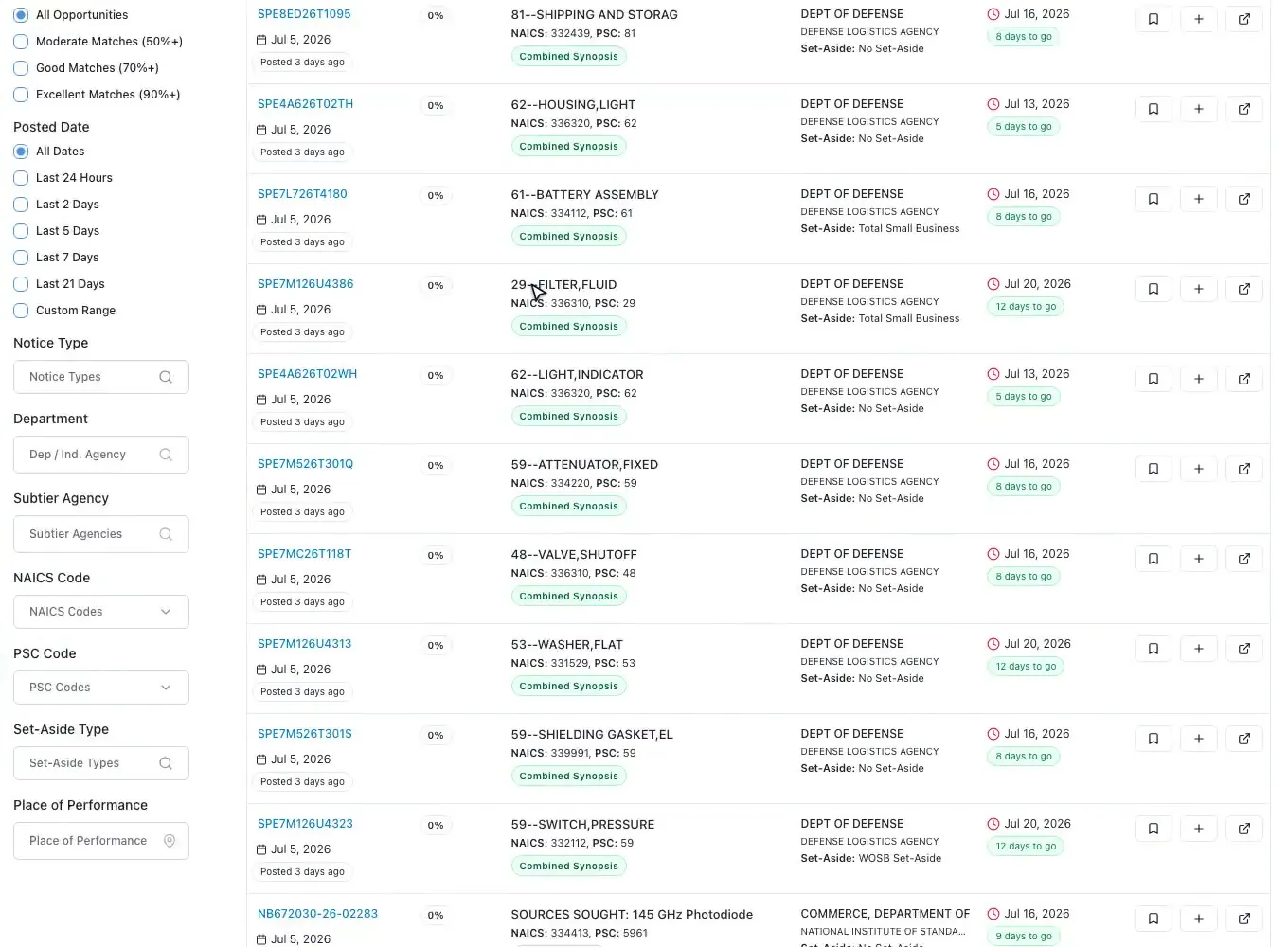
ProposalWorkspace keeps a state and local opportunity workspace beside the federal one - its coverage is limited to the state and local notices we currently carry, not every state - with the same browse, save and alert experience: notice types such as RFP, RFQ, IFB and RFI shown as coloured pills, filters by state, category, agency type and posting date, a match score against your company profile, and one-click import into the same proposal pipeline your federal bids use, with the AI reading the solicitation on the way in.
Up next
How to write a capability statement that contracting officers keep
A capability statement is the one-page document that answers a contracting officer's first question: who are you and what can you do for me. Most are thrown away because they read like brochures. This guide shows how to write one that survives the first read and gets you onto a bidder's list.
6 min
New proposal guides, by email
One email when we publish a new proposal guide for companies that bid to federal and state agencies, and the occasional product update. No drip campaigns, no sharing your address, unsubscribe with one click.
This guide is general information for federal contractors drawn from the FAR and standard capture and proposal practice. It is not legal advice; always read the specific solicitation and consult counsel on protests, contract terms and compliance questions.