What you will learn
- The Q&A period is your only formal chance to fix ambiguity before you bid. Ask precise, quoted, numbered questions by the deadline.
- Answers are usually issued as an amendment and become part of the solicitation; an answer that changes a requirement changes what you must comply with.
- Amendments must be acknowledged in your offer as the solicitation instructs (
FAR 52.215-1(b)(1)andFAR 14.201-6(f)patterns). An unacknowledged material amendment can make the offer non-responsive. - Every amendment triggers the same routine: read it whole, update the compliance list, then the outline, then the drafts, then the calendar.
- Late-arriving amendments often move the due date. Never assume; check the amendment text and the notice history.
Chapter 01of 051 min
The question and answer period
Most solicitations set a deadline for written questions, typically one to two weeks after release, and answer them in writing to all offerors through an amendment or a posted Q&A document. The purpose is fairness: every offeror sees the same clarifications. That is also why answers are binding on the government only when incorporated into the solicitation, which is why they usually arrive as an amendment rather than as an email.
Under FAR 15.201, exchanges with industry are encouraged before the solicitation is released; once it is out, contact is channelled through the contracting officer to keep the competition even. Questions are that channel. Use it for genuine ambiguity, conflicts between sections, missing attachments, unrealistic constraints and anything the bid decision depends on.
Chapter 02of 051 min
Writing questions that get useful answers
- 1
Quote the passage and cite its location
"Section L.4.2(c), page 61, states that the Technical Volume shall not exceed 25 pages. Section M.2.1, page 70, references a 30-page Technical Volume. Please confirm the page limit."
- 2
Ask one thing per question, and ask for a decision
Questions that bundle three issues get partial answers. Frame each so the answer can be a fact or a yes or no.
- 3
Number and group them
By section, in solicitation order. The agency will often answer in the same order, which makes the answers easy to map back to your compliance list.
- 4
Submit exactly as instructed
Some solicitations require a form or a spreadsheet; most want email to a named address with the solicitation number in the subject line. Submit before the deadline and keep the sent message.
- 5
Decide what not to ask
If a question would reveal a discriminator or an unusual approach, weigh the value of the answer against what competitors learn. Sometimes the right move is to state an assumption in the proposal instead, where Section L allows assumptions.
Q3. Attachment J-4 (Past Performance Questionnaire) is referenced in L.6.1 but is not included in the posted documents. Please provide the questionnaire. Q7. PWS 3.4.2 requires "24x7 coverage of the NOC"; PWS 3.4.5 requires "coverage during core hours (0700-1900 ET)". Please confirm which applies to the NOC function. Q12. Section L.4.4 requires resumes for key personnel "not to exceed two pages". Please confirm whether the letters of commitment in the same appendix are excluded from the two-page limit.
Chapter 03of 051 min
What an amendment can change
An amendment (Standard Form 30 in most agencies) is the only instrument that formally changes a solicitation. It can do anything: extend or shorten the due date, replace attachments, change the NAICS, add or remove requirements, revise page limits, correct evaluation factors, or incorporate the Q&A. Amendments are numbered and cumulative, and each one is posted to the same notice on SAM.gov. Late amendments are common; an amendment issued the day before the due date is unusual but legal, and it applies.
| If the amendment changes | Then |
|---|---|
| The due date or time | Update the calendar and every internal review date; tell the team in writing. Check the time zone. |
| Section L instructions or page limits | Rebuild the affected outline sections and page budgets; re-verify formatting. |
| Section M factors or weights | Re-read every heading for the new language; re-allocate pages by the new weights. |
| The PWS or SOW | Update the compliance list first, then the technical volume; check staffing and price for knock-on effects. |
| Attachments (pricing template, forms, questionnaires) | Replace the files in your working set immediately; mark the old versions superseded so nobody submits them. |
| Contract terms in Sections F, G, H or I | Have the person who owns terms and pricing review them; a changed clause can change the price or the risk. |
Chapter 04of 051 min
Acknowledging amendments
Solicitations require offerors to acknowledge receipt of each amendment, usually by signing and returning the SF 30, by completing the acknowledgement block on the offer form (SF 33 or SF 1449), or by stating the amendment numbers and dates in the cover letter, whichever Section L specifies. The provision at FAR 52.215-1(b)(1) requires acknowledgement of amendments as part of a compliant proposal, and for sealed bids FAR 14.201-6(f) makes it explicit. Failure to acknowledge an amendment that materially changes the solicitation can make an offer non-responsive, and contracting officers have rejected otherwise competitive offers for exactly that.
Acknowledgement routine
- A named person owns amendment tracking for the pursuit.
- Every amendment is logged with number, date received, what it changed and who reviewed it.
- Acknowledgement is done in the form Section L requires, for every amendment, including ones that only extend the date.
- The cover letter lists every amendment number and date as a belt-and-braces measure.
- The final submission package is checked against the amendment log before upload.
Chapter 05of 051 min
Keeping the proposal in step with change
Amendments hurt teams that have no single list of requirements. When the compliance list is the source of truth, an amendment is a set of edits to that list, and every edit points at the outline section and the writer who must respond. The routine is the same every time.
- 1Read the amendment in full, including every replaced attachment, before anyone acts on it.
- 2Compare it with the base solicitation and prior amendments; list every changed requirement with its old and new text.
- 3Update the compliance list, noting the amendment number on each changed line.
- 4Update the outline and the page budget; then update the drafts, marking changes so reviewers can see them.
- 5Update the calendar, the price model and the staffing plan for any knock-on effects.
- 6Acknowledge the amendment and file it in the pursuit record.
Before you go
Questions people ask
- Are answers in the Q&A binding on the government?
- Only when they are incorporated into the solicitation, which is why most agencies issue them as an amendment. If an answer changes a requirement but no amendment follows, ask for one; otherwise rely on the solicitation text and state your assumption.
- Do we have to acknowledge an amendment that only extends the due date?
- Acknowledge every amendment. Contracting officers differ on what is "material", and acknowledging costs nothing while a missed acknowledgement can cost the competition.
- What if we already submitted when an amendment is issued?
- You may withdraw and resubmit, or submit a proposal modification, before the (possibly extended) due date. Contact the contracting officer for the accepted method and acknowledge the amendment in the modification.
- Can we ask questions after the Q&A deadline?
- You can ask, and contracting officers sometimes answer, but they are not obliged to and any answer must be shared with all offerors. Plan to have your questions in by the deadline.
- How do we handle a conflict the Q&A did not resolve?
- Comply with the more demanding reading, state the assumption you made where Section L permits assumptions, and cite both passages. Do not silently choose the easier reading.
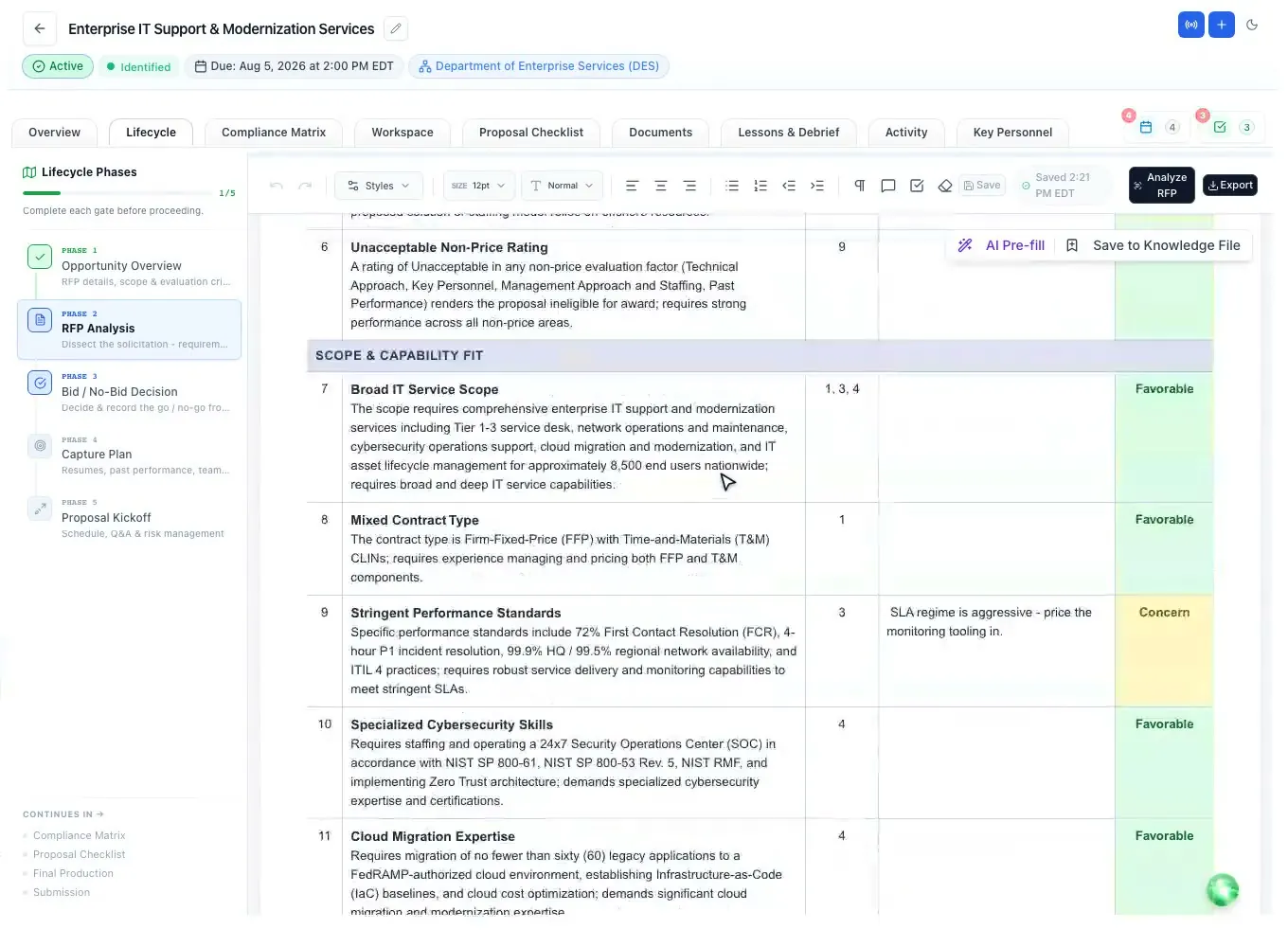
Amendment changes correlated to the matrix and applied as tracked edits
ProposalWorkspace compares an amendment against the base solicitation and reports, section by section, what was added, modified or removed, updates the compliance matrix accordingly, and lets the AI apply the resulting changes to the draft as tracked edits attributed to the amendment, so reviewers see exactly what moved and why.
Up next
Government contracting glossary: 120 terms from 8(a) to WOSB
Government contracting has a vocabulary that assumes you already know it. This glossary defines the terms you will meet in solicitations, evaluations, capture meetings and debriefs, in plain English and with the regulation cited where it matters.
11 min
New proposal guides, by email
One email when we publish a new proposal guide for companies that bid to federal and state agencies, and the occasional product update. No drip campaigns, no sharing your address, unsubscribe with one click.
This guide is general information for federal contractors drawn from the FAR and standard capture and proposal practice. It is not legal advice; always read the specific solicitation and consult counsel on protests, contract terms and compliance questions.