What you will learn
- Freeze content at T minus 48 hours. After that, only compliance fixes and production changes are allowed.
- Verify everything against the final PDFs and the exact Section L instructions, not against the Word files and memory.
- Late is late. Under
FAR 15.208a late proposal is generally not considered; the deadline is the stated time in the stated time zone, at the stated place. - Submit a day early when the method allows it, then confirm receipt in writing.
- Assign one person to own the submission itself, with a second person watching, and rehearse the upload before the day.
Chapter 01of 061 min
Three principles for the last two days
- Freeze, then verify. Content changes after T minus 48 hours create errors faster than they add value. Compliance and production fixes only.
- Trust the final files, not the working ones. Pagination shifts on PDF conversion, fonts substitute, images move. Every check is against the exact files you will submit.
- One owner, one watcher. The submission is a single person's job, with a second person checking each step. Committees miss things; pairs catch them.
Chapter 02of 061 min
T minus 48 hours: freeze and production
Content freeze
- All volumes complete; every placeholder resolved or removed.
- Gold Team decisions incorporated; no open comments in any document.
- Amendment log reconciled: every amendment read, its changes made, acknowledgement prepared.
- Staffing, hours and labor categories match between the technical, management and price volumes.
- Key personnel names, titles and resumes consistent across the volumes and the appendix.
- Company data (legal name, UEI, CAGE, address, size status under the solicitation's NAICS) identical everywhere.
Production
- Final PDFs generated from the final source files, with the same fonts embedded.
- Headers and footers carry the solicitation number, company name and proprietary marking as Section L requires.
- Page numbers continuous and correct; table of contents regenerated.
- Cross-reference matrix regenerated against final page numbers.
- Graphics legible in black and white; captions and figure numbers correct.
- File names exactly as Section L specifies, or a consistent convention with company name, volume and solicitation number.
Chapter 03of 061 min
T minus 24 hours: compliance verification
Two people, the final PDFs, and Section L open beside them. Check each instruction literally; do not assume that something verified last week is still true.
Against Section L
- Every volume Section L requires is present, named and ordered as instructed.
- Page counts measured in the PDFs against each limit, including what counts (tables, figures, footnotes) and what is excluded.
- Font, size, margins and line spacing as instructed, including inside tables, figures and headers.
- File format, file size caps and number of files as instructed.
- Required content items for each volume present, in the required order.
- Proprietary and restrictive markings applied as the solicitation directs, and only where justified.
Forms and signatures
- SF 33 or SF 1449 completed and signed by a person with authority to bind the company.
- Every amendment acknowledged in the form Section L requires, plus listed in the cover letter.
- Representations and certifications complete (or the SAM reference given where allowed); SAM registration Active.
- Cover letter states the offer validity period, size status, UEI and CAGE, and the negotiator's contact details.
- Subcontracting plan, teaming letters, letters of commitment and any required certifications signed and dated.
- Pricing template completed on the government's form without altering its structure; arithmetic checked.
Chapter 04of 061 min
The submission method, rehearsed
By method
- Agency portal or SAM.gov upload
- Register and log in days ahead; confirm file size and type limits; upload a test file if the portal allows; screenshot every confirmation page; note the portal's own timestamp.
- Confirm the exact address and any subject line format; check the recipient's attachment size limit (often 10 to 25 MB); split volumes across emails if instructed; request a read receipt and an acknowledgement; keep the sent items with timestamps.
- Hard copy
- Print the required number of copies and originals; sign originals in ink; package with the solicitation number on the outside; use a courier with tracking; allow for building security delays; obtain a signed receipt.
- Hybrid or media
- Follow every instruction for labelling media; test the media on a different machine; include the required paper copies.
Chapter 05of 061 min
Submission day
- 1
Morning: final file check
Open every file you will submit from the submission folder, not from the working folder. Confirm each is the final version, opens without error and shows the correct page count.
- 2
Submit early
For portal and email submissions, submit the morning of the day before the deadline where allowed, or first thing on the day. Uploads fail, portals queue, and email bounces; time is the only cure.
- 3
Capture the evidence
Screenshot confirmation pages, save portal receipts, keep sent emails with timestamps and attachment lists, and file the courier receipt. This is your proof if timeliness is ever questioned.
- 4
Confirm receipt
Ask the contracting officer or specialist to confirm receipt of all volumes. A short, polite email listing the files sent is standard practice.
- 5
Stand down the team, then close the file
Tell everyone the proposal is in. File the final package, the compliance matrix, the amendment log and the evidence of submission in the pursuit record. Book the lessons review while the experience is fresh.
Chapter 06of 061 min
When something goes wrong
- The portal rejects a file. Check size and type limits first; compress or split as Section L allows; if the portal itself is down, email the contracting officer immediately, describe the problem with timestamps, and ask for instructions. Do not wait.
- You find an error after submission. Before the deadline you may withdraw and resubmit or submit a modification; contact the contracting officer for the accepted method. After the deadline, a correction is generally not accepted.
- An amendment arrives on the last day. Read it in full; if it changes the due date, replan; if it changes content, decide with the capture lead whether to resubmit and acknowledge it in the resubmission.
- A signer is unavailable. Know in advance who else holds authority to bind the company, and have their signature on file where the form allows.
The one-page final check
- Deadline confirmed with date, time and time zone, from the latest amendment.
- Submission method, address and file rules confirmed from Section L.
- All volumes present, named, ordered, within page limits, in the required format.
- Forms signed, amendments acknowledged, SAM Active, reps and certs complete.
- Price on the government template; numbers consistent with staffing.
- Submitted early; confirmation captured; receipt requested and received.
Before you go
Questions people ask
- What counts as "late" for a federal proposal?
- Any proposal received at the designated location after the exact date and time specified in the solicitation. FAR 15.208 allows narrow exceptions, mainly government mishandling and emergencies; portal congestion and email delays on your side do not qualify.
- Can we submit part of the proposal now and the rest later?
- Only if Section L allows separate submissions, and every part must still arrive by the deadline. Submitting all volumes together, early, is safer.
- What if the portal is down at the deadline?
- Notify the contracting officer in writing immediately with screenshots and timestamps, and follow their instructions. Agencies sometimes extend a deadline for a documented system outage; they rarely do for an individual offeror's problem. Submitting a day early removes the risk.
- Do we need to acknowledge an amendment that arrived after we submitted?
- Yes, if it is material, by submitting an acknowledgement or a modification before the (possibly revised) deadline. Contact the contracting officer for the accepted method.
- How long should we keep the submission records?
- At least through award and any protest period, and ideally for the life of the contract. The compliance matrix, amendment log, final files and submission evidence are the record of what you promised.
An AI-generated submission checklist and deadline reminders
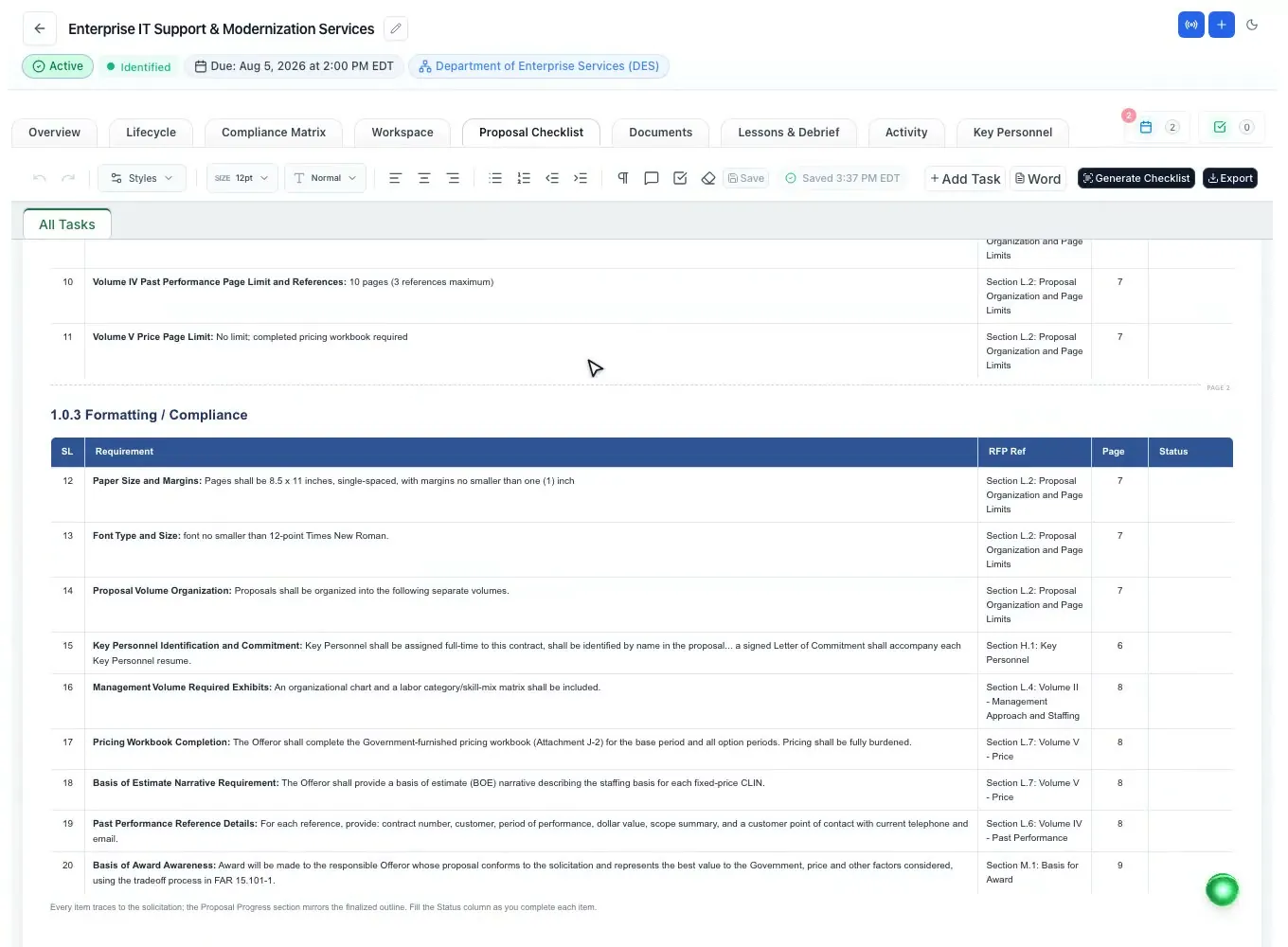
ProposalWorkspace generates the administrative submission checklist from the solicitation, grouped by submission details, page limits and formatting, forms and certifications, and puts the deadline, the review milestones and the tasks on the proposal calendar with reminders, so the final 48 hours run from a list built from the RFP rather than from memory.
Up next
Federal debriefs under FAR 15.506: your rights and the clock
A debriefing is the only time the government will tell you, in its own words, why you won or lost. The right to one expires three days after you learn the result. Request it, prepare for it, and treat what you hear as the most valuable capture intelligence you will get all year.
8 min
New proposal guides, by email
One email when we publish a new proposal guide for companies that bid to federal and state agencies, and the occasional product update. No drip campaigns, no sharing your address, unsubscribe with one click.
This guide is general information for federal contractors drawn from the FAR and standard capture and proposal practice. It is not legal advice; always read the specific solicitation and consult counsel on protests, contract terms and compliance questions.