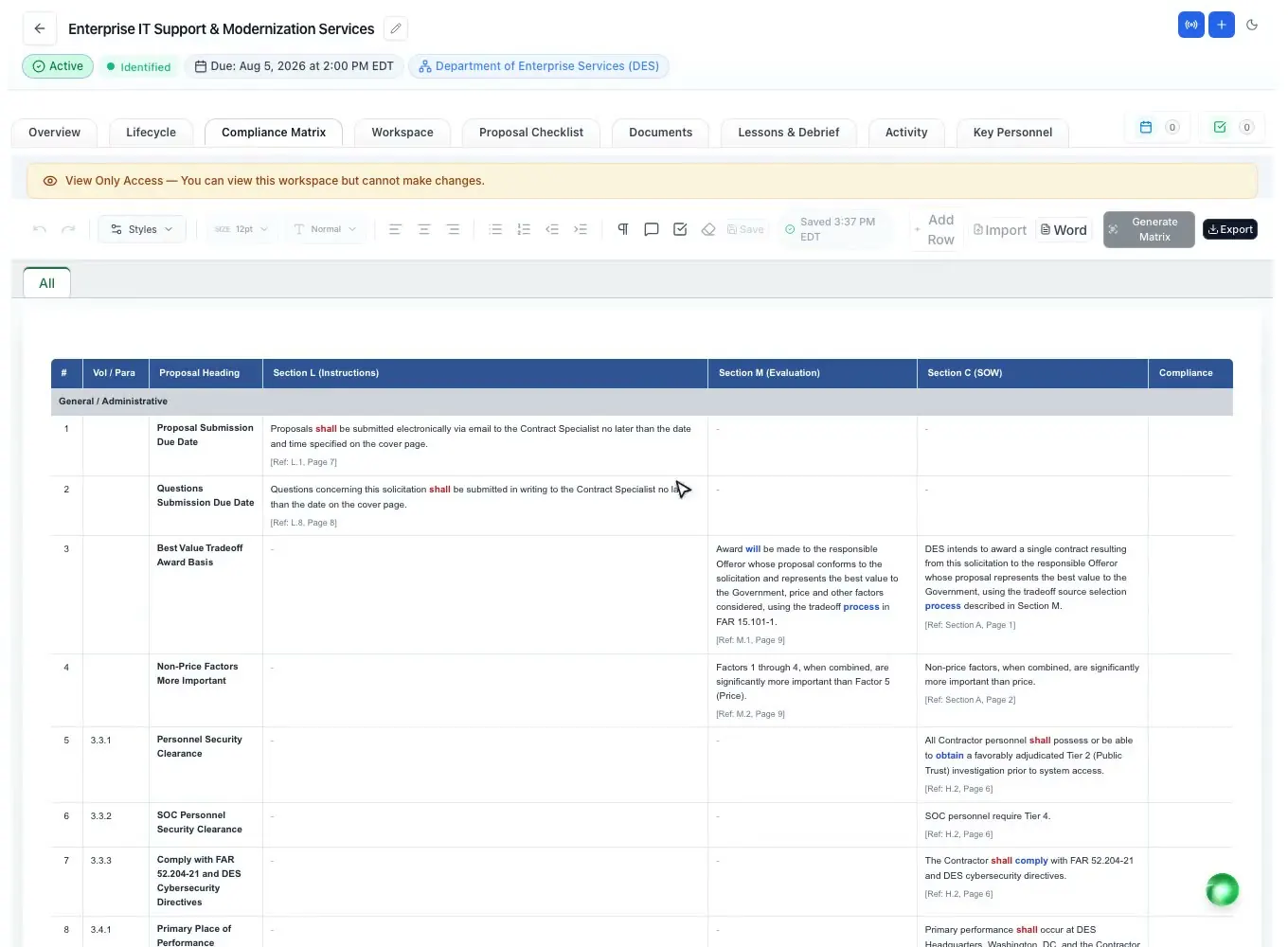
Compliance matrix
Section L, M and C decomposed into rows with a page reference, an owner and a compliance call.
Read moreCompliance matrix example
Updated
This compliance matrix example is filled in from a made-up IT help desk RFP, so you can see how real solicitation sentences become matrix lines: one obligation per line, the binding words marked, every evaluation factor mapped to the section that earns it, and an amendment folded in. It uses the same columns as our blank compliance matrix template.
Every feature on every plan, from $99 a month billed yearly.
The setup
To keep the example readable, the solicitation is invented: a federal agency wants a contractor to run its IT help desk for one base year and four option years. Section L asks for three volumes (Technical, Past Performance, Price) with a 25-page limit on the Technical volume. Section M evaluates the technical approach, staffing and past performance on a best value tradeoff basis. The performance work statement (PWS) lists the help desk tasks and service levels.
None of the text below comes from a real solicitation, agency or contractor. The point is the method: how each sentence of a real RFP turns into one or more lines that a team can own, answer and check. Every requirement is copied in the solicitation's words, because a paraphrase can drop the one word an evaluator checks.
The columns are the eleven generic columns of the blank compliance matrix template, shortened in the tables below to fit the page. Owners are shown as roles, not names.
Instructions
Section L sets the structure of the proposal, so it goes in first. Look at line 2 and line 3: the invented L.3.2 says "The offeror shall describe its approach to staffing the help desk and shall provide a resume for each key personnel position." That is one sentence with two "shall" obligations, so it becomes two lines with two possible answers. If they shared a line, a reviewer could tick it once the staffing approach was written and never notice the missing resumes.
Line 4 shows a formatting instruction. Page limits and font rules are easy to forget in a matrix because they are not "content", yet a page over the limit may simply not be read.
| ID | Source | Page | Requirement (solicitation's words) | Type | Binding | Answered in | Owner | Compliance |
|---|---|---|---|---|---|---|---|---|
| 1 | L.2.1 | 41 | The proposal shall be submitted in three volumes: Technical, Past Performance and Price. | Instruction | Shall | All volumes | Proposal manager | Compliant |
| 2 | L.3.2 | 43 | The offeror shall describe its approach to staffing the help desk ... | Instruction | Shall | Vol. I, 3.1 | Technical lead | Compliant |
| 3 | L.3.2 | 43 | ... and shall provide a resume for each key personnel position. | Instruction | Shall | Vol. I, App. A | Recruiting lead | Partly compliant |
| 4 | L.2.4 | 42 | The Technical volume shall not exceed 25 pages, in 12-point font. | Instruction | Shall | Vol. I (all) | Proposal manager | Compliant |
| 5 | L.3.4 | 44 | The offeror should describe any tools it will use to measure customer satisfaction. | Instruction | Should | Vol. I, 2.4 | Technical lead | Compliant |
Evaluation and work
Line 5 above was a "should": a preference, not an obligation. Skipping it would not make the proposal unacceptable, but it would hand evaluators an easy weakness, so it still gets an owner and an answer. Lines 6 and 7 below come from Section M. An evaluation line is answered by the section that earns the points, so the "Answered in" column for line 6 points to the technical approach that the factor scores.
Lines 8 to 11 are work requirements from the PWS. Each task and each service level becomes its own line, because the technical approach has to answer every one of them. Line 10 shows a measurable service level copied exactly; the number is the requirement.
Line 12 shows an amendment. The invented Amendment 0002 changed the response time in PWS 4.2 from four hours to two hours. The line is updated, the amendment is written in Notes, and the owner re-checks the answer. Without that note, nobody can tell which version of the requirement the section was written against. How amendments work: solicitation amendments and Q&A.
| ID | Source | Page | Requirement (solicitation's words) | Type | Binding | Answered in | Notes |
|---|---|---|---|---|---|---|---|
| 6 | M.2.1 | 52 | The Government will evaluate the offeror's technical approach to delivering tiered help desk support. | Evaluation | Will | Vol. I, 2.1-2.3 | Factor 1, most important |
| 7 | M.2.3 | 53 | Past performance will be evaluated for recency and relevance. | Evaluation | Will | Vol. II, 1-3 | Three references, last 3 years |
| 8 | PWS 3.1 | 12 | The contractor shall provide Tier 1 and Tier 2 support from 7:00 a.m. to 7:00 p.m. Eastern. | Work | Shall | Vol. I, 2.1 | |
| 9 | PWS 3.3 | 13 | The contractor shall maintain a knowledge base of resolved issues. | Work | Shall | Vol. I, 2.2 | |
| 10 | PWS 4.1 | 15 | The contractor shall resolve 80 percent of Tier 1 tickets at first contact. | Work | Shall | Vol. I, 2.3 | Service level |
| 11 | PWS 5.2 | 17 | The contractor shall deliver a monthly status report. | Work | Shall | Vol. I, 4.2 | |
| 12 | PWS 4.2 | 15 | The contractor shall respond to priority tickets within two hours. | Work | Shall | Vol. I, 2.3 | Changed by Amendment 0002 (was four hours) |
For evaluators
Many solicitations ask for a cross-reference matrix: a short table at the front of a volume that shows evaluators where each instruction or evaluation factor is answered. You do not build it from scratch. It comes straight out of the "Answered in" column of the compliance matrix, sorted by the solicitation's own paragraph numbers.
Keep it short, keep it in the solicitation's order and keep the page numbers updated after the last edit. Evaluators use it to find your answer quickly; a wrong page number sends them looking. More: what a cross-reference matrix is.
| Solicitation reference | Requirement (short) | Proposal section | Page |
|---|---|---|---|
| L.3.2 / M.2.2 | Staffing approach | Vol. I, 3.1 | 14 |
| L.3.2 | Key personnel resumes | Vol. I, Appendix A | A-1 |
| M.2.1 / PWS 3.1 | Tiered help desk support | Vol. I, 2.1 | 5 |
| PWS 3.3 | Knowledge base | Vol. I, 2.2 | 8 |
| PWS 4.1 / 4.2 | Service levels | Vol. I, 2.3 | 10 |
| PWS 5.2 | Monthly status report | Vol. I, 4.2 | 21 |
Takeaways
Four habits make the example work. Copy requirements word for word. Split every sentence that holds more than one obligation. Map evaluation factors to the section that earns the points, not just to the section with the same name. And note every amendment on the line it changed.
The example also shows what a matrix is not: it is not a summary of the RFP and not a writing plan. It is a checklist that the proposal is held against, line by line, before each review and before submission. The longer the solicitation, the more lines it has; a real RFP often produces a few hundred.
In ProposalWorkspace
Building a matrix like this by hand from a long RFP takes hours. In ProposalWorkspace the built-in AI decomposes Section L, Section M and Section C or the PWS into matrix rows with the requirement in the solicitation's words and a page reference, and colors the binding and optional words inline so a "should" never passes for a "shall".
Each row gets an Owner and a Compliance call (Compliant, Partial, Non-Compliant or Exception), the summary banner shows how much is assessed, and one click reports where each row is answered in the written proposal or that it is not addressed yet. Amendments are compared with the base RFP and applied as tracked changes. The matrix exports to Excel and Word.
How it works
One line per instruction, split wherever a sentence holds two obligations.
Each evaluation factor pointed at the section that earns its points.
Every PWS task and service level on its own line, copied exactly.
Update the changed lines and write the amendment in Notes.
Sort the "Answered in" column into the table evaluators read.
Every feature is on every plan. Plans start at $99 a month billed annually for Solo with 2 seats ($129 billed monthly). Subscribe today or book a demo with our team. Full pricing
In the product
Section L, M and C decomposed into rows with a page reference, an owner and a compliance call.
Read moreEach amendment compared with the base RFP and applied as tracked changes.
Read moreRequirements extracted with a page or section cite before you write a word.
Read moreAn annotated outline that follows Section L, so "Answered in" has a home.
Read moreRequirement coverage and page limits checked in the document you are finishing.
Read moreReviews on the schedule, with section scoring against each requirement.
Read moreQuestions people ask
No. The solicitation, agency and requirements are made up so the example can be shared openly. The method is the one teams use on real federal, state and local RFPs.
It depends on the solicitation. Because every obligation gets its own line, a full RFP with Section L, M, the PWS and attachments often produces a few hundred lines.
Because each obligation needs its own answer and its own check. If two "shall" statements share a line, one can be answered and the line marked done while the other is missed.
Yes. A "should" is a preference, not an obligation, so missing it rarely makes a proposal unacceptable, but evaluators may note it as a weakness. Mark it as non-binding and answer it anyway.
Download the blank Excel template with the same columns from the compliance matrix template page.
Yes. The built-in AI builds the matrix from Section L, M and C with a page reference on each row; you set the owner and compliance call, and it exports to Excel and Word.
ProposalWorkspace starts at $99 a month billed annually ($129 billed monthly) for 2 seats, with every feature on every plan. See pricing or book a demo.
 ProposalWorkspace
Set up in minutes
Plans from $99 a month, billed yearly. Subscribe today or book a demo with our team.