RFP analysis and bid/no-bid
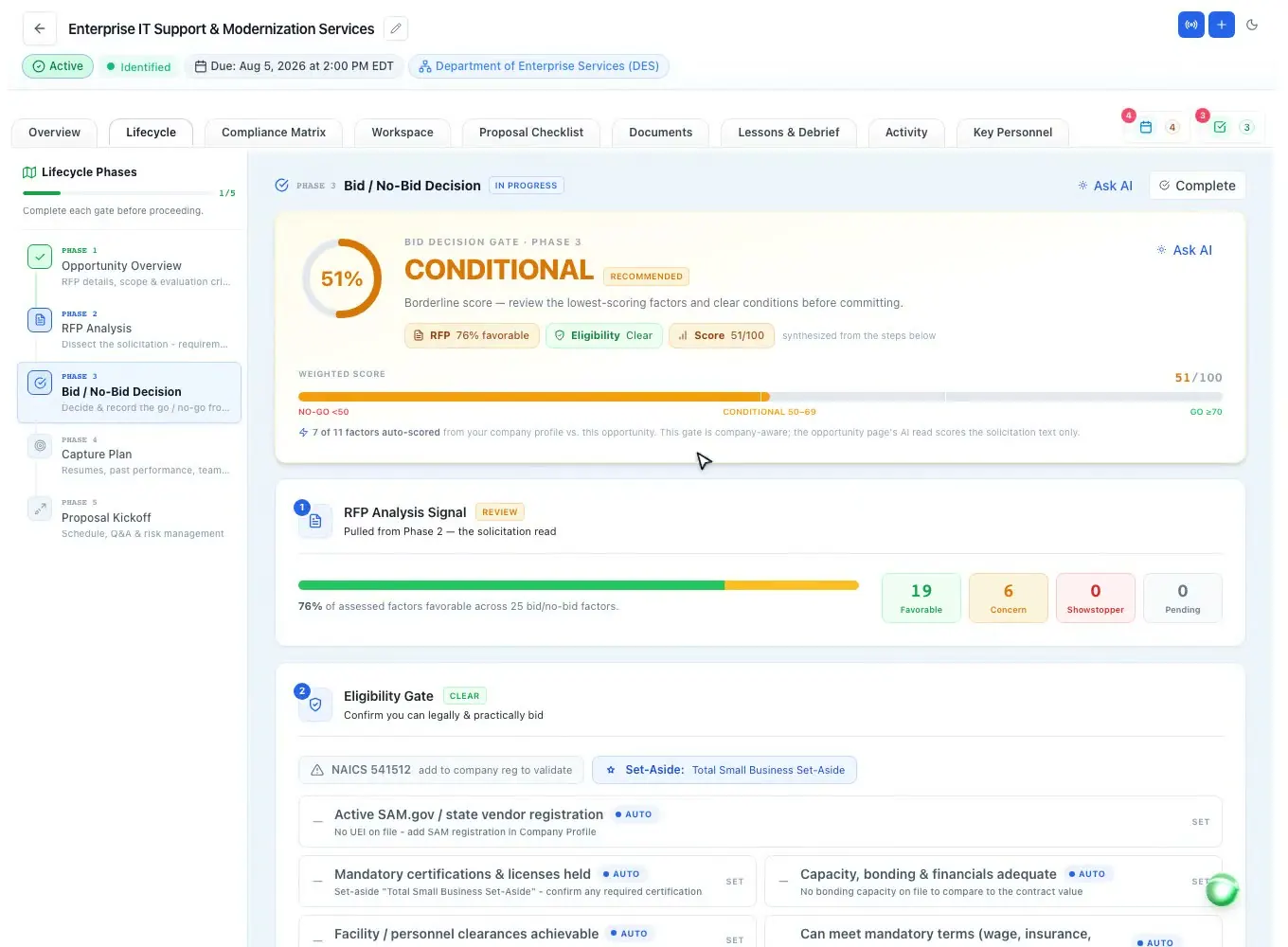
Requirements with page cites, a go/no-go worksheet and a weighted scorecard.
Read moreGovernment proposal writing
Updated
To write a government proposal, decide first whether the bid is worth it, then let the solicitation set everything else: the instructions say what to write and in what order, the evaluation criteria say how it is scored, and the work statement says what you promise to do. Build the outline from those three, write every section to the score, review it as an evaluator would, and submit early.
Every feature on every plan, from $99 a month billed yearly.
Step 1
The fastest way to improve your win rate is to write fewer, better proposals. Contractors report an average of 84 hours going into one proposal, so every bid you should not have made takes time from one you could have won. Make the bid/no-bid decision on purpose, early, and write down why.
Start with the eligibility gates, which no amount of good writing can fix: the set-aside and your size under the NAICS code, required registrations (SAM.gov UEI), clearances, licenses, mandatory past performance and the place of performance. Then weigh the rest: do you know the customer, can you staff the work, is there an incumbent the customer is happy with, and can you price it to win and still make money.
If you found the notice early, as a sources sought or draft RFP, use the time to shape your answer, line up teaming partners and gather past performance. Once the final RFP is out, communication with the agency goes through the contracting officer and the written questions period.
A practical worksheet for the decision: the bid/no-bid decision worksheet, or the shorter bid/no-bid checklist.
Step 2
A federal RFP in the uniform contract format puts the three parts you write to in fixed places (FAR 15.204-1; 15.109 in the FAR overhaul text). Section L is the instructions: volumes, order, page limits, fonts, delivery. Section M is how the proposal is scored. Section C, or the statement of work or PWS, is the work itself. Read all of it, including Sections B, F, H and the attachments, where deliverables, key personnel and special terms hide.
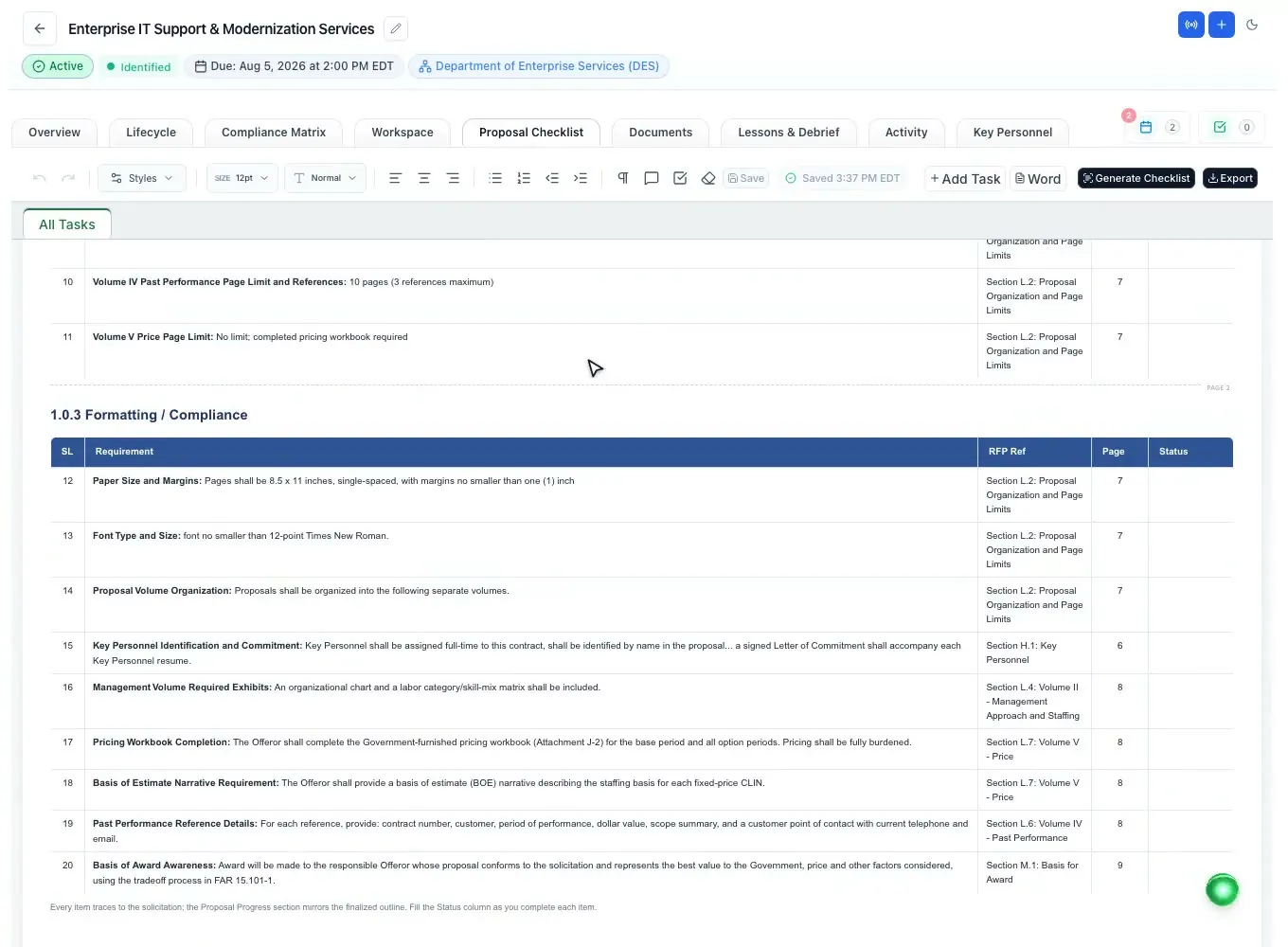
Then break it into a compliance matrix: one line for each requirement, in the solicitation's own words, with where it came from and where your proposal will answer it. A sentence with two "shall" statements is two lines. This is the document that keeps a team from missing a requirement, and it becomes the cross-reference matrix if the RFP asks for one. A blank one to start from: the compliance matrix template.
Write down every ambiguity, conflict between sections and missing piece as you read. Those become your questions for the contracting officer, due by the date in the RFP. A state or local RFP has the same parts under other names: instructions to proposers, evaluation criteria and a scope of work.
How the three sections fit together, in depth: Section L, M and C explained.
| Part | Usually in | What it tells you | What you do with it |
|---|---|---|---|
| Instructions | Section L | Volumes, order, page limits, format, delivery | Build the outline in this order and these names |
| Evaluation criteria | Section M | Factors, their relative importance, basis of award | Write every section so an evaluator can score it |
| Work statement | Section C, SOW or PWS | The tasks, standards and deliverables | Show how you will do each task |
| Pricing schedule | Section B | Line items and quantities | Price every line item, nothing more or less |
| Terms and attachments | Sections F, H, J | Period, key personnel, special terms, forms | Catch requirements the other sections do not repeat |
Step 3
Evaluators score with Section M in one hand and your proposal in the other. Make their job easy: use the volume names, section order and numbering the instructions give, so each requirement is where they expect it. If Section L is silent on order, follow the order of the evaluation factors in Section M, then the work statement.
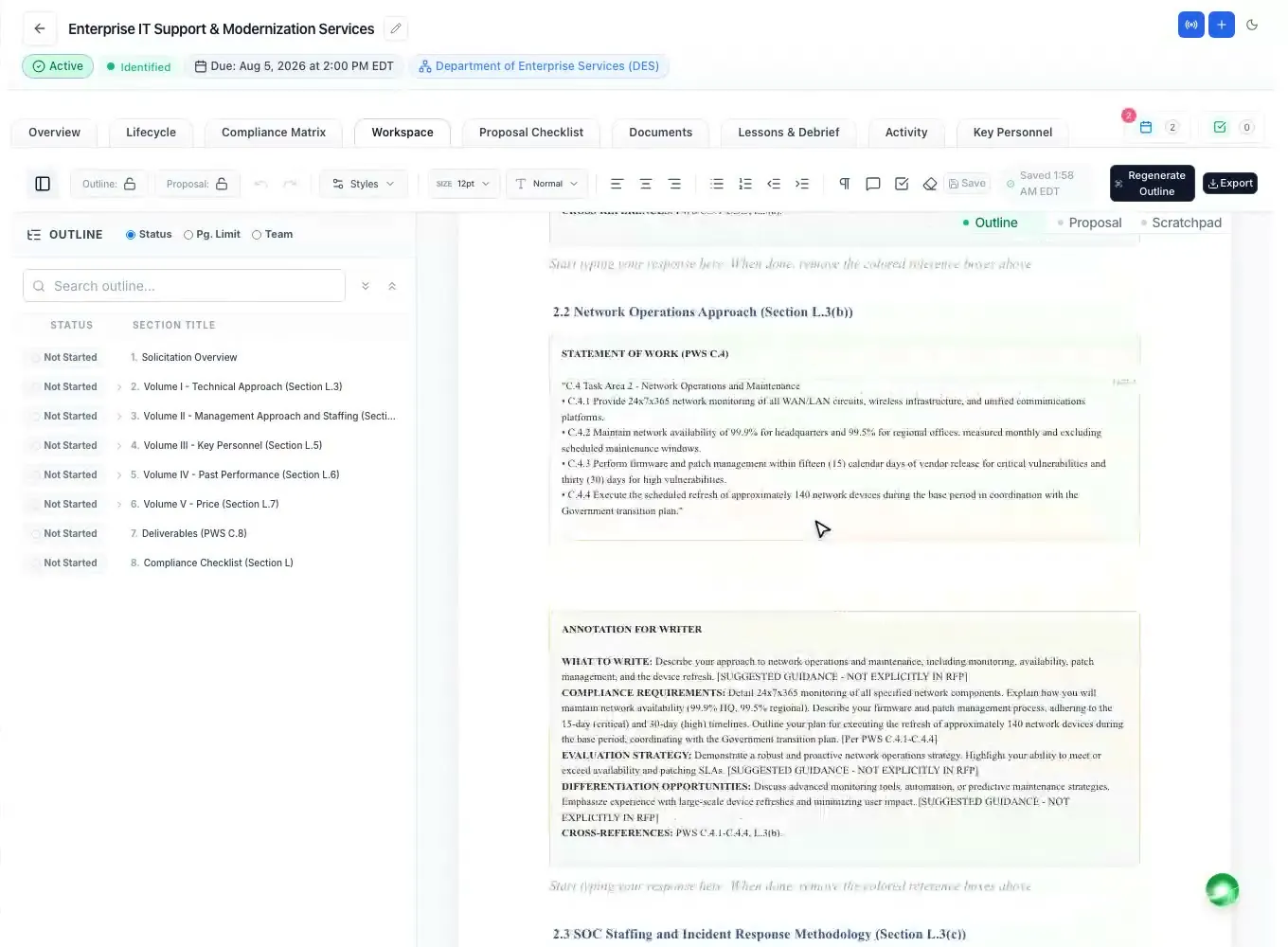
An annotated outline goes one step further: under each heading, note the requirement it answers, the evaluation factor it earns points on, the page budget and the proof you plan to use. Writers then start from a brief, not a blank page, and the page limit is split before anyone writes too much.
Agree on the outline before writing starts and change it only on purpose. Most late-stage chaos in a proposal comes from a structure that kept moving.
How to build one by hand: a federal proposal outline that follows Section L. A starting shape for the volumes: the proposal outline template.
Steps 4 to 6
Decide your win themes before drafting: the two or three reasons this customer should pick you, each tied to an evaluation factor and backed by a discriminator you can prove. Every section then answers its requirement, says what the customer gets from your approach, and proves it with a number, a named past project or a method.
For the technical approach, answer the requirement in the same words the RFP uses, explain how you will do the work, and point to the risk you are reducing. Avoid restating the work statement back to the customer; evaluators score how, not that. In depth: how to write the technical approach and win themes and discriminators.
Past performance is scored on recency, relevance and quality: pick references that match the work, size and complexity, and say why each is relevant. Key personnel resumes must meet every stated qualification, in the format the RFP asks for, often with a signed letter of commitment. See past performance write-ups and key personnel resumes and letters of commitment.
Write plainly and in active voice. Use graphics to show a process or an organization, with captions that state the benefit. Every claim needs proof an evaluator can find in a sentence.
Step 7
The cost volume answers the pricing instructions exactly: every CLIN in Section B, the option years, the rates and the format asked for, usually a spreadsheet plus a narrative. It must tell the same story as the technical volume: the staff, hours and materials you priced are the ones you described.
How price is judged depends on Section M. Under a best value tradeoff the agency can pay more for a better proposal; under lowest price technically acceptable the lowest acceptable offer wins. On cost-type work the agency may test price realism, so a bid that is too low for the work can count against you.
Larger contracts may also require a small business subcontracting plan from a large business, and some ask about organizational conflicts of interest. Read for those early; they are easy to miss and hard to fix late.
Step 8
Color team reviews are scheduled reads at set points: a Pink Team on an early draft to check structure, themes and compliance; a Red Team on a near-final draft, scored against Section M as an evaluator would; a Gold Team for the final go-ahead. Put the dates on the schedule at kickoff so writing has a deadline before the deadline.
Give reviewers the RFP, the compliance matrix and the evaluation criteria, not just the draft. Ask them to score and to say what is missing, not to rewrite. A finding is useful when it names the requirement, the problem and the fix.
What each review should look for: Pink, Red and Gold Team reviews.
Steps 9 and 10
Run a final compliance and format check against Section L: page counts per volume, fonts, margins, file names, file types and sizes, signed forms and the cover page (an SF 33 or SF 1449 where the RFP uses one). Remove tracked changes, comments and placeholder text. Confirm every amendment is reflected in the proposal and acknowledged the way the RFP asks (FAR 15.206).
Submit early. A proposal that arrives after the stated time is late and is generally not considered (FAR 15.208); portal trouble and slow email on your side rarely count as an excuse. Plan to submit a day ahead and keep the confirmation.
The mistakes that cost bids most often are mechanical: late submission, pages over the limit (often removed unread), a missed amendment, a "shall" with no answer, the wrong format or file type, and a price that does not match the technical volume. A checklist catches them: the proposal submission checklist. After the award, ask for a debriefing whether you win or lose.
State and local bids follow the same logic with local rules: many still require notarized forms, sealed hard copies or a specific portal, a bid bond on construction, and an exact match to the proposal form. Read the instructions to proposers as closely as you would Section L.
How it works
A page-cited RFP analysis and a weighted bid/no-bid scorecard with showstoppers and a recorded decision.
A compliance matrix from Sections L, M and C with a page reference on every row, and questions for the contracting officer.
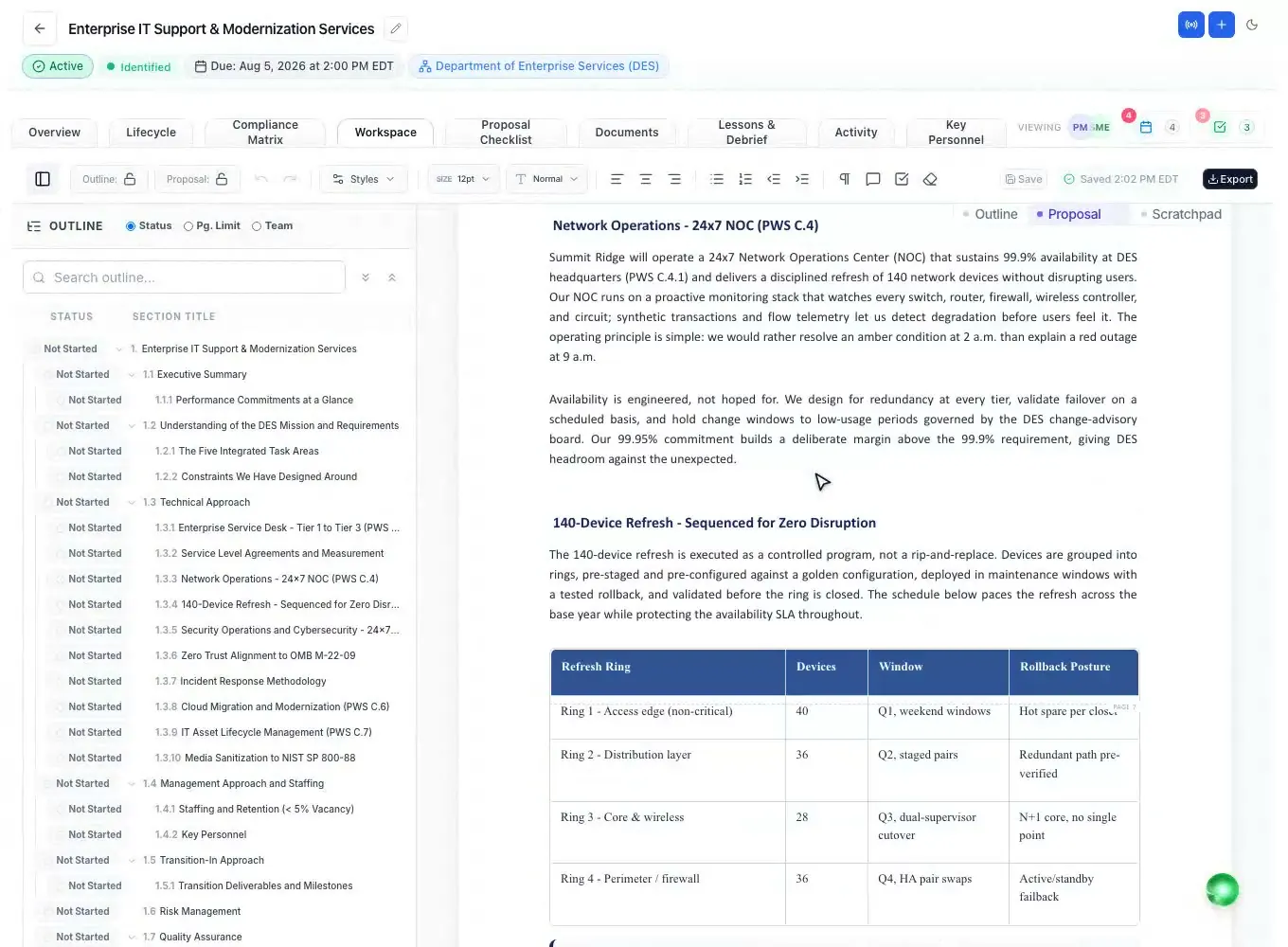
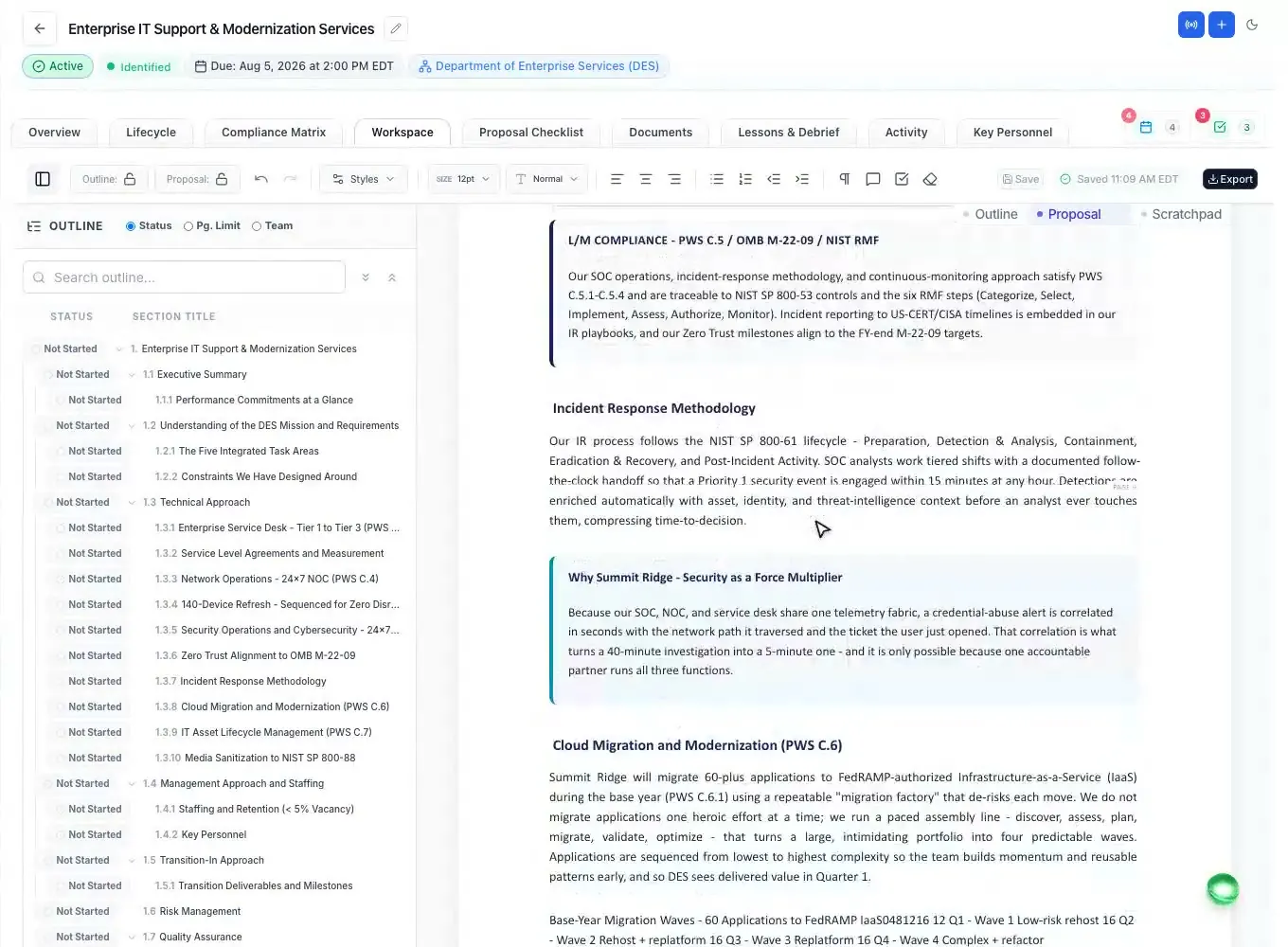
An annotated outline in Section L order, then an AI first draft from your own Company Library.
Pink, Red and Gold Team dates with reminders, tracked changes and evaluator-style section scores.
The Word add-in checks page limits, leftover comments and placeholders; export each volume to Word or PDF.
Every feature is on every plan. Plans start at $99 a month billed annually for Solo with 2 seats ($129 billed monthly). Subscribe today or book a demo with our team. Full pricing
In the product
Requirements with page cites, a go/no-go worksheet and a weighted scorecard.
Read moreSection L, M and C as rows with owners, compliance calls and Excel or Word export.
Read moreAn annotated outline that follows the RFP's own volumes and order.
Read moreA first draft of every section from the outline and your own records.
Read moreReview dates on the schedule, tracked changes and evaluator-style scoring.
Read moreTwelve checks on the open document, page limits by section included.
Read moreQuestions people ask
Start with one solicitation that fits your company. Read Section L, M and C, list every requirement in a compliance matrix, outline the proposal in the order the instructions give, write each section to the evaluation criteria, have someone else review it, and submit at least a day early.
As long as the RFP allows and no longer. Page limits are set per volume in the instructions, and pages over the limit may be removed before evaluation. Split the limit across the outline before writing so the sections that score the most get the room.
It depends on the size of the bid. Contractors report an average of 84 hours going into one proposal; a response period is often around 30 days, so plan the outline, reviews and a submission day ahead before writing starts.
Mostly mechanical errors: submitting late, going over the page limit, missing an amendment, leaving a "shall" unanswered, using the wrong format or file type, or omitting a required form. A final check against Section L and a submission checklist catch most of them.
Yes. Many contracts are set aside for small businesses, and evaluators score the proposal, not the company size. Bid where you have relevant past performance, team where you lack a capability, and keep the writing specific and proven.
The steps are the same; the rules are local. State and local RFPs use their own forms and may require notarized signatures, hard copies, a bid bond or a specific portal. See state and local proposal software.
Yes. ProposalWorkspace reads the RFP with page citations, builds the compliance matrix and the annotated outline, drafts each section from your own records and keeps reviews on schedule. Plans start at $99 a month billed annually ($129 billed monthly) for 2 seats. See pricing or book a demo.
 ProposalWorkspace
Set up in minutes
Plans from $99 a month, billed yearly. Subscribe today or book a demo with our team.