What you will learn
- Check the eligibility gates first: set-aside status, NAICS size standard, clearances, mandatory certifications, registrations. Any failed gate is a no-bid, whatever the fit.
- Score the rest on weighted factors: customer relationship, incumbency, competition, past performance relevance, solution fit, price position, capacity and teaming.
- Name your showstoppers before scoring. One showstopper outweighs any total.
- Make the decision within three to five business days of release. Every day spent deciding is a day not spent writing.
- Record the decision and the reasons. Reviewing past decisions against results is how your bid judgment improves.
Chapter 01of 061 min
Why a method beats a meeting
Bid decisions made in a room tend to be made by the most senior or most optimistic person present. A written method changes that. It forces the team to check eligibility before enthusiasm, to name the reasons for and against, and to compare this pursuit against the others competing for the same writers. It also creates a record. Six months later, when the award notice comes out, you can compare what you believed with what happened.
The method below has three parts: gates, factors and showstoppers. Gates are binary and come first. Factors are weighted and scored. Showstoppers are the specific facts that would make you walk away regardless of score.
Chapter 02of 061 min
Part 1: eligibility gates
Each gate is a yes or no question with a verifiable answer. Failing any gate ends the review. Do not score a pursuit you are not eligible to win.
| Gate | Where to check | Notes |
|---|---|---|
| Set-aside eligibility | Notice header; SAM registration | If set aside for 8(a), HUBZone, SDVOSB or WOSB, you must hold that status at the time of offer. |
| Size under the assigned NAICS | SBA size standards table; your revenue or headcount | Size is judged under the NAICS the agency assigned, not the one you prefer. Affiliates count. |
| Registrations and certifications | Section L, Section K, PWS | Active SAM registration, and any required ISO, CMMI, FedRAMP or industry certifications by the date required. |
| Facility and personnel clearances | DD 254, Section H | A facility clearance cannot be obtained in a proposal timeline. If required at award and you lack it, no-bid or team with a cleared prime. |
| Contract vehicle | Notice | If the buy is a task order under a vehicle you do not hold, you cannot prime it. |
| Organizational conflict of interest | Section H, FAR 9.5 | Prior work advising this office on this requirement may disqualify you. |
| Deadline feasibility | Section L | Can you produce a compliant proposal by the date with the people available? Be honest about page count and volumes. |
Chapter 03of 061 min
Part 2: weighted factors
Score each factor from 1 (weak) to 5 (strong), multiply by the weight, and sum. The weights below are a sound starting point for services contractors; adjust them to your business but keep them fixed across pursuits so scores are comparable.
| Factor | Weight | What a 5 looks like | What a 1 looks like |
|---|---|---|---|
| Customer knowledge | 20 | You have met the program office, know the pain points, and shaped the requirement through Sources Sought or industry day. | You learned of the requirement from the solicitation. |
| Incumbency and competition | 15 | You are the incumbent with good CPARS, or the incumbent is weak and the field is small. | A strong incumbent with clean performance and a full and open field. |
| Past performance relevance | 15 | Three references of the same scope, size and agency type within the recency window in Section M. | Adjacent work only, or references outside the window. |
| Solution fit | 15 | You perform this work today with the people who would staff it. | You would need to build or buy the capability. |
| Price position | 15 | You know the likely budget and can price competitively at your margin. | No visibility into budget or incumbent price; your rates are above the market. |
| Capacity and staffing | 10 | Key personnel identified and willing; capacity to absorb the contract. | Key personnel would be contingent hires; the proposal team is already on two other bids. |
| Strategic value | 10 | A target agency, a vehicle you need, or work that builds a past performance you lack. | Off-strategy work taken for revenue. |
Included with ProposalWorkspace
Bid / no-bid worksheet
The gates, the weighted factors, the showstopper list and a decision record, pre-filled from the solicitation and saved with the pursuit so the next bid starts from what you learned.
Sign up and the template is yours to use - the 14-day trial includes every feature, no credit card.
Chapter 04of 061 min
Part 3: showstoppers
A showstopper is a single fact that makes the pursuit a no-bid regardless of the total. Name your company's showstoppers in advance so nobody argues them away in the moment. Common ones:
- A mandatory requirement you cannot meet and cannot take exception to.
- Key personnel requirements (for example, a Program Manager with a specific certification and clearance) with no candidate and no time to recruit.
- A firm-fixed-price contract for work whose scope you cannot bound.
- An LPTA evaluation where your cost structure cannot reach the likely price to win.
- A required transition period shorter than your realistic onboarding time.
- A proposal deadline that collides with a higher-priority pursuit for the same writers.
Chapter 05of 061 min
Reading the total
A simple decision rule
- 80 or above, no showstoppers
- Bid. Assign the proposal manager and start the compliance matrix the same day.
- 60 to 79, no showstoppers
- Conditional bid. State what would raise the score (a teaming partner, a customer meeting, a key hire) and set a date to re-decide.
- Below 60
- No-bid. Record the reasons and, if the customer matters, plan capture for the recompete.
- Any showstopper
- No-bid, whatever the total, unless the showstopper is removed by a specific, dated action.
The rule is deliberately simple. The value of the worksheet is not the arithmetic; it is the conversation the factors force and the record they leave.
Chapter 06of 061 min
Running the review in three days
- 1
Day 1: gates and first read
The capture lead reads the notice, Section L, Section M and the PWS, checks every gate and drafts factor scores with one sentence of evidence each. Gaps in evidence become questions for the Q&A deadline.
- 2
Day 2: challenge session
A one-hour review with the people who would write and price the proposal. Each score must be defended with evidence from the solicitation, past performance records or customer conversations. Optimism without evidence lowers a score.
- 3
Day 3: decision and record
The decision maker signs the worksheet: bid, conditional bid or no-bid, with the reasons. If bid, the proposal manager receives the worksheet, because the weaknesses it names are the risks the proposal must mitigate.
Before the decision is final
- All seven gates answered yes, with the source noted.
- Every factor score has a sentence of evidence.
- Showstoppers reviewed against the company list.
- Proposal calendar checked for collisions with other pursuits.
- Questions for the Q&A deadline captured from the gaps.
- Decision, reasons and reviewers recorded and dated.
Before you go
Questions people ask
- What win rate should a good bid/no-bid process produce?
- There is no universal number; it depends on your market and how much you compete full and open versus set-aside. The useful measure is trend: if your win rate rises while your bid count falls, the process is working.
- Should we bid to "get on the radar" of a new customer?
- Rarely. A weak proposal is remembered as a weak proposal. A well-written Sources Sought response, an industry day conversation or a subcontracting role on a stronger team gets you on the radar at a fraction of the cost.
- How do we score customer knowledge if we have never met the customer?
- Score it a 1 or 2 and say so. Then decide whether there is still time to change it: a question during the Q&A period, a conversation with the small business office, or a teaming partner who knows the customer can move the score before you commit.
- What about task orders under a vehicle we hold?
- Use the same worksheet with shorter timelines. Task order competitions are faster and the field is known, so incumbency and price position usually dominate.
- Who makes the final decision?
- One named person, usually the business owner or the capture executive, after the challenge session. Committees dilute accountability; the worksheet gives the decision maker the evidence to decide alone.
How ProposalWorkspace handles this
An AI-extracted bid/no-bid worksheet with a reusable knowledge file
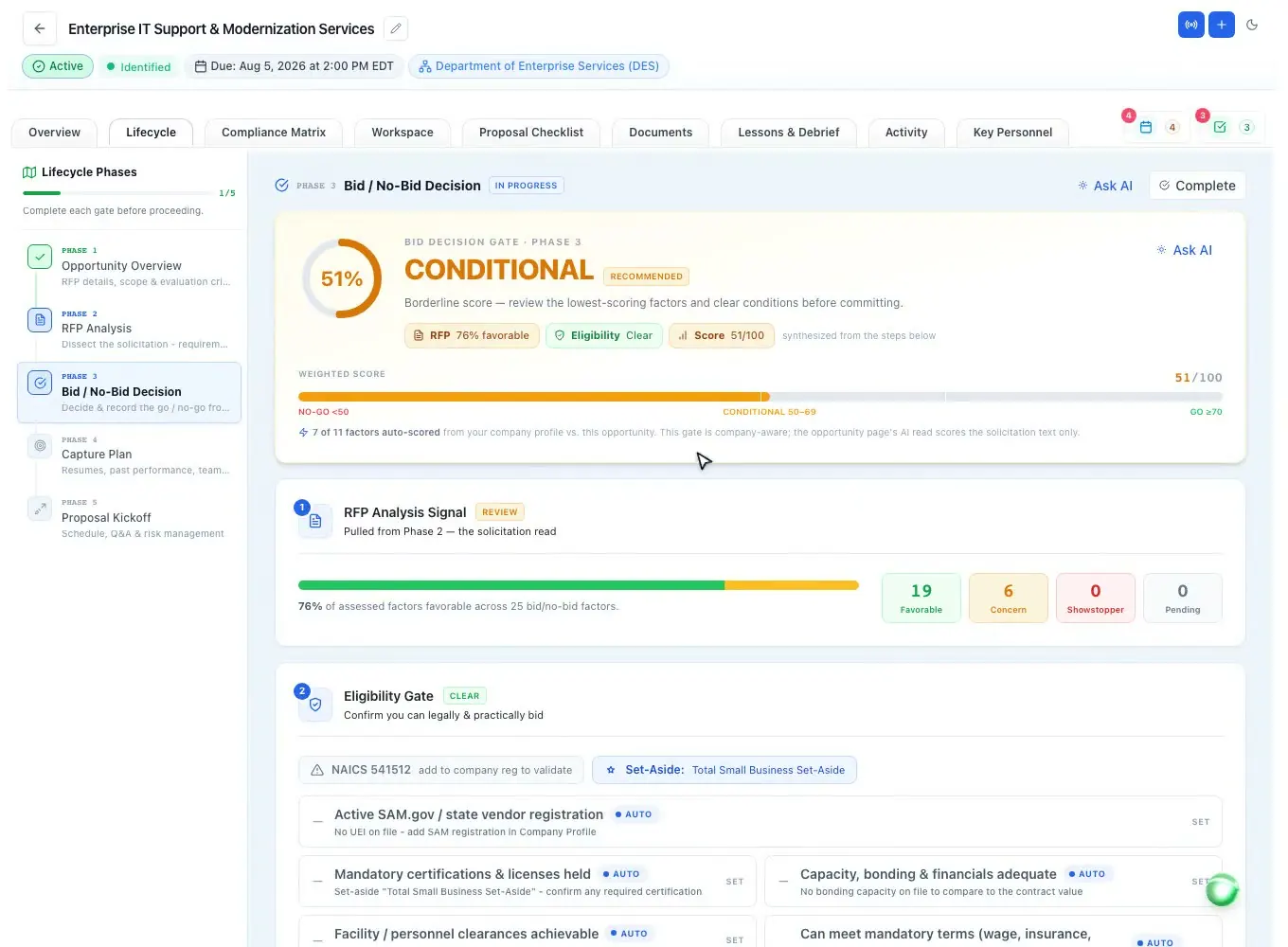
ProposalWorkspace reads the solicitation and returns categorized GO/NO-GO factors with page citations, in a worksheet where each factor is marked Favorable, Concern, Showstopper or N/A. The bid decision then gets its own gate: any showstopper blocks the bid, a weighted scorecard recommends GO, CONDITIONAL or NO-GO, and you record the call with your reasons. Your assessments are saved to a company knowledge file, and the next bid is pre-filled from it.
Up next
How to write a federal proposal outline that follows Section L
The outline is the proposal's architecture. Get it right and every writer knows what to say, where, in how many pages, and against which evaluation factor. Get it wrong and the best content in the world ends up where the evaluator is not looking.
7 min
New proposal guides, by email
One email when we publish a new proposal guide for companies that bid to federal and state agencies, and the occasional product update. No drip campaigns, no sharing your address, unsubscribe with one click.
This guide is general information for federal contractors drawn from the FAR and standard capture and proposal practice. It is not legal advice; always read the specific solicitation and consult counsel on protests, contract terms and compliance questions.