What you will learn
- Evaluators assess past performance on recency, relevance and quality (
FAR 15.305(a)(2)). Section M defines all three for each solicitation; use its definitions, not yours. - Relevance is scope, magnitude and complexity compared with this requirement. A smaller contract doing the same work usually beats a larger one doing different work.
- Quality is proven with CPARS ratings, past performance questionnaires and specific results, not adjectives.
- An offeror with no relevant record may not be evaluated favorably or unfavorably on past performance (
FAR 15.305(a)(2)(iv)), which in a tradeoff means the competitor with a strong record wins that factor. - Past performance questionnaires are a deliverable with a deadline that belongs to your customer. Start them the day the RFP drops.
Chapter 01of 051 min
How past performance is evaluated
FAR 15.304(c)(3) makes past performance an evaluation factor in most negotiated acquisitions above the simplified acquisition threshold, and FAR 15.305(a)(2) describes the evaluation: the government considers the currency and relevance of the information, the source and context of it, and general trends in the contractor's performance. Agencies turn this into three tests, defined in Section M.
| Test | What Section M usually says | What it means for your choice of references |
|---|---|---|
| Recency | Performed within the last three to five years, sometimes "ongoing or completed within". | A contract that ended six years ago is usually excluded, however good it was. |
| Relevance | Similar in scope, magnitude (dollar value, number of users, sites) and complexity to this requirement. | Match the PWS tasks and the size. Some agencies rate relevance itself: Very Relevant, Relevant, Somewhat Relevant, Not Relevant. |
| Quality | How well you performed: CPARS ratings, questionnaires, references, and any problems and how you fixed them. | Have the evidence before you cite the contract. A reference the customer will not vouch for is a liability. |
Chapter 02of 051 min
Choosing the references
- 1
Read the relevance definition and the count
Section L states how many references to submit (commonly three to five) and Section M defines relevance. Write both down before you look at your contract list.
- 2
Score every candidate contract against the definition
For each contract in the recency window, note the PWS tasks it covered, its value, its user or site count and its complexity drivers (clearances, 24x7, multiple locations). Rank by how many of this solicitation's dimensions it matches.
- 3
Check the quality evidence
Pull the CPARS for each candidate. Confirm the ratings are Satisfactory or better, and know exactly what any Marginal rating says. Confirm the customer point of contact is still there and willing to respond to a questionnaire.
- 4
Cover the PWS, not just the best contracts
Three references that all prove Task 3.1 and none that prove Task 3.4 leave a relevance gap. Choose the set that, together, covers the scope.
- 5
Consider teammate and subcontractor references
Most solicitations allow references from major subcontractors and teaming partners and say how much of the work they must perform to count. Use them to cover gaps, and make sure Section L's rules on affiliate and predecessor references are followed.
Chapter 03of 051 min
Writing a reference the evaluator can score
Section L usually prescribes the fields. Where it does not, the structure below covers what evaluators expect, in the order they read it.
The reference record
- Identification
- Customer agency and office, contract number, contract type, your role (prime or subcontractor, and percentage of work), total value, period of performance including options exercised.
- Point of contact
- Contracting officer and contracting officer's representative with current phone and email. Verify both before submission.
- Scope description
- What the contract required, written in the PWS's vocabulary and mapped to this solicitation's tasks.
- Relevance statement
- One paragraph that argues scope, magnitude and complexity explicitly against Section M's definition.
- Performance and results
- Measured outcomes: service levels met, ratings received, deliverables on time, cost performance, problems encountered and corrective actions.
- Key personnel continuity
- Which proposed key personnel worked on this contract, if any. Continuity is a strength evaluators value.
Relevance to this requirement. The contract is Very Relevant under Section M.4.2: it delivered the same three PWS functions (Tier I and II service desk, network operations and cybersecurity monitoring) for a civilian agency of comparable size (5,800 users versus 6,200 here, 38 sites versus 40), under a firm-fixed-price contract of similar magnitude ($4.8M versus an estimated $5.1M). Complexity drivers match: 24x7 coverage, Secret-level personnel and a 45-day transition from an incumbent. CPARS ratings for all three evaluated years were Very Good or Exceptional in Quality, Schedule and Management.
Chapter 04of 051 min
Past performance questionnaires
Many solicitations attach a Past Performance Questionnaire (PPQ) for your customers to complete and send directly to the contracting officer by a stated date. The questionnaire is outside your control, which is exactly why it must be managed.
- Send each questionnaire to the customer point of contact on day one, with a courteous note, the due date and the contracting officer's address filled in.
- Offer to pre-fill the administrative fields (contract number, value, dates) so the customer only rates and comments.
- Follow up a week before the deadline and confirm it was sent. Where Section L allows, include a copy in your proposal.
- Never complete the rating portion yourself or ask the customer to sign a form you wrote. Evaluators recognize it, and it can be treated as a misrepresentation.
Chapter 05of 051 min
When your record is thin or imperfect
A new company, a new service line or a contract that went badly are all survivable. What is not survivable is hiding them.
- No relevant record. Under
FAR 15.305(a)(2)(iv), you receive a neutral rating rather than an unfavorable one. In a tradeoff you will lose that factor to a competitor with a strong record, so make the technical and management factors carry the proposal, and use teammates' references where Section L allows. - A Marginal CPARS. Address it directly in the write-up: what happened, what you changed, and evidence the fix worked. Evaluators can consider your response; they cannot consider what you did not say.
- Key personnel experience. Some solicitations allow the experience of proposed key personnel from prior employers to count. Use it where allowed and label it accurately.
- Commercial and state work. Non-federal references usually count if they meet the relevance definition. Explain the customer and the terms so a federal evaluator can compare them.
Past performance volume check
- Number of references matches Section L; each meets the recency window in Section M.
- Each reference has verified points of contact who have agreed to respond.
- Relevance is argued explicitly against Section M's definition for each reference.
- Results are measured, and CPARS ratings are stated accurately.
- Questionnaires sent, tracked and confirmed submitted.
- Problems and corrective actions on any reference are disclosed and explained.
Before you go
Questions people ask
- How many past performance references should we submit?
- Exactly as many as Section L allows. Submitting more is often treated as non-compliance and the extras are ignored, or worse, the evaluator reads only the first ones in the order you provided.
- Does past performance as a subcontractor count?
- Usually, when you performed a meaningful share of the work and the solicitation permits it. State your role and percentage of effort clearly, and make sure the prime's point of contact will confirm it.
- Can the government use past performance we did not submit?
- Yes. FAR 15.305(a)(2) allows the government to consider information from its own records and other sources, including CPARS on contracts you did not cite. Know your CPARS before you bid.
- What is the difference between past performance and experience?
- Experience is whether you have done this kind of work; past performance is how well you did it. Some solicitations evaluate them as separate factors, so read Section M for which one a given volume must address.
- Our customer never responds to questionnaires. What can we do?
- Tell the contracting officer in the proposal that the questionnaire was sent, to whom and when, and include the CPARS instead where allowed. Many agencies accept CPARS in lieu of a questionnaire for federal references.
Past performance records and post-award imports
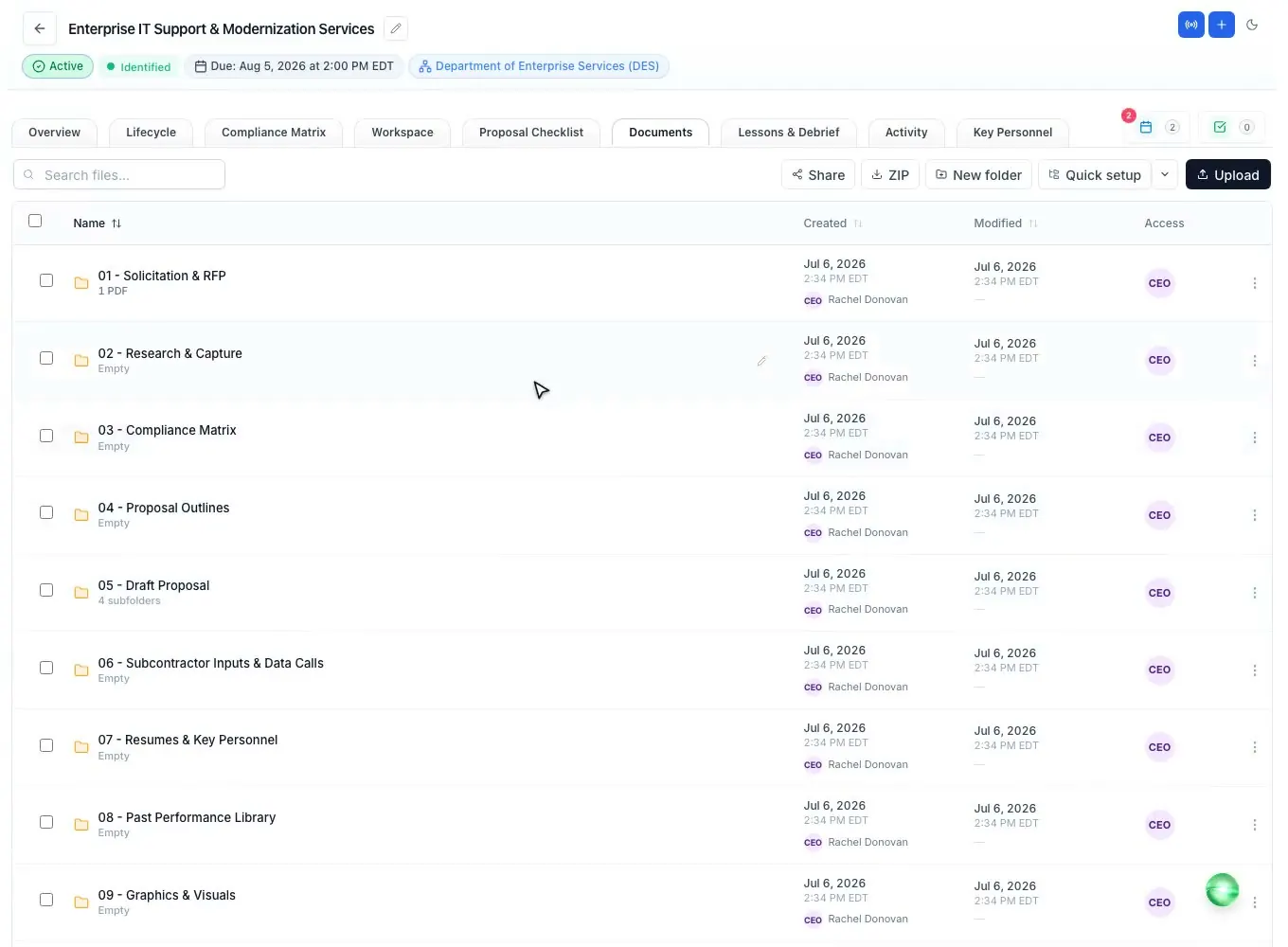
ProposalWorkspace keeps your past performance records in the Company Library with the fields evaluators ask for, imports award results from the federal award record, and lets the proposal editor draft the write-up against the solicitation's own relevance definition, with page limits enforced in the outline.
Up next
Pink, Red and Gold Team reviews: what each one checks
Color team reviews are how experienced proposal teams catch problems while there is still time to fix them. Each review has one question to answer. Run them with the right people, against the solicitation, on a schedule set on day one, and the Red Team stops being the place where proposals get rewritten.
7 min
New proposal guides, by email
One email when we publish a new proposal guide for companies that bid to federal and state agencies, and the occasional product update. No drip campaigns, no sharing your address, unsubscribe with one click.
This guide is general information for federal contractors drawn from the FAR and standard capture and proposal practice. It is not legal advice; always read the specific solicitation and consult counsel on protests, contract terms and compliance questions.