What you will learn
- The outline's order and numbering come from Section L. The heading language comes from Section M. The content proves Section C.
- Budget pages by evaluation weight, not by how much you have to say.
- Every heading is a promise to the evaluator; the first sentence under it should keep that promise.
- Assign one owner per section and freeze the outline before drafting starts. Changes after that go through the proposal manager.
- Build the outline as a document skeleton with page placeholders, not as a bullet list in an email.
Chapter 01of 061 min
The three inputs to every outline
Federal evaluators are trained to read a proposal against the solicitation, not on its own terms. So the outline has to be derived from the solicitation, in a traceable way. Three sections supply it.
- Section L supplies the volumes, their order, what each must contain and the page limits. This is the skeleton.
- Section M supplies the evaluation factors and subfactors and the words the evaluator will look for. These become the heading language and the page budget.
- Section C (the SOW or PWS) supplies the tasks. Where Section M says the technical approach will be evaluated by PWS task, the tasks become subsections.
Chapter 02of 061 min
Building the outline in six steps
- 1
List the volumes exactly as Section L names them
Use the solicitation's volume names and numbers. If Section L says "Volume II - Technical Proposal", that is your title, not "Technical Approach". Include the administrative volume, the price volume and any small business subcontracting plan or contract documents volume.
- 2
Number the top level from Section L's content list
Section L typically lists what each volume must address, often as numbered or lettered items. Each becomes a level-one heading in the same order: 1.0, 2.0, 3.0. Never reorder to tell a better story; the evaluator's scoring sheet is in Section L order.
- 3
Write the headings in Section M language
Under each Section L item, name the Section M factor it answers and borrow its words. If Section M evaluates "the feasibility and completeness of the transition plan", the heading is "3.0 Transition Plan: A Feasible and Complete Approach" and the first subsections address feasibility and completeness by name.
- 4
Add PWS-driven subsections
Where Section M says the technical approach will be evaluated task by task, create one subsection per PWS paragraph, in PWS order, with the PWS paragraph number in the heading (for example, "1.3 Task 3.2 - Network Operations"). Where Section M evaluates themes instead of tasks, organize by theme and cross-reference the tasks.
- 5
Budget the pages by evaluation weight
Divide the volume's page limit among the level-one sections in proportion to Section M's stated importance. A factor described as "significantly more important" gets the lion's share. Write the page budget next to every heading; writers who know they have four pages write four pages.
- 6
Assign owners, dates and placeholders
One owner per section, a draft-due date for Pink Team, and placeholders for every required exhibit: resumes, letters of commitment, past performance questionnaires, the cross-reference matrix, reps and certs. A placeholder in the skeleton is a requirement that cannot be forgotten.
Chapter 03of 061 min
A worked example
Section L requires a 30-page Technical Volume addressing (a) Technical Approach, (b) Management Approach and (c) Staffing and Key Personnel. Section M lists three factors in descending order of importance: Technical Approach, Management Approach, Key Personnel. Technical Approach will be evaluated "for each PWS task in Section 3", and the PWS has five tasks.
Volume II - Technical Proposal (30 pages) 1.0 Technical Approach (Factor 1, most important) - 16 pages, owner: technical lead 1.1 Understanding of the Requirement and Our Approach - 2 1.2 Task 3.1 Service Desk Operations - 3 1.3 Task 3.2 Network Operations - 3 1.4 Task 3.3 Cybersecurity Support - 3 1.5 Task 3.4 Application Support - 2 1.6 Task 3.5 Reporting and Governance - 1.5 1.7 Technical Risks and Mitigations - 1.5 2.0 Management Approach (Factor 2) - 9 pages, owner: program manager 2.1 Organization and Lines of Authority - 2 2.2 Quality Control and Performance Measurement - 3 2.3 Transition-In Plan - 3 2.4 Communication with the Government - 1 3.0 Staffing and Key Personnel (Factor 3) - 5 pages, owner: staffing lead 3.1 Staffing Model and Surge - 2 3.2 Key Personnel Qualifications (resumes in Appendix A, not counted) - 3 Appendix A - Key Personnel Resumes and Letters of Commitment (page limits per L.4.3) Cross-Reference Matrix (excluded from page count per L.4.2)
Everything in that outline can be traced to a sentence in the solicitation. When a Red Team reviewer asks why Section 2.2 exists, the answer is "Section M, Factor 2, subfactor b", and that is the answer the evaluator will be looking for too.
Chapter 04of 061 min
Headings that score
A heading has three jobs: tell the evaluator which requirement is being answered, signal the answer, and be findable in the scoring sheet. Long, marketing-style headings fail the first job; bare numbers fail the second.
| Weak heading | Strong heading | Why |
|---|---|---|
| 2.3 Transition | 2.3 Transition-In Plan: Full Operating Capability in 45 Days | Names the Section M term and states the result the evaluator wants to verify. |
| 1.4 Our Innovative Cyber Solution | 1.4 Task 3.3 Cybersecurity Support | Ties the section to the PWS task the evaluator is scoring. |
| 3.0 People | 3.0 Staffing and Key Personnel | Uses Section L's own words so it is found in the scoring sheet. |
Chapter 05of 061 min
Living inside the page limits
- Read Section L's definition of a page: font, size, margins, line spacing, and whether tables, figures and footnotes use a smaller allowed size.
- Decide what is excluded from the count (cover, table of contents, cross-reference matrix, resumes) and only if Section L says so.
- Keep a running page count in the outline and update it at every review. A section that is over budget is stealing pages from a more important factor.
- Check the final PDF, not the Word document. Pagination shifts on conversion, and evaluators receive the PDF.
Chapter 06of 061 min
Outline control after kickoff
Freeze the outline at kickoff and make the proposal manager the only person who can change it. Writers who add sections break the trace to Section L; writers who merge sections break the page budget. Amendments are the legitimate reason to change the outline; when one arrives, revise the outline first, then the compliance matrix, then the drafts.
Outline sign-off
- Volumes named and ordered exactly as Section L.
- Every Section L content item is a heading, in Section L order.
- Every Section M factor and subfactor is named in a heading.
- PWS tasks appear as subsections where Section M evaluates by task.
- Page budget per section sums to the limit and follows Section M weights.
- One owner and one due date per section.
- Placeholders for every exhibit, resume, letter and matrix.
Before you go
Questions people ask
- What if Section L and Section M are organized differently?
- Follow Section L for order and numbering, then map Section M factors onto that structure in the headings. If a Section M factor has no natural home in Section L's order, add a subsection where the evaluator is most likely to look and point to it from the cross-reference matrix.
- Should the outline include win themes?
- Win themes are placed inside the outline, not as headings. Note the theme each section must carry in the writer guidance under the heading, so themes recur where the evaluator reads rather than in a marketing section nobody scores.
- How detailed should the outline be before writing starts?
- Down to the level where each item is one writer's work for one review cycle, with a page budget and the requirement IDs from the compliance matrix it must answer. That usually means three levels for a technical volume.
- Can we reuse an outline from a previous proposal?
- Reuse the discipline, not the outline. Every solicitation's Section L is different, and a reused outline is the most common cause of content that does not match the scoring sheet.
- Where do resumes and letters of commitment go?
- Wherever Section L says. If it is silent, put them in an appendix to the volume that addresses key personnel and confirm in a question whether the appendix counts against the page limit.
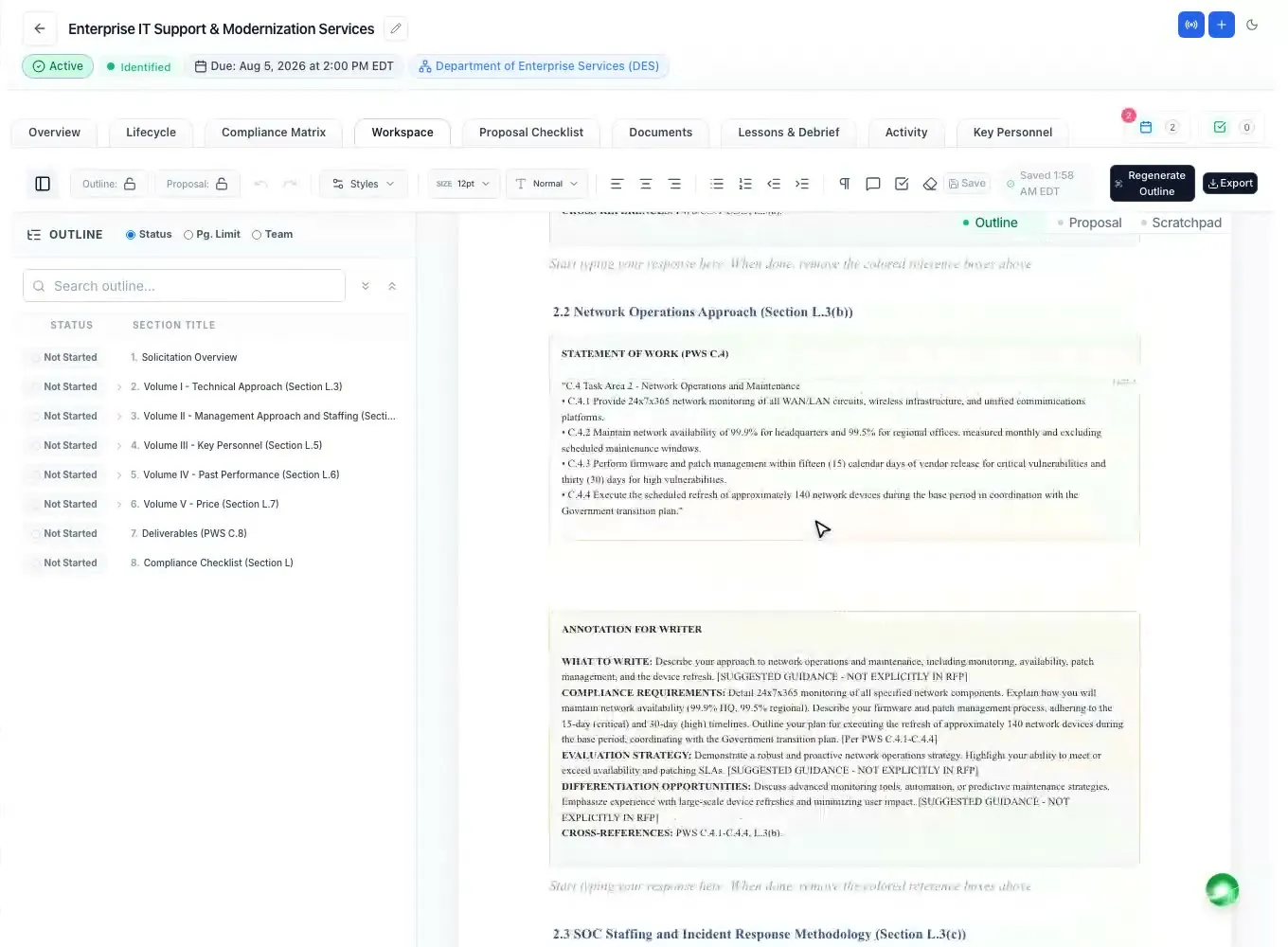
An annotated outline generated from Sections L, M and the SOW
ProposalWorkspace generates a compliant Section L, M and SOW outline with writer guidance and placeholders for resumes, letters and reps and certs, straight into the proposal editor. Headings carry federal-style numbering that stays consistent across the editor, the outline pane and the Word and PDF exports, with per-section owners, status and page limits.
Up next
Federal contract proposal template: the sections every bid needs
Every federal proposal is built from the same set of volumes, and every solicitation rearranges them a little. This template explains what each volume is for, what evaluators expect to find in it, and the order of operations that gets a compliant bid out of the door.
7 min
New proposal guides, by email
One email when we publish a new proposal guide for companies that bid to federal and state agencies, and the occasional product update. No drip campaigns, no sharing your address, unsubscribe with one click.
This guide is general information for federal contractors drawn from the FAR and standard capture and proposal practice. It is not legal advice; always read the specific solicitation and consult counsel on protests, contract terms and compliance questions.