What you will learn
- Capture starts six to eighteen months before release and ends at the bid decision. Its product is knowledge: customer hot buttons, competitor positions, the solution the customer wants, and a plan to win.
- Talking to the government before a solicitation is encouraged (
FAR 15.201); after release, contact goes through the contracting officer. - Every conversation has a purpose and a record. A call plan names who you meet, what you need to learn and what you will offer them.
- Industry days, Sources Sought responses and draft RFP comments are your legitimate levers on the requirement. Use all three.
- The capture plan hands the proposal team its themes, its teaming decisions, its key personnel and its price strategy on day one.
Chapter 01of 061 min
What capture is, and why it decides the outcome
Capture management is the disciplined pursuit of a specific opportunity before the solicitation is released. It answers four questions: what does the customer actually need and fear, who else will bid and what will they offer, what solution and price would win, and what must we change about ourselves (team, people, certifications) to be the safe choice. The proposal then executes the answers. Companies that skip capture write proposals from the solicitation alone, which is why their proposals answer the words and not the need.
The reason capture works is timing. Before release, the program office is still deciding what to ask for, the contracting officer is still deciding the acquisition strategy, and both are allowed to talk to industry. After release, the requirement is fixed and contact is controlled. The influence window closes the day the RFP is posted.
Chapter 02of 061 min
The rules of engagement
FAR 15.201 says exchanges of information among interested parties, from the earliest identification of a requirement through receipt of proposals, are encouraged, and lists the legitimate channels: industry conferences, public hearings, market research, one-on-one meetings with potential offerors, presolicitation notices, draft RFPs, RFIs, presolicitation conferences and site visits. The limits are equally clear. Contact must not give one offeror information that others do not get on request, and after the solicitation is issued, exchanges go through the contracting officer.
- Before release: meet program staff, attend industry days, respond to Sources Sought and RFIs, comment on draft RFPs, ask about acquisition strategy. Never ask for source selection information or for another offeror's data.
- After release: questions in writing to the contracting officer only; no contact with program staff about the procurement; no gifts, meals or favors at any time (
FAR 3.101). - Always: be truthful about capabilities, respect the Procurement Integrity Act (
41 USC 2101-2107), and keep a record of every meeting.
Chapter 03of 062 min
The call plan: conversations with a purpose
A call plan is a short table of the people you need to meet, what you need to learn from each, what you can offer them, and who on your side will do it. It turns "we should talk to the customer" into scheduled work with outcomes.
| Who | What to learn | What to offer | Owner and date |
|---|---|---|---|
| Program manager or COR | Pain points with the current contract, what success looks like, timeline and budget signals. | Relevant experience, a capability briefing, candid answers about what is hard. | Capture lead, month 1 |
| Contracting officer or specialist | Acquisition strategy, likely contract type, set-aside thinking, expected release date. | A capability statement, a Sources Sought response, questions that improve the solicitation. | Capture lead, month 2 |
| Small business specialist | How the agency meets its goals, which set-asides are planned, who they recommend to program offices. | A tailored capability statement and a real answer to "what do you do". | Business development, month 1 |
| End users and technical staff | The operational reality: tools, volumes, frustrations, the environment. | Technical exchange, demonstrations where appropriate. | Technical lead, months 2 to 4 |
| Incumbent's partners and former staff | Where the incumbent struggles, which key people might move, teaming interest. | Teaming conversations, employment conversations conducted ethically. | Capture lead, ongoing |
- 1
Prepare three questions and one thing to give
Every meeting has a purpose. Prepare the questions whose answers change your plan, and bring something useful: a relevant example, a lesson from similar work, a market observation.
- 2
Listen for hot buttons and vocabulary
Write down the words the customer uses for their problems. Those words become win themes and headings.
- 3
Ask the acquisition questions carefully
"Is the requirement likely to be set aside?" and "What contract type are you considering?" are appropriate. "Who else has met with you?" is not.
- 4
Record the meeting the same day
Attendees, what was learned, what was promised, and the next step. The capture plan is built from these records.
- 5
Follow up on every promise
If you offered a briefing or a capability statement, send it within a day. Reliability before award is the first past performance the customer sees.
Chapter 04of 061 min
Industry days and site visits
An industry day is the agency's briefing to all interested companies on an upcoming requirement, often with a question period, one-on-one sessions and a sign-in list that competitors can request. Treat it as a capture event, not a lecture.
- Read every posted document before you go and prepare questions that reveal the agency's thinking without revealing yours.
- Send the people who will run the contract, not only business development. Program staff notice who understands the work.
- Book the one-on-one session if offered; it is the closest thing to a customer meeting after the presolicitation notice.
- Note who else attends. The attendee list is the first reliable view of your competition and of potential teammates.
- Capture every question asked by any company; the agency's answers and the questions themselves reveal hot buttons and competitor positions.
- Attend site visits when offered and always when mandatory; the physical environment is where the technical approach becomes credible.
Chapter 05of 061 min
Shaping the requirement: Sources Sought and draft RFP comments
The two written levers before release are the Sources Sought or RFI response and comments on a draft RFP. Both are opportunities to influence the acquisition strategy and the requirement itself, within the rules, because the agency asks for them.
- Sources Sought responses feed the set-aside decision and often the NAICS choice; a strong small business response can restrict the competition to your category. See the Sources Sought guide.
- Draft RFP comments are your chance to point out unrealistic page limits, ambiguous requirements, evaluation factors that favor an incumbent, contract types that shift unreasonable risk, and missing information. Comment by section number, quote the text, propose specific alternative language, and frame every comment as a way to get the government better proposals.
- Recommend, do not demand. Agencies adopt suggestions that make their job easier and their competition fairer; they ignore lobbying.
Draft Section L.4.2(c), page 61. The 15-page limit for the Technical Volume covers six PWS tasks, key personnel qualifications and a transition plan. To allow offerors to demonstrate understanding of each task at the depth Section M.2.1 evaluates, we recommend a 25-page limit for the Technical Volume, or moving key personnel qualifications to a separate volume excluded from the limit.
Chapter 06of 061 min
The capture plan itself
The capture plan is a living document, usually short, that records what you have learned and what you have decided. It is reviewed at the Blue Team and handed to the proposal manager at kickoff. A workable outline:
Capture plan contents
- Opportunity summary
- Customer, requirement, value, contract type, expected release and award dates, incumbent and history.
- Customer analysis
- Decision makers and influencers, hot buttons in their words, how the current contract is perceived, budget signals.
- Competitive analysis
- Likely bidders, their strengths and weaknesses for this requirement, their probable price position and teammates.
- Win strategy
- Win themes with proofs, discriminators, ghosting opportunities, and the gaps you must close (people, certifications, past performance).
- Solution and teaming
- The solution concept, key personnel candidates, teaming partners and their roles, subcontracting plan considerations.
- Price to win
- What you know about budget and the incumbent price; the price position you intend to take and why.
- Action plan
- The call plan, events, Sources Sought and draft RFP actions, with owners and dates, and the bid decision date.
Capture readiness at bid decision
- Hot buttons recorded in the customer's words, from at least two sources.
- Competitors named with a view on their likely approach and price.
- Three to five win themes drafted with proofs.
- Key personnel candidates identified and their availability confirmed.
- Teaming partners agreed in principle, with work share and exclusivity discussed.
- Sources Sought response submitted and draft RFP comments made where available.
- Price-to-win position stated with its basis.
- Gaps and the actions to close them assigned with dates.
Before you go
Questions people ask
- Is it legal to meet with the government before an RFP is released?
- Yes. FAR 15.201 encourages exchanges of information before receipt of proposals, including one-on-one meetings, as long as no offeror receives information others cannot get and no source selection information is disclosed.
- How do we get a meeting with a program office?
- Through the agency's small business office, through industry day one-on-one sessions, by responding to Sources Sought notices, and by asking directly with a specific, relevant reason. A capability briefing on work you have done for a similar customer is a reasonable request.
- What if the incumbent seems unbeatable?
- Capture is how you find out whether that is true. If the customer is satisfied, the incumbent is strong and the requirement is unchanged, a no-bid is the right outcome and capture has saved a proposal's worth of effort.
- How much time should capture take for a small business?
- A few hours a month per pursuit for most of the window, concentrated around Sources Sought responses, industry days and draft RFPs. The discipline matters more than the hours.
- Can we hire from the incumbent during capture?
- Employment conversations are lawful when conducted ethically and without misuse of the incumbent's proprietary information or violation of non-compete obligations. Involve counsel where key personnel are concerned, and never trade information for a job offer.
Pre-award pursuits with capture intelligence and a graduation into the proposal
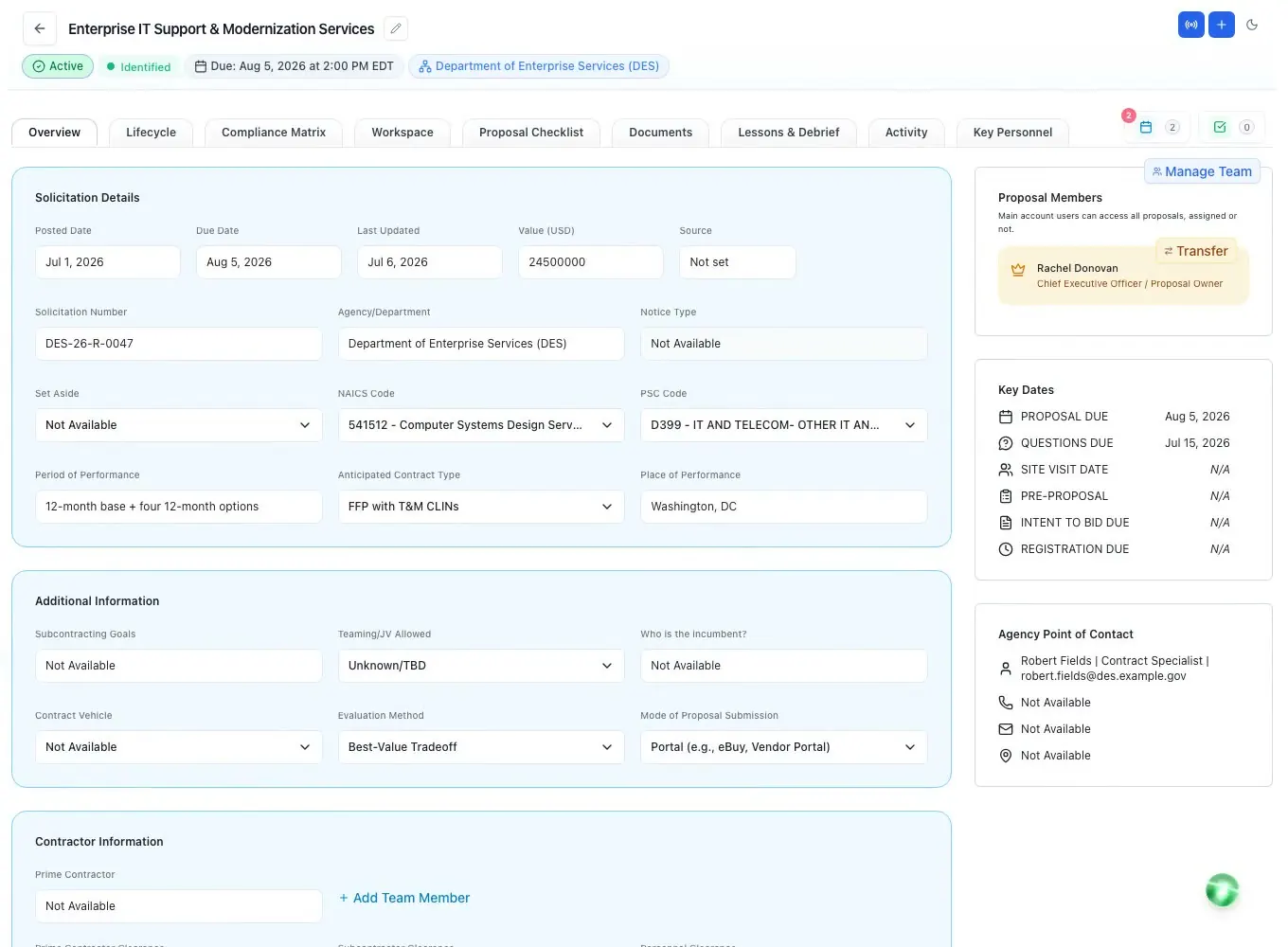
ProposalWorkspace runs a pursuit through notice intake, capture intelligence, a drafted response, submission tracking and watching for the solicitation, with the FAR 15.201 quiet-period reminder on post-solicitation phases. When the RFP arrives the pursuit graduates into the full proposal workflow, carrying the capture plan, win themes, teaming and key personnel choices with it.
Up next
Bid or no-bid: a decision worksheet you can defend
Most losing proposals were lost at the bid decision, not in the writing. A disciplined bid/no-bid review, run within days of a solicitation dropping, keeps your team's hours for the pursuits you can actually win. This is the worksheet experienced capture managers use.
6 min
New proposal guides, by email
One email when we publish a new proposal guide for companies that bid to federal and state agencies, and the occasional product update. No drip campaigns, no sharing your address, unsubscribe with one click.
This guide is general information for federal contractors drawn from the FAR and standard capture and proposal practice. It is not legal advice; always read the specific solicitation and consult counsel on protests, contract terms and compliance questions.