What you will learn
- A win theme links a customer hot button to a discriminator (something competitors cannot honestly claim) and a proof (a fact the evaluator can verify), then names the benefit.
- Themes come from capture, not from the writing room. If you do not know the customer's hot buttons, you have features, not themes.
- Three to five themes per proposal. More than that and none of them repeats often enough to be remembered.
- Themes go where evaluators read: the first sentence under scored headings, section summaries and graphics captions, not a separate "why us" section.
- Test every theme with two questions: could a competitor say this, and could an evaluator check it. If either answer is wrong, it is not a theme yet.
Chapter 01of 061 min
Theme, discriminator, benefit: three different things
The words get used interchangeably and the confusion produces weak proposals. A feature is something your solution has. A benefit is what that feature does for the customer. A discriminator is a feature or benefit that competitors cannot honestly match. A win theme is a sentence that ties a discriminator to a specific customer concern and proves it. Only the last one earns a strength in an evaluation, because only the last one gives the evaluator something to write down that distinguishes you.
| Term | Example | Why it matters |
|---|---|---|
| Feature | We use an ITIL-aligned service desk toolset. | Every competitor can say it. Earns nothing on its own. |
| Benefit | Incidents are resolved faster. | Better, but unproven and generic. |
| Discriminator | Our service desk team transitioned the same agency's neighboring bureau in 45 days with 82 percent incumbent staff retention. | Specific, verifiable, hard to copy. |
| Win theme | Because you told us a rocky transition is your biggest risk, our 45-day transition playbook, proven on the neighboring bureau with 82 percent staff retention, delivers full operating capability without a service interruption. | Names the hot button, the discriminator, the proof and the benefit in one sentence. |
Chapter 02of 061 min
A four-part formula
- 1
Hot button: what the customer is worried about
A hot button is a concern the customer holds strongly enough to score against, whether or not Section M names it: a failed transition last time, an audit finding, staff turnover, a mandate with a deadline. You learn hot buttons from capture conversations, industry days, Sources Sought questions, protests, prior award decisions and the language of the PWS itself.
- 2
Discriminator: what only you can say
A capability, experience, person, tool or result that competitors cannot honestly claim for this requirement. Be strict: if the incumbent or the largest competitor could write the same sentence, it is a feature, not a discriminator.
- 3
Proof: what makes it believable
A named contract, a CPARS rating, a measured result with a date, a certification number, a named person with a resume in the appendix. Proof is what turns a claim into a strength; without it evaluators discount the claim to zero.
- 4
Benefit: what it does for the customer
State the outcome in the customer's terms: fewer outages, an audit passed, a mandate met on time, lower transition risk. Tie the benefit to the evaluation factor when you can.
Theme 1 (transition risk): Because a failed transition is the risk you named at industry day, our 45-day playbook, proven on the neighboring bureau with 82 percent staff retention, reaches full operating capability without a service interruption. Theme 2 (first-contact resolution): Because first-contact resolution drives your user satisfaction metric, our knowledge-centered support model, which raised FCR from 71 to 92 percent on a comparable 6,000-user desk within six months, lifts your metric in the first option year. Theme 3 (security mandates): Because the Zero Trust milestone falls inside the base year, our team, which delivered the same milestone for a sister agency ahead of schedule, brings a tested implementation plan rather than a learning curve.
Chapter 03of 061 min
Where themes come from
Themes are a capture product. Teams that try to write them at kickoff, from the solicitation alone, produce generic statements because the solicitation does not tell you what the customer fears. Build the raw material before the RFP drops: what the current contractor does badly, what the program office says in public, what the last award decision rewarded, what questions the agency asked in its Sources Sought notice. The capture planning guide covers the conversations that produce it.
- Customer conversations: what they volunteer when asked what worries them about the next contract.
- Industry day questions: the questions the agency asks bidders reveal what it is unsure about.
- Section M and the PWS: repeated words and unusual emphasis point at hot buttons ("seamless", "no degradation", "within 30 days").
- Competitor weaknesses: known incumbent problems become themes when you can prove you avoid them, framed positively, never by naming the competitor.
Chapter 04of 061 min
Where themes go in the proposal
A theme that lives on a separate "Why choose us" page is read once, if at all. Themes work when they appear where evaluators score. Place each theme, in varied wording, in several of these spots:
- The first sentence under a scored heading, so the evaluator meets the strength before the detail.
- Section summaries at the end of each major section, restating the theme with its proof.
- Graphic titles and captions, which evaluators read even when they skim. A caption is a theme in ten words.
- The executive summary, if Section L allows one, as the place all themes appear together.
- Past performance write-ups, where the proof lives, phrased to echo the theme it supports.
Chapter 05of 061 min
The tests: is it a theme yet?
Run every theme through these
- Could the incumbent or the strongest competitor honestly write this sentence? If yes, find the discriminator.
- Could an evaluator verify the proof from the proposal (a contract, a rating, a resume, a number with a date)? If no, add the proof or drop the claim.
- Does it name a concern the customer actually has, in their words? If it names a concern you assume, check it in capture.
- Does it state the benefit in the customer's terms rather than yours?
- Does it appear in at least three scored places, worded differently each time?
- Is it free of adjectives that carry no evidence ("robust", "world-class", "innovative")?
Chapter 06of 061 min
Ghosting the competition, ethically
Ghosting means writing a theme so that it highlights a competitor's weakness without naming the competitor: "Unlike approaches that rely on contingent hires, our team is on staff today" when the incumbent is known to staff with contingent hires. It is legitimate when the statement about your own approach is true and provable. It becomes a problem when it disparages, speculates, or makes claims about a competitor you cannot support. Keep the sentence about you; let the evaluator draw the comparison.
Before you go
Questions people ask
- How many win themes should a proposal have?
- Three to five. Each should map to a major evaluation factor or a known hot button. Beyond five, themes stop repeating often enough to register.
- What if we have no real discriminator?
- Then the bid decision was probably wrong, or capture is incomplete. Look harder at people, past performance and approach; a discriminator can be small and specific. If there truly is none, price and flawless compliance are your strategy, and the themes should say so plainly.
- Should win themes appear in the price volume?
- Only as the assumptions and approach that explain the price, since price evaluators do not score themes. Consistency matters more: a theme about a lean staffing model must match the hours in the price volume.
- Are win themes the same as strengths?
- A strength is what the evaluator records; a win theme is how you present the evidence so the evaluator records it. Good themes produce strengths.
- Can we reuse themes across proposals?
- Discriminators and proofs recur; hot buttons do not. Rebuild each theme around the specific customer's concern, or it becomes the generic boilerplate evaluators ignore.
Capture plan themes carried into the outline and the editor
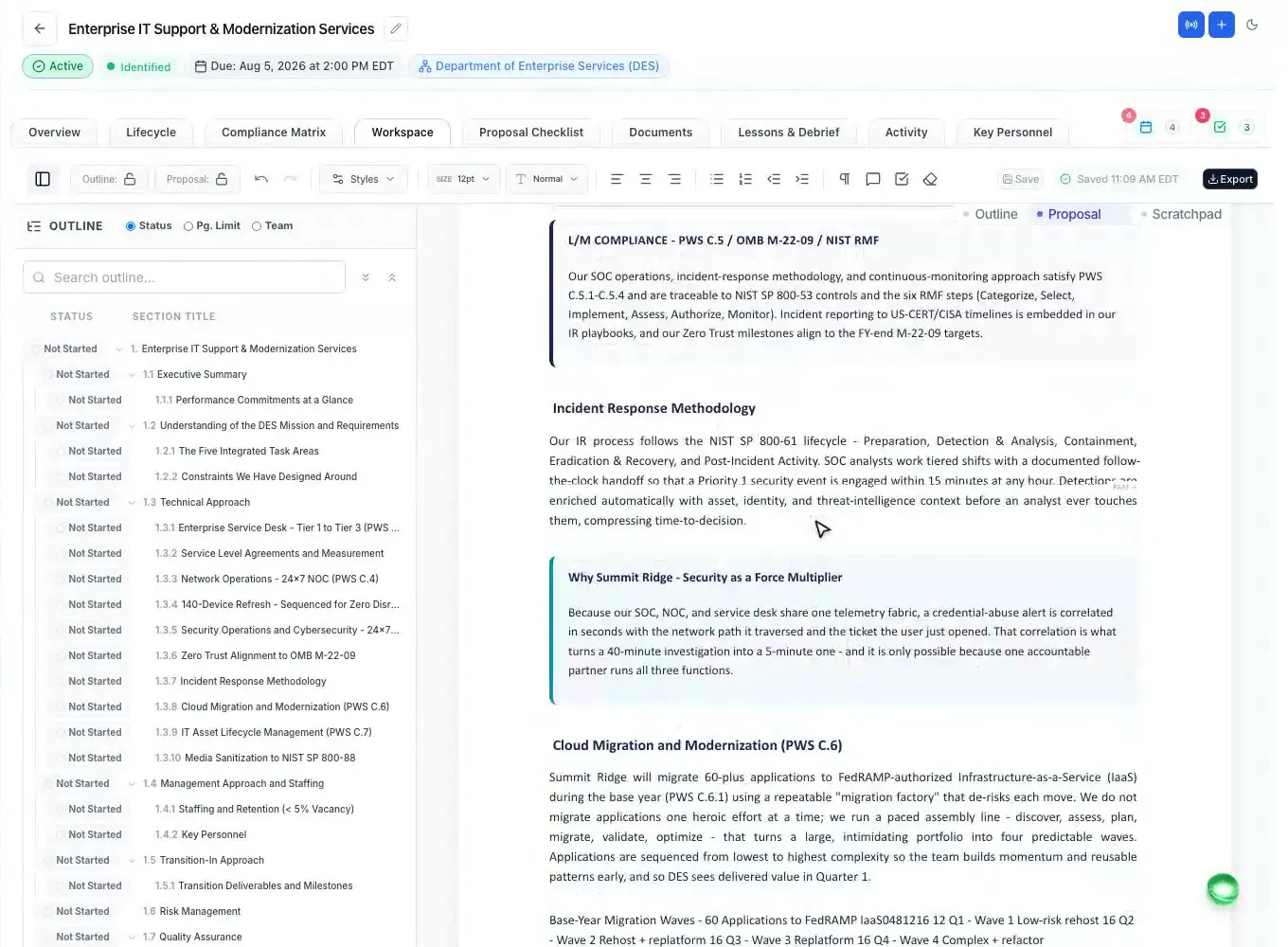
ProposalWorkspace keeps win themes, teaming and past performance choices in the capture plan on the pursuit, then the generated outline carries writer guidance under every heading and the editor's Ask-AI presets include checks for Section L and M compliance, active voice and ghosting competitors, so themes reach the sections evaluators score instead of a slide nobody reads.
Up next
How to write a technical approach evaluators score highest
The technical volume is where most of the score lives and where most proposals waste their pages restating the requirement. Evaluators are looking for something specific: evidence that you understand the work and a sound, feasible way of doing it. This guide shows how to write to that standard, section by section.
7 min
New proposal guides, by email
One email when we publish a new proposal guide for companies that bid to federal and state agencies, and the occasional product update. No drip campaigns, no sharing your address, unsubscribe with one click.
This guide is general information for federal contractors drawn from the FAR and standard capture and proposal practice. It is not legal advice; always read the specific solicitation and consult counsel on protests, contract terms and compliance questions.