What you will learn
- The agency is doing market research (
FAR Part 10). Your response feeds the set-aside decision under the rule of two inFAR 19.502-2. - Answer the questions in the order asked, with the headings the notice uses. Reviewers tally responses; they do not hunt for answers.
- Lead with eligibility and capacity: size status under the stated NAICS, certifications, relevant experience with dollar values and dates.
- Keep it to the page limit, often 5 to 10 pages. A crisp response that fits beats a long one that does not.
- Use the response to shape the buy: suggest the NAICS, the contract type or a set-aside, and ask the questions that will improve the eventual solicitation.
Chapter 01of 051 min
Why agencies issue Sources Sought notices and RFIs
Before an agency can buy anything of consequence, it has to understand the market: who can do the work, whether small businesses can, what the work should cost and how it should be structured. FAR Part 10 requires this market research, and FAR 15.201(e) describes Requests for Information as a way to obtain price, delivery, capability and other market information when the government does not yet intend to award a contract. A Sources Sought notice is the most common form of this research on SAM.gov.
Your response has two audiences. The contracting officer uses it to decide the acquisition strategy: full and open competition, a small business set-aside, an 8(a) or SDVOSB set-aside, or a sole source. The program office uses it to sharpen the requirement, sometimes borrowing language from good responses when it writes the Statement of Work. Both audiences reward specificity and punish generic marketing.
Chapter 02of 051 min
What a strong response contains
Most notices list the information wanted. Follow that list exactly, in that order, using their headings. Where a notice is vague, the following structure covers what contracting officers expect.
The standard contents
- Company data
- Legal name, address, UEI, CAGE code, point of contact with phone and email, website, and the NAICS code with your size status under it.
- Business type
- Small business (state the size standard and your revenue or headcount basis), 8(a), HUBZone, SDVOSB, WOSB or EDWOSB with certification status, and whether you would prime or subcontract.
- Capability statement
- One page. Core competencies tied to the notice, differentiators that can be verified, and the contract vehicles you hold (GSA MAS, GWACs, agency IDIQs).
- Relevant experience
- Three to five contracts of similar size, scope and complexity. For each: customer, contract number, value, period of performance, your role (prime or sub), and two sentences on what you did that maps to the notice.
- Capacity and approach
- Staffing you can commit, clearances held, facilities, key partners, and a short paragraph on how you would approach the requirement as described.
- Answers to the specific questions
- Many notices ask direct questions: recommended NAICS, contract type, whether the requirement should be broken into lots, performance risks. Answer each one directly, numbered as they numbered them.
Chapter 03of 052 min
Writing the response: a step-by-step method
- 1
Decide within a day whether to respond
Ask three questions: are we eligible under the NAICS and any stated set-aside; do we have at least two relevant past performances; is this a customer we want. If the answer to all three is yes, respond. If the requirement is out of scope for you but you could subcontract, say so honestly; teaming interest is useful information to the agency.
- 2
Build the outline from the notice itself
Copy every requested item and every numbered question into a document as headings. This is your outline. It guarantees you answer everything and makes the reviewer's tally easy.
- 3
Write the eligibility paragraph first
State the NAICS, the size standard, and your status under it in one plain sentence: "Under NAICS 541512 (size standard $34 million), Acme Systems is a small business and an SBA-certified HUBZone firm." This sentence does more for a set-aside decision than any other.
- 4
Select past performance for relevance, not prestige
A $2 million contract doing the same work for a similar agency beats a $50 million contract doing something adjacent. Match scope, size and complexity to the notice. Include the customer point of contact where permitted; contracting officers do call.
- 5
Answer the shaping questions with a point of view
If asked about contract type, recommend one and give the reason (for example, firm-fixed-price for well-defined help desk services, labor-hour for surge engineering support). If asked about the NAICS, agree or propose an alternative and explain the size-standard effect. Thoughtful answers here are how requirements get written in your favor.
- 6
Format for a two-minute read
Headings matching the notice, short paragraphs, a table for past performance, and a one-page capability statement up front. Respect the page limit and the file format requested (PDF unless told otherwise). Put your company name, the notice number and the date in the header of every page.
- 7
Submit early and confirm receipt
Email to the address in the notice, with the notice number and your company name in the subject line. Submit at least a day early; then ask the contracting officer to confirm receipt. Keep the sent message and any acknowledgement in the pursuit record.
Enterprise Service Desk Support, U.S. Department of the Interior, Contract 140D0421F0123. Prime. $4.8M firm-fixed-price, Sep 2022 to Sep 2025 (base plus two options exercised). Acme operates a 24x7 Tier I and Tier II service desk for 6,200 users across 40 sites, meeting a 92% first-contact resolution target every month since transition. Directly comparable to the scope described in Section 3 of this notice.
Chapter 04of 051 min
When it is an RFI rather than a Sources Sought
An RFI usually goes deeper than a Sources Sought notice. It may attach a draft Statement of Work or draft RFP and ask for comments, pricing information, rough order of magnitude estimates, or your view on technical approaches. Treat the comment opportunity seriously: this is your one chance to point out ambiguous requirements, unrealistic page limits, evaluation factors that favor an incumbent, or a contract type that transfers unreasonable risk. Frame every comment as a question or a suggestion that helps the government get better proposals, and never disparage a competitor.
- Comment on the draft SOW by section number, quoting the text you mean.
- If asked for pricing information, give ranges with the assumptions that drive them rather than a single number you may be held to later.
- Ask about the incumbent, the current contract value and the transition period if the notice does not say. Agencies answer more freely at the RFI stage than during the solicitation.
- Keep a copy of what you submitted. When the RFP arrives, compare it to the draft to see which comments were adopted.
Chapter 05of 051 min
The mistakes that waste a response
- Sending the generic capability statement. If the response could have been sent to any notice, it will not move this one.
- Ignoring the questions. Every unanswered numbered question is a mark against you in the reviewer's table.
- Overstating size status. Size is determined under the NAICS the agency assigns, at the time of your offer. A wrong claim can become a size protest later.
- Missing the deadline. Market research responses have real due dates. Late responses are usually discarded.
- Treating it as the proposal. No pricing volume, no 30-page technical approach. The agency wants evidence, not a bid.
Before you send it
- Every requested item and numbered question is answered, in the order asked.
- NAICS, size standard and size status appear on page one.
- Each past performance entry has customer, contract number, value, dates, role and relevance.
- Page limit, file format and naming convention match the notice.
- Notice number and company name are in the subject line and the page header.
- A copy is filed in the pursuit record with the submission time.
Before you go
Questions people ask
- Is responding to a Sources Sought notice worth it if we cannot prime the work?
- Yes, if you say so. Tell the agency you are interested as a subcontractor or teaming partner and describe the part of the scope you can perform. Contracting officers use that information, and primes read award notices to find partners who showed up early.
- How long should a Sources Sought response be?
- As long as the notice allows and no longer. Five to ten pages is typical. A one-page capability statement plus a past performance table plus direct answers to the questions is often enough.
- Does responding commit us to bidding?
- No. A Sources Sought or RFI response is not an offer and creates no obligation. It does put your company on the contracting officer's list, which is the point.
- Can we ask questions in our response?
- Yes, and you should. Questions about scope, incumbency, contract type and evaluation approach are appropriate at this stage. Put them in a clearly labeled section at the end so they do not interrupt the answers the agency asked for.
- What if the notice has no questions and no format?
- Use the standard structure in this guide: company data, business type, capability statement, relevant experience, capacity and approach. Keep it to five pages and send it as a PDF.
Pre-award pursuits with a draft-response phase
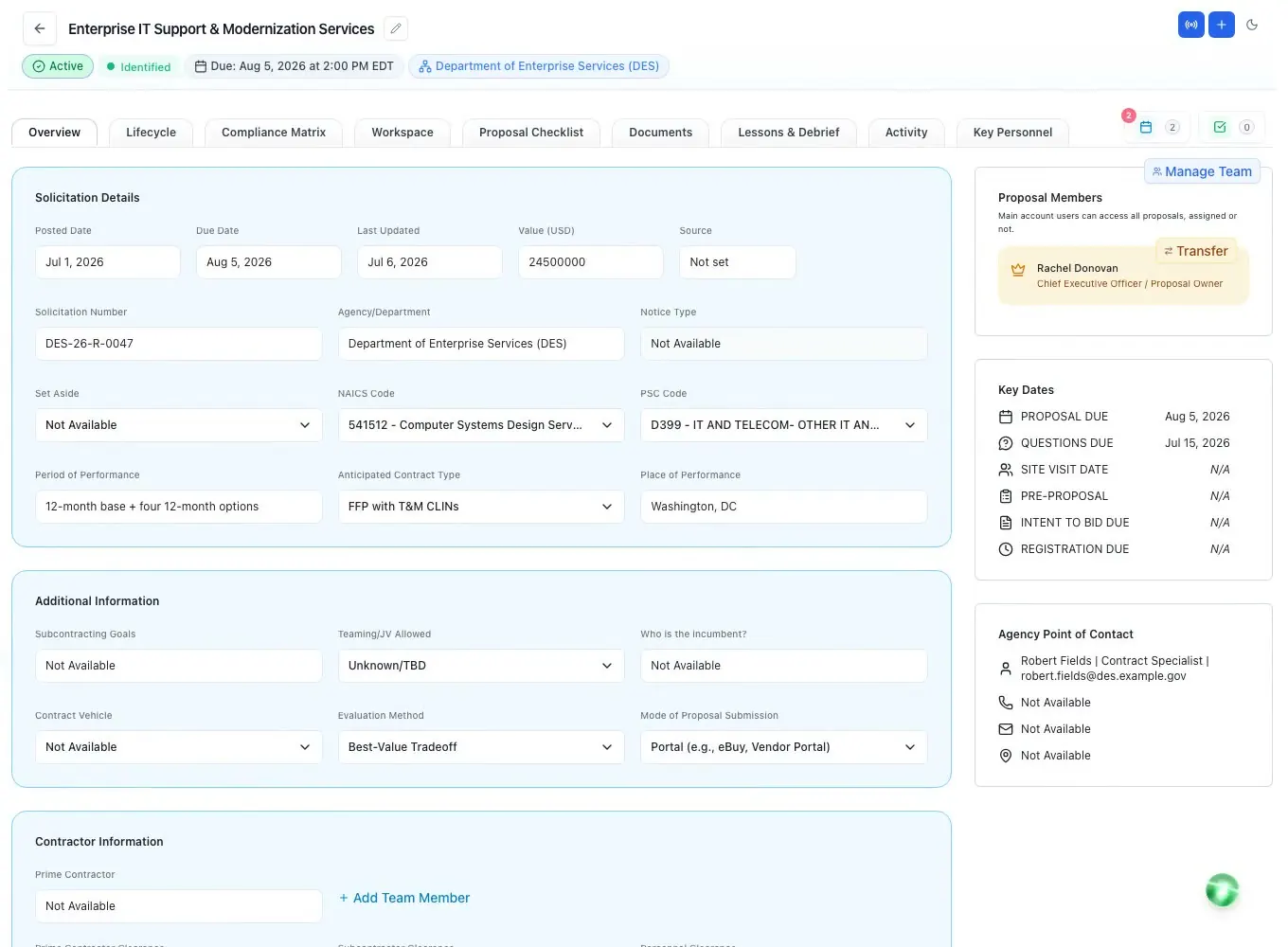
ProposalWorkspace tracks a notice from intake through capture intelligence to a drafted capability statement or RFI response, with the deadline on the calendar and the quiet-period ethics reminder from FAR 15.201 on every post-solicitation phase. When the solicitation drops, the pursuit graduates into a full proposal without re-entering anything.
Up next
Section L, Section M and Section C explained
Three sections of a federal RFP decide whether a proposal is even scored: Section L tells you how to write it, Section M tells you how it will be judged, and Section C tells you what the work is. Read them in the right order and the outline writes itself.
8 min
New proposal guides, by email
One email when we publish a new proposal guide for companies that bid to federal and state agencies, and the occasional product update. No drip campaigns, no sharing your address, unsubscribe with one click.
This guide is general information for federal contractors drawn from the FAR and standard capture and proposal practice. It is not legal advice; always read the specific solicitation and consult counsel on protests, contract terms and compliance questions.