What you will learn
- For negotiated procurements under
FAR Part 15, submit a written request within 3 days after the date you receive notice of award (FAR 15.506(a)(1)); for preaward exclusions, within 3 days of the notice of exclusion (FAR 15.505(a)(1)). - The agency should debrief you "to the maximum extent practicable, within 5 days" after receiving a timely request (
FAR 15.506(a)(2)). FAR 15.506(d)lists what you get: your significant weaknesses and deficiencies, the overall evaluated cost or price and technical rating of you and the winner, your past performance information, the overall ranking if any, and a summary of the award rationale.- For a required debriefing, the GAO protest clock runs from the debriefing date; a timely request preserves that timing and the right to a stay of performance.
- DoD enhanced debriefings (
DFARS 215.506-70) add written follow-up questions within 2 business days and agency answers within 5 business days; the protest clock starts after the answers.
Chapter 01of 071 min
What a debriefing is, and the two kinds
In a negotiated procurement under FAR Part 15, an offeror is entitled to a debriefing on request. There are two kinds. A preaward debriefing (FAR 15.505) is available to an offeror excluded from the competitive range or otherwise eliminated before award. A postaward debriefing (FAR 15.506) is available to every offeror, successful and unsuccessful, after award. Both exist to explain the government's evaluation of your proposal, not to reopen the competition.
Task orders under multiple-award contracts follow different rules: FAR 16.505(b)(6) requires a debriefing for orders exceeding a stated threshold, on the same 15.506 pattern. Commercial-item and simplified acquisitions may offer only a brief explanation of the basis for award (FAR 13.106-3(d)) rather than a full debriefing. Know which regime you are in before you write the request.
Chapter 02of 071 min
The clock: three days, then five
- 1
Day 0: you receive the notice
For a postaward debriefing the trigger is the date you receive notification of the award (
FAR 15.506(a)(1)); for preaward, the notice of exclusion (FAR 15.505(a)(1)). Record the date and the time the notice arrived, and the method. - 2
Within 3 days: submit a written request
Email the contracting officer, cite the solicitation number, state that you request a debriefing under FAR 15.506 (or 15.505), and ask for a written debriefing or an in-person or virtual meeting per your preference. Ask the contracting officer to acknowledge receipt. A request received after three days may be granted, but it is no longer required and it no longer preserves the protest timing.
- 3
About 5 days later: the debriefing
The agency should hold the debriefing, to the maximum extent practicable, within five days after receiving your timely request. If it is delayed at the agency's request, ask them to confirm in writing that the debriefing is the "required" one for timing purposes.
- 4
After the debriefing: the protest window
If you are considering a protest, the debriefing date matters. See the section on protests below, and talk to counsel before the debriefing, not after.
Chapter 03of 071 min
What the government must tell you, and what it will not
Required content of a postaward debriefing (FAR 15.506(d))
- Your evaluation
- The government's evaluation of the significant weaknesses or deficiencies in your proposal, if applicable.
- Comparative totals
- The overall evaluated cost or price (including unit prices) and technical rating, if applicable, of the successful offeror and of your own proposal, and your past performance information.
- Ranking
- The overall ranking of all offerors, when any ranking was developed during source selection.
- Rationale
- A summary of the rationale for award.
- Commercial items
- For acquisitions of commercial products, the make and model of the product to be delivered by the successful offeror.
- Questions
- Reasonable responses to relevant questions about whether source selection procedures in the solicitation, regulations and law were followed.
FAR 15.506(e) is just as important. The debriefing may not include point-by-point comparisons of your proposal with other offerors' proposals, and may not reveal trade secrets, privileged or confidential commercial information, or the names of individuals providing past performance references. Asking for a competitor's technical approach wastes your limited time; asking why a stated strength of yours was not scored as a strength does not.
Chapter 04of 071 min
Preparing for the debriefing
- 1Re-read Section M and your own Red Team findings. The weaknesses the government found are often ones your reviewers flagged and the team argued away.
- 2Prepare a written list of questions, ordered by importance, tied to specific factors and sections. Send the list ahead if the agency invites it.
- 3Decide who attends: the capture lead, the proposal manager, the technical lead, and, if a protest is possible, counsel. Keep the group small and disciplined.
- 4Assign one person to take verbatim notes. If the debriefing is in writing, read it twice before responding.
- 5Agree in advance that nobody will argue. The debriefing is for listening; disagreement belongs in a written follow-up or a protest, not in the room.
Chapter 05of 071 min
DoD enhanced debriefings
Under DFARS 215.506-70, for Department of Defense contract awards above stated thresholds, an offeror may submit additional written questions within two business days after receiving the postaward debriefing, and the agency must respond in writing within five business days. The debriefing is not considered concluded until the agency delivers its responses, which moves the start of the protest timing accordingly. Use the two days: the follow-up questions are your chance to pin down exactly which requirement each weakness relates to.
Chapter 06of 071 min
How the debriefing affects a protest
This guide is not legal advice, and the decision to protest should involve counsel. The timing rules, however, are worth knowing before the debriefing because they affect what you ask and when.
- A protest to the Government Accountability Office must generally be filed within 10 days after the basis of protest is known or should have been known; where a debriefing is requested and required, the protest must be filed within 10 days after the debriefing (
4 CFR 21.2(a)(2)). - To obtain an automatic stay of contract performance under the Competition in Contracting Act, the agency must receive notice of a GAO protest within 10 days after award, or within 5 days after a required debriefing, whichever is later (
FAR 33.104(c)). - A late debriefing request can forfeit the debriefing-based timing. This is the practical reason to request within three days even when you do not expect to protest.
- Agency-level protests (
FAR 33.103) and Court of Federal Claims actions have their own rules. Counsel will explain which forum fits the issue.
Chapter 07of 071 min
Turning the debrief into lessons
The debriefing is worth more as capture intelligence than as protest material. Within a week of the debriefing, while the notes are fresh, run a short lessons review with the people who wrote the proposal.
- 1
Record every weakness verbatim
Use the government's words. "The proposal did not demonstrate how the transition plan would achieve full operating capability within 45 days" is a lesson; "transition section was weak" is not.
- 2
Find the root cause for each
Was it a missing requirement (compliance matrix), a structure problem (outline), an evidence problem (past performance, resumes), a pricing problem, or a capture problem (customer knowledge)? Each root cause points at a different process fix.
- 3
Write the corrective action
One action per lesson with an owner: a change to the review checklist, a new question for future Q&A periods, a gap in the bench to recruit for, a pricing assumption to revisit.
- 4
Store the lessons where the next proposal will find them
A lesson filed in a debrief folder is forgotten by the next kickoff. Keep lessons in one library tagged by agency, factor and root cause, and review the relevant ones at every bid decision.
- 5
Compare with your bid decision
Pull the bid/no-bid worksheet. Where the debriefing contradicts a score you gave yourself, that factor is one your team overrates. That is the single most useful output of the whole exercise.
Debrief checklist
- Award or exclusion notice date and time recorded.
- Written debriefing request sent within 3 days, citing the FAR section, with acknowledgement requested.
- Question list prepared by factor; attendees and note-taker assigned.
- For DoD awards, follow-up questions submitted within 2 business days.
- Counsel consulted on protest timing before the debriefing if a protest is possible.
- Lessons recorded verbatim, root-caused, assigned and filed within a week.
Before you go
Questions people ask
- Should we request a debriefing even when we won?
- Yes. A successful offeror is entitled to one, and the government will tell you which of your strengths mattered and what weaknesses it still saw. That is the cheapest guidance you will get on the recompete.
- What if the agency refuses or delays the debriefing?
- If your request was timely, the debriefing is required; a delay at the agency's request does not cost you the timing benefits, but ask the contracting officer to confirm in writing. If the agency refuses outright, consult counsel promptly because protest deadlines may be running.
- Can we bring a lawyer to the debriefing?
- Generally yes, and agencies often have counsel present too. Tell the contracting officer in advance who will attend.
- Will the government tell us the winner's price?
- For a postaward debriefing under FAR 15.506(d)(2), you receive the overall evaluated cost or price of the successful offeror, including unit prices when applicable. You will not receive its cost breakdown or proprietary information.
- We received a "brief explanation" rather than a debriefing. Is that normal?
- It is for simplified acquisitions and some commercial-item buys, where FAR 13.106-3(d) requires only a brief explanation of the basis for award. Full debriefing rights apply to negotiated procurements under Part 15 and to larger task orders under FAR 16.505.
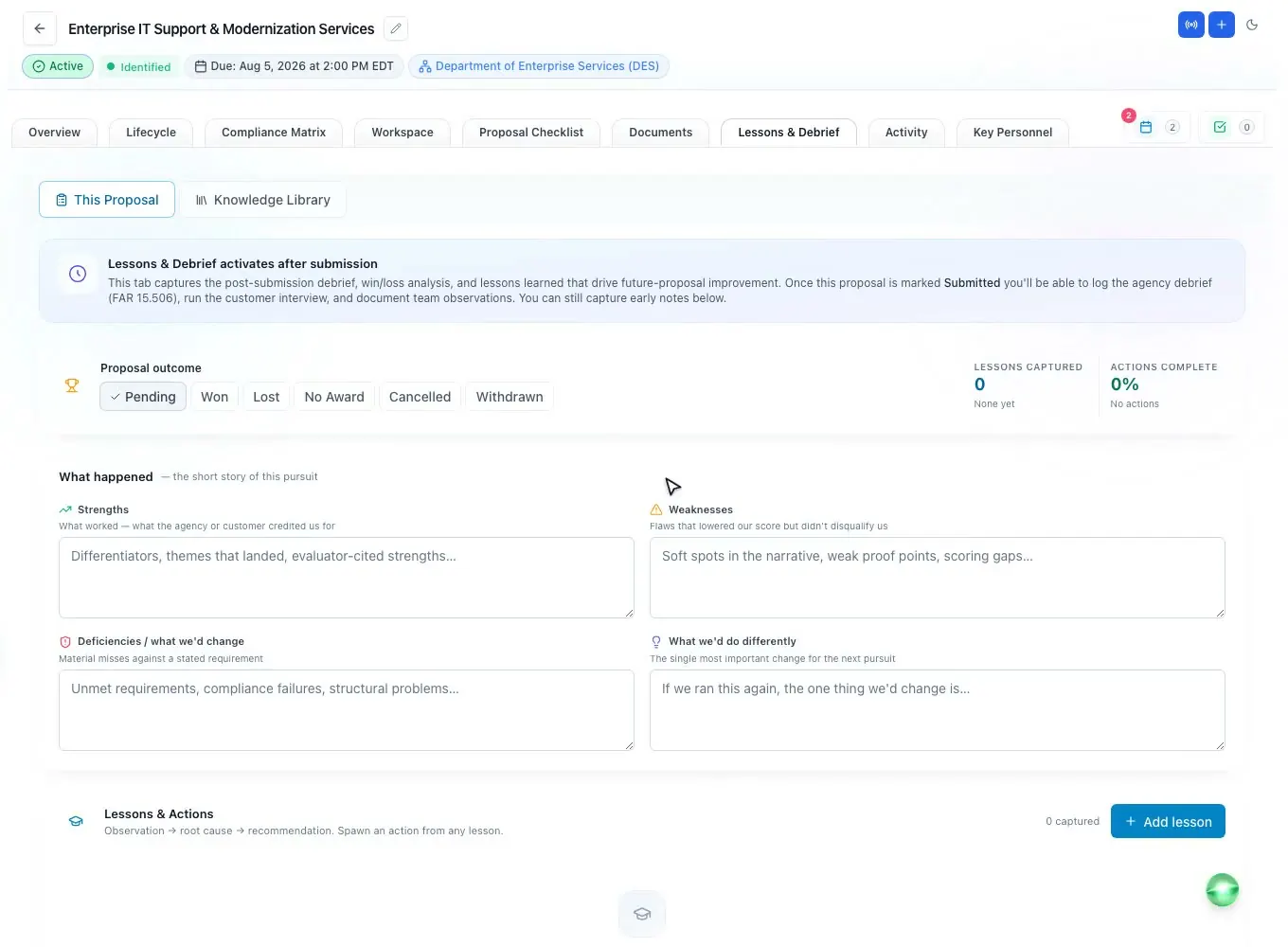
The Lessons and Debrief tab with a FAR 15.506 clock
ProposalWorkspace tracks the outcome, the debrief request deadline and the letter pipeline on each proposal, extracts discrete lessons from a written debrief with the observation, the likely root cause and a recommendation, and ranks past lessons for relevance when the next similar solicitation arrives.
Up next
SAM.gov registration explained: UEI, CAGE code and what to expect
You cannot be awarded a federal contract without an active SAM.gov registration, and you cannot get one in a day. This guide walks through the registration in the order it actually happens, what each step is for, the delays that catch new contractors, and the annual renewal that quietly lapses if nobody owns it.
7 min
New proposal guides, by email
One email when we publish a new proposal guide for companies that bid to federal and state agencies, and the occasional product update. No drip campaigns, no sharing your address, unsubscribe with one click.
This guide is general information for federal contractors drawn from the FAR and standard capture and proposal practice. It is not legal advice; always read the specific solicitation and consult counsel on protests, contract terms and compliance questions.