What you will learn
- Each color has one job: Blue checks strategy, Pink checks structure and coverage, Red scores the draft as the evaluator will, Gold approves the final, White checks production. Green reviews price.
- Reviewers review against the solicitation and the compliance matrix, not against their own preferences.
- Red Team reviewers must not have written the proposal, and must score using Section M's rating scheme.
- Schedule reviews backward from the submission date, with recovery time after each. A Red Team three days before submission is a rehearsal, not a review.
- Every finding becomes an assigned action with a due date. Findings without owners are not fixed.
Chapter 01of 061 min
The colors and what each one checks
The color team system comes from the Shipley-style proposal process most large federal contractors use, and small teams can run a scaled version of it. The names vary slightly between companies; the questions do not.
| Review | When | The one question | What the reviewers read |
|---|---|---|---|
| Blue Team | Before or at kickoff | Is our strategy right, and can we win? | Bid decision, win themes, competitor assessment, solution concept, price-to-win. |
| Pink Team | At about 30 to 40 percent of the schedule | Is the structure compliant, and is the story there? | Outline, storyboards or annotated headings, the compliance matrix, draft themes and graphics concepts. |
| Red Team | At about 70 to 80 percent | How would the evaluator score this draft? | The full draft, read against Section L and M, scored with the agency's rating scheme. |
| Green Team | In parallel with Red | Is the price competitive, compliant and consistent with the technical volume? | Price volume, basis of estimate, staffing versus the technical approach. |
| Gold Team | After Red Team recovery | Is this the proposal we are willing to sign? | The final draft, executive read, risk and commitments. |
| White Team (or White Glove) | Final days | Is it complete, compliant and ready to submit? | The production package: files, forms, signatures, page counts, naming, the submission method. |
Chapter 02of 061 min
Pink Team: structure before prose
Pink Team happens before most of the writing. The reviewers see the outline with page budgets, the compliance matrix with owners, and for each section a short statement of the approach, the win theme and the planned graphic. Some teams use storyboards; a well-annotated outline does the same job.
- Does every Section L item and Section M factor have a home in the outline?
- Does every mandatory row in the compliance matrix map to a section and an owner?
- Is the page budget proportional to Section M's weights?
- Does each section have a clear point and a theme that connects to the customer's hot buttons?
- Are the graphics planned, and does each one make a point the text cannot?
Findings from Pink Team are cheap to fix because nothing has been written yet. Structural findings after Red Team are the most expensive kind.
Chapter 03of 061 min
Red Team: score it as the evaluator will
- 1
Pick reviewers who did not write it
Independence is the point. Senior people who know the customer and the work, a compliance-minded reader, and where possible someone who has evaluated proposals for the government.
- 2
Give them the evaluator's materials
Section L, Section M, the PWS, the compliance matrix and a scoring sheet built on the agency's rating scheme (for example Outstanding to Unacceptable, with definitions of strength, weakness, significant weakness and deficiency).
- 3
Give them a complete draft
Red Team reviews a proposal, not a set of notes. Placeholders are allowed for resumes and forms; missing sections are not.
- 4
Review by factor, not by page
Assign each reviewer the sections that answer a Section M factor, exactly as the government assigns its evaluators. Ask for a rating, the strengths and weaknesses that justify it, and the specific fix for each weakness.
- 5
Debrief in one session
The proposal manager collects findings, removes duplicates, and turns each into an action with an owner and a date. Reviewers explain findings; writers do not defend the draft in the room.
- 6
Protect the recovery period
Red Team recovery is the most productive writing time of the whole schedule. Plan at least a week for it on a full proposal, and do not let new sections be added during it.
Factor 2, Section 2.3 Transition-In Plan. Rating: Marginal. Weakness: the plan states a 45-day transition but the staffing table on page 19 shows key personnel starting on day 30 with no knowledge-transfer activities before then, so the evaluator cannot see how the 45-day claim is met. Fix: add a week-by-week transition schedule (one graphic) showing incumbent knowledge capture in days 1 to 14, and align the staffing table. Owner: management volume lead. Due: Thursday.
Chapter 04of 061 min
Gold Team and the final checks
Gold Team is the executive read: the person who will sign the offer reads the final draft as a whole, confirms the commitments the company is making (key personnel, transition dates, service levels, price) and either approves it or sends specific items back. It is not a rewrite. If Gold Team is producing new content, the Red Team came too late.
White Team, sometimes called the White Glove review, is production quality control: the final files against Section L's submission instructions. It is a checklist, executed by people who have not been staring at the proposal for weeks.
White Team checklist
- Every volume present, named exactly as Section L requires, in the required file format.
- Page counts verified in the final PDF against each limit; excluded pages are the ones Section L excludes.
- Fonts, margins and line spacing match Section L, including in tables and figures.
- Cross-reference matrix regenerated against final page numbers.
- All forms signed and dated; every amendment acknowledged; reps and certs complete.
- Pricing in the price volume matches the staffing in the technical volume.
- Proprietary markings and the cover letter are correct; file sizes are under the portal limit.
- Submission method tested; a dry run uploaded or an email test sent a day early.
Chapter 05of 061 min
Scheduling the reviews
Set the review dates at kickoff, working backward from the submission date, and treat them as fixed. A typical 30-day schedule for a full proposal:
A 30-day plan
- Day 1
- Kickoff: outline, compliance matrix, assignments, review dates.
- Day 4
- Blue Team on strategy and themes, if not done before release.
- Day 10
- Pink Team on the annotated outline and matrix.
- Day 20
- Red Team on the complete draft; Green Team on price.
- Days 21 to 26
- Red Team recovery.
- Day 27
- Gold Team.
- Day 28
- White Team; final production.
- Day 29
- Submit, one day early.
Chapter 06of 061 min
Running it with a small team
A three-person company cannot field separate teams for each color, and it does not need to. Keep the questions and compress the roles: the owner runs Blue and Gold; an outside reviewer (a consultant, a trusted partner, a retired contracting professional) runs Red with the scoring sheet; the proposal manager runs Pink and White from the compliance matrix and the checklist. The discipline that matters is independence at Red Team and the recovery time after it.
Before you go
Questions people ask
- Do we need every color for a short proposal?
- No. For a ten-page task order response, a Pink Team on the outline, a Red Team on the draft and a White Team checklist are enough. Keep the three questions even when the reviews are an hour each.
- Who should sit on a Red Team?
- People who did not write the proposal, who know the customer and the work, and who will score honestly against Section M. One person with government evaluation experience is worth several senior managers.
- How should Red Team findings be scored?
- Use the agency's rating scheme from Section M or its source selection procedures. Each finding should name the factor, the rating it drives, the strength or weakness, and the fix. Vague comments such as "tighten this up" are not findings.
- What is a Green Team?
- The price review. It checks that the price is competitive, that the basis of estimate is sound, that the price volume is compliant with Section L, and that staffing and assumptions match the technical volume. It runs in parallel with Red Team so inconsistencies surface while both can still change.
- Can AI replace a Red Team?
- It can rehearse one. A tool that scores a section against its compliance row like an evaluator finds gaps earlier and cheaper. The human Red Team still decides whether the proposal will win, because that judgment needs knowledge of the customer and the competition.
Review milestones, tracked changes and an AI evaluator
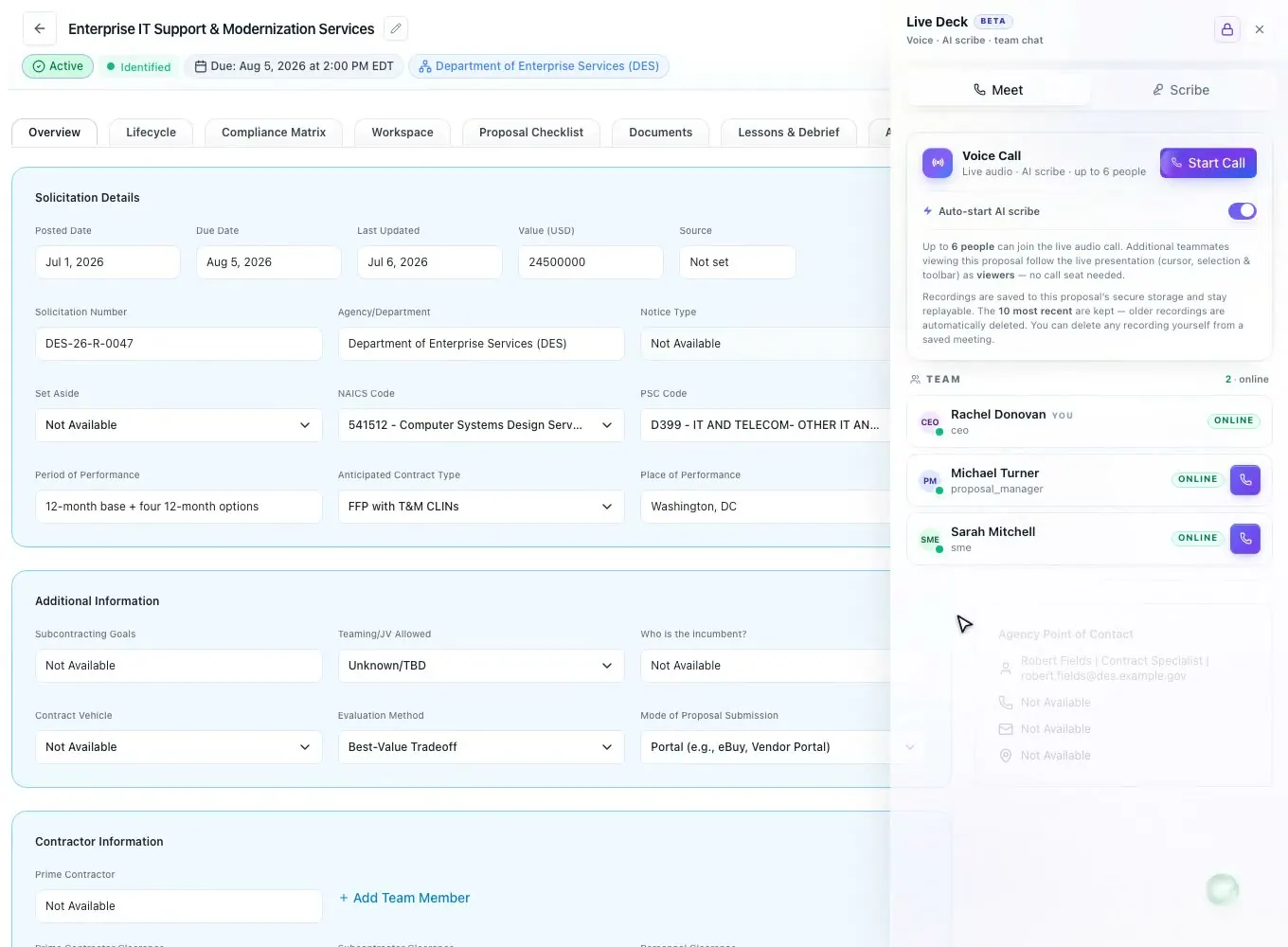
ProposalWorkspace puts Pink, Red, Gold and Final review milestones on the proposal calendar with reminders, keeps reviewer comments and tracked changes inside the editor, and can score a drafted section against its compliance row as a Source Selection Board evaluator would, so the team knows where the weaknesses are before the human reviewers sit down.
Up next
The proposal submission checklist: the last 48 hours
Proposals are lost in the last 48 hours more often than anyone admits: a page over the limit, an unsigned form, a portal that rejects a file, a deadline in the wrong time zone. This checklist is the routine experienced proposal managers run so that the final two days are production, not panic.
6 min
New proposal guides, by email
One email when we publish a new proposal guide for companies that bid to federal and state agencies, and the occasional product update. No drip campaigns, no sharing your address, unsubscribe with one click.
This guide is general information for federal contractors drawn from the FAR and standard capture and proposal practice. It is not legal advice; always read the specific solicitation and consult counsel on protests, contract terms and compliance questions.