What you will learn
- One page, five sections: core competencies, past performance, differentiators, company data and contact. Anything else is decoration.
- Write it for the reader's job. A contracting officer needs your NAICS codes, size status, UEI and CAGE in ten seconds; a program manager needs proof you have done this work before.
- Every differentiator must be verifiable: a certification number, a contract, a measured result. "Customer-focused" is not a differentiator.
- Keep a master version and tailor a copy to each Sources Sought notice, industry day or agency visit. The tailored version leads with the competencies that match that requirement.
- It is a PDF with your logo, not a Word document, and the file name carries your company name and the date.
Chapter 01of 061 min
What a capability statement is for
In federal and state contracting, a capability statement is the standard one-page introduction a company gives to a government buyer. Contracting officers ask for it during market research (FAR Part 10), small business specialists collect them to build source lists, program offices skim them at industry days, and primes request them from potential subcontractors. Its job is not to sell; it is to let a busy reader classify you correctly in under a minute and find you again later.
That reader is usually filling in a table: company name, size status, socio-economic categories, NAICS codes, what they do, whether they have done it before, and how to reach them. A capability statement that puts those facts where the reader expects them gets kept. One that buries them under a mission statement does not.
Chapter 02of 061 min
The five sections
What goes on the page, in reading order
- Header
- Company name and logo, one-line description of what you do ("Cybersecurity and IT service desk support for civilian agencies"), and the certifications you hold as small badges or a short line.
- Core competencies
- Three to six bullets describing the services you actually deliver, in the government's vocabulary. Each bullet is a capability, not an adjective: "Tier I and II service desk operations, 24x7, ITIL-aligned" rather than "world-class support".
- Past performance
- Three to five contracts: customer, contract number or vehicle, value, dates, and one line on what you did. Choose the ones closest to the work you are targeting. Include a point of contact where the customer allows it.
- Differentiators
- Two to four reasons you are the safer or better choice, each with proof: a clearance level, a certification (with number), a measurable result on a named contract, a unique tool or facility, a rare combination of experience.
- Company data
- UEI, CAGE code, DUNS if still requested, primary and secondary NAICS codes with size status, socio-economic certifications, contract vehicles held, accepted payment methods (government purchase card), and any bonding capacity if relevant.
- Contact
- One named person with title, phone, email and the company address and website. The person named must answer the phone.
Core competencies - 24x7 Tier I and Tier II service desk operations for 5,000 to 15,000 users (ITIL 4 aligned) - Network operations and monitoring for multi-site civilian agencies - Cybersecurity support: continuous monitoring, vulnerability management, ATO package preparation under NIST SP 800-53 - Transition-in of incumbent service desks within 45 days with staff retention above 80 percent
Chapter 03of 061 min
Differentiators that survive scrutiny
The differentiator section is where most capability statements fail. "Customer focus", "commitment to quality" and "experienced team" describe every company and therefore none. A differentiator is a fact about your company that a competitor cannot honestly copy and a reader can check.
| Weak | Strong |
|---|---|
| Experienced, certified staff | Twelve cleared engineers (Secret and above), eight holding CISSP, on staff today |
| Proven track record | Exceptional CPARS ratings on three consecutive years of a $4.8M DOI service desk contract |
| Commitment to quality | ISO 9001:2015 certified, certificate number on request; CMMI-DEV Maturity Level 3 appraised 2025 |
| Innovative solutions | Proprietary transition playbook that reached full operating capability in 45 days on the last two takeovers |
Chapter 04of 061 min
Format and length
- One page. Two-page statements are acceptable only when a specific request allows it. Most readers stop at page one.
- PDF, with your logo, readable in black and white, and under 2 MB so it passes email filters.
- Company name and date in the file name, for example
Acme-Systems-Capability-Statement-2026-09.pdf, so the reader can find it later in a folder of hundreds. - Scannable layout: short headings, bullets, and the company data block in a shaded box the eye can find at once.
- No pricing, no long narrative, no stock photos. Space is the scarce resource.
Chapter 05of 061 min
Master version, tailored copies
Keep one master capability statement that is current and complete, then create a tailored copy for each occasion: a Sources Sought response, an industry day, a meeting with a small business specialist, a teaming request from a prime. Tailoring means reordering, not rewriting. Lead with the competency that matches the requirement, choose the three past performances closest to it, and make the header's one-line description echo the notice's language.
- 1
Read the notice or know the office
Pull the NAICS, the scope and the vocabulary from the notice, or the office's recent awards if there is no notice.
- 2
Reorder the competencies
Put the matching competency first and phrase it in the notice's words. Drop competencies that are irrelevant to this reader; a shorter list of relevant capabilities reads stronger.
- 3
Swap the past performance
Choose the references closest in scope, size and customer type. If one reference is with the same agency, it goes first.
- 4
Check the company data
Confirm size status under the notice's NAICS and its size standard. Your status can differ by code.
- 5
Name the person who will follow up
The contact on a tailored statement should be the person who will attend the meeting or write the response, not a generic inbox.
Chapter 06of 061 min
Where the capability statement goes to work
- Sources Sought and RFI responses, where it is usually the first page of the response (see the Sources Sought guide).
- Agency small business offices (OSDBU or OSBP), which maintain vendor lists and forward statements to program offices.
- Industry days and matchmaking events, printed and as a PDF you can send the same afternoon.
- Prime contractors looking for small business subcontractors to meet subcontracting plan goals.
- Your SAM.gov registration and website, where buyers doing market research look first.
Before it goes out
- One page, PDF, company name and date in the file name.
- One-line description in the header says what you do in the buyer's words.
- Core competencies are capabilities, not adjectives.
- Past performance entries have customer, contract, value, dates and a result.
- Every differentiator has a proof a reader could check.
- UEI, CAGE, NAICS codes with size status, certifications and vehicles are correct today.
- The named contact will answer.
Before you go
Questions people ask
- Is a capability statement required to bid?
- No. It is a market research and introduction document. But contracting officers and small business specialists ask for it constantly, and a Sources Sought response without one is at a disadvantage.
- How is a capability statement different from a capabilities briefing?
- The statement is the one-page leave-behind. A capabilities briefing is the 15-to-30 minute presentation you give in an agency meeting. Build the briefing from the statement, not the other way around.
- Should we list every NAICS code we are registered under?
- List the primary code and the secondary codes where you have real past performance, with size status for each. A long list of codes with no supporting experience reads as a company that does not know what it sells.
- Can we include client logos?
- Only with permission. Federal agency seals generally may not be used to imply endorsement; name the agency in text instead. Commercial client logos need the client's consent.
- How often should it be updated?
- Review it quarterly and after any new contract, certification or key hire. An out-of-date capability statement that still lists an expired certification is worse than none.
Pre-award pursuits with a drafted capability statement
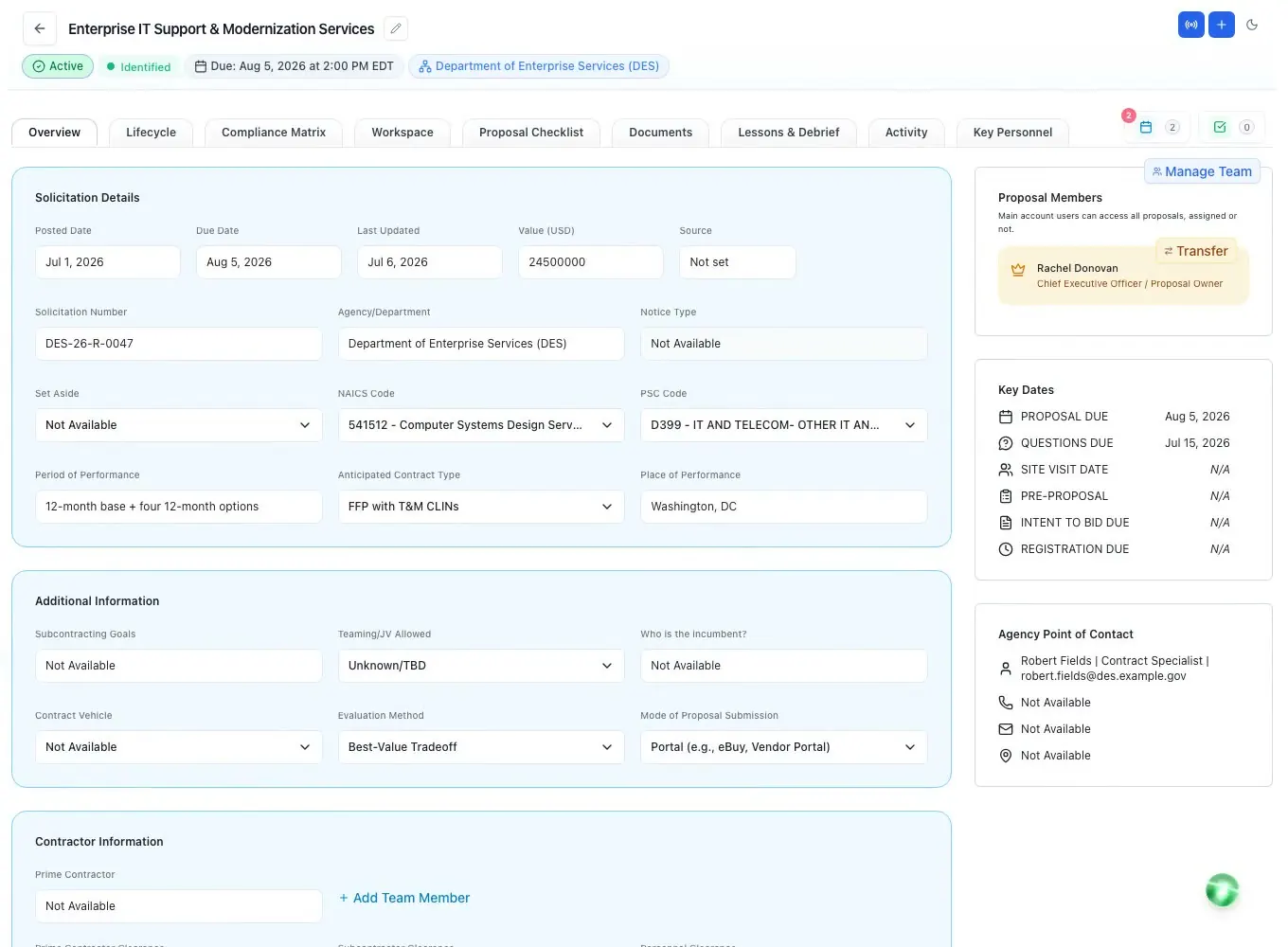
ProposalWorkspace tracks every Sources Sought and RFI from intake to a drafted capability statement or response, with the deadline on the calendar and your company profile, certifications, NAICS codes and past performance records already in the workspace, so each tailored version starts from the facts rather than from a blank page.
Up next
How to respond to a Sources Sought notice or RFI
A Sources Sought response is not a proposal, and it is not marketing. It is evidence that helps a contracting officer make a decision about competition. Written well, it can set the requirement aside for companies like yours before a single page of the RFP exists.
7 min
New proposal guides, by email
One email when we publish a new proposal guide for companies that bid to federal and state agencies, and the occasional product update. No drip campaigns, no sharing your address, unsubscribe with one click.
This guide is general information for federal contractors drawn from the FAR and standard capture and proposal practice. It is not legal advice; always read the specific solicitation and consult counsel on protests, contract terms and compliance questions.