What you will learn
- Find every key personnel requirement in Section L, Section M, the PWS and Section H. They are rarely all in one place.
- Each resume must prove each minimum qualification explicitly, with dates that let an evaluator compute years of experience.
- Follow the RFP's resume format and page limit exactly. When no format is given, use a consistent one that makes the qualifications table the first thing seen.
- A letter of commitment signed by the person is required by most solicitations for anyone not currently employed by you, and is wise for everyone proposed.
- Read the key personnel clause in Section H: substitution rules after award are contractual, and proposing someone you cannot deliver is a performance problem, not just a proposal problem.
Chapter 01of 061 min
What "key personnel" means in a federal contract
Key personnel are the positions the government considers essential to performance: typically a Program or Project Manager, technical leads, and specialist roles named in the solicitation. Two things distinguish them from the rest of your staffing plan. First, they are evaluated: Section M usually scores their qualifications and experience. Second, they are contractual: a key personnel clause in Section H (many agencies have their own; the DoD version is common) binds you to provide the named people and to obtain the contracting officer's approval before substituting them.
Chapter 02of 061 min
Finding the whole requirement
The key personnel requirement is scattered by design: Section L says what to submit, Section M says how it is scored, the PWS or a Section J attachment lists the positions and minimum qualifications, and Section H carries the clause. Build one table from all four before anyone opens a resume.
Where each piece lives
- Positions and minimum qualifications
- PWS, often a paragraph titled "Key Personnel" or "Personnel Qualifications", or a Section J attachment with labor category descriptions.
- What to submit
- Section L: resume format, page limit per resume, whether letters of commitment are required, and for whom (usually anyone not a current employee).
- How it is scored
- Section M: whether key personnel is a factor or a subfactor, whether it is scored on exceeding the minimums, and whether "contingent hire" status is penalized.
- Post-award obligations
- Section H key personnel clause: notice period for substitutions, approval rights, "equal or better" standard, and sometimes a minimum retention period after award.
- Security
- DD 254 and Section H: clearance level, whether the person must be cleared at proposal, at award or within a period, and citizenship requirements.
Position: Program Manager (key) Source: PWS 1.6.1, p. 9; Section L 4.4(b), p. 62; Section M Factor 3, p. 71 Minimums: Bachelor's degree; 10 years managing IT services contracts of similar size; PMP certification; Secret clearance at award Desired: Master's degree; ITIL v4; 5 years supporting this agency Resume format: 2 pages, agency template at Attachment J-7 Letter of commitment: required if not a current employee; must state availability within 30 days of award
Chapter 03of 061 min
Choosing the people
- 1
Screen the bench against the minimums first
Minimums are pass/fail. A brilliant candidate with nine years where ten are required is a deficiency. Screen every candidate against every minimum before anyone considers strengths.
- 2
Then score against the desired qualifications
Section M often awards strengths for exceeding minimums or holding the desired qualifications. Rank the candidates who pass the minimums by how many desireds they hold and how relevant their recent work is to this agency and this PWS.
- 3
Confirm availability and willingness in writing
Ask each candidate directly whether they will take the position on the proposed start date at the proposed location, and get it in writing. The letter of commitment formalizes this, but the conversation should happen before the letter is drafted.
- 4
Decide on contingent hires early
If you must propose someone who is not yet your employee, check whether Section M penalizes contingent hires, whether Section L requires a letter of commitment for them, and how the person's current employer (possibly the incumbent) affects the ethics of the approach. Never propose a person without their knowledge.
Chapter 04of 061 min
Writing the resume the evaluator needs
A proposal resume is not the person's career resume. It is a compliance document written to one solicitation. Its job is to make each required qualification findable in seconds and provable in a sentence.
- Use the RFP's format if one is given, field for field, in its order. If none is given, use a one-page qualifications table on top (requirement, how met, where in resume) followed by the narrative.
- State the qualification in the requirement's words. If the PWS says "10 years of experience managing IT service contracts", the resume says "11 years managing IT service contracts (2015 to present)" near the top.
- Give dates that let years be computed. Month and year for every position. Evaluators add them up; unclear dates get counted conservatively.
- Name the certification and its status. "PMP, Project Management Institute, active, certification number available on request." Expired certifications do not count.
- Lead each position with relevance to this PWS. A paragraph on a comparable contract with size, scope and results beats a list of duties.
- Cover clearances precisely. Level, investigation type and date where allowed, and whether it is active or current.
- Respect the page limit and the font instructions. Resumes over the limit are cut at the limit, often losing the very page with the certification.
Chapter 05of 061 min
Letters of commitment
A letter of commitment is a signed statement from the proposed individual that they will accept the position if the contract is awarded. Solicitations usually require one for every proposed key person who is not a current employee, and some require it for all key personnel. Even when optional, it is worth including: it answers the evaluator's quiet question about whether the person is real and available.
What the letter should contain
- Addressee
- Your company, on your letterhead or the person's, addressed to the proposal or the contracting officer if the RFP says so.
- Position and solicitation
- The exact position title from the PWS and the solicitation number.
- The commitment
- A clear statement that the person will accept the position and be available on or before the required date (many RFPs specify "within 30 days of award").
- Mandatory statements
- Anything Section L requires, such as acknowledging the location, the salary agreement, exclusivity, or that the person is not committed as key personnel on a competing offer.
- Signature and date
- The individual's signature and the date. Electronic signatures are generally accepted unless the RFP says otherwise.
I, [full name], commit to serve as Program Manager on the [Agency] [Program] contract, Solicitation No. [number], if it is awarded to [Company]. I confirm that I will be available to begin work at [location] within 30 days of contract award and that I have not committed to serve as key personnel on any other offer submitted under this solicitation.
Chapter 06of 061 min
What happens after award
The key personnel clause outlives the proposal. Typical terms: the contractor shall provide the named individuals; substitutions require advance written notice (often 15 to 30 days) and the contracting officer's approval; replacements must have qualifications equal to or better than the original; and some clauses forbid substitution for a period after award except for reasons beyond your control. Read the clause before you propose, because it defines the promise you are making.
- Keep the requirement table, the resumes and the letters in the contract file; substitution requests must show the replacement meets the same minimums.
- Brief proposed personnel on the clause so they understand the commitment period.
- If a proposed person becomes unavailable between submission and award, notify the contracting officer promptly and propose a qualified replacement. Silence is the worst option.
Key personnel package check
- Every position from the PWS, Section L, M and H is in the requirement table with its minimums and desireds.
- Each proposed person passes every minimum, with evidence quoted from their resume.
- Resumes follow the RFP format and page limit, with computable dates and named certifications.
- Letters of commitment are signed, dated, name the position and solicitation, and include every mandatory statement.
- Clearance level and status are verified with your security officer, not assumed from the resume.
- Each person has confirmed availability at the required location and start date.
Before you go
Questions people ask
- Can we propose someone who currently works for the incumbent?
- It is common and generally lawful, but handle it carefully: the person must agree knowingly, there must be no use of the incumbent's proprietary information, and some solicitations require a letter of commitment from such individuals. Have counsel review any non-compete concerns.
- What if we do not have a qualified person for a key position?
- Options are to recruit a contingent hire with a signed letter of commitment, to team with a partner who has the person, or to no-bid. Proposing an unqualified person is not an option; it is a deficiency that can make the proposal unawardable.
- Do resumes count against the technical volume page limit?
- Only if Section L says so. Many solicitations exclude resumes from the page count but set a per-resume limit instead. When Section L is silent, ask during the Q&A period.
- Is a letter of intent the same as a letter of commitment?
- Not quite. A letter of intent expresses interest; a letter of commitment states the person will accept the position if awarded. Solicitations that ask for commitment letters expect the stronger form.
- How do evaluators treat "years of experience" when the resume has overlapping jobs?
- Conservatively. Overlapping periods are counted once, and gaps are not filled in. State the total in the requirement's words at the top of the resume and make sure the dated positions add up to it.
Key personnel from bench to submission-ready package
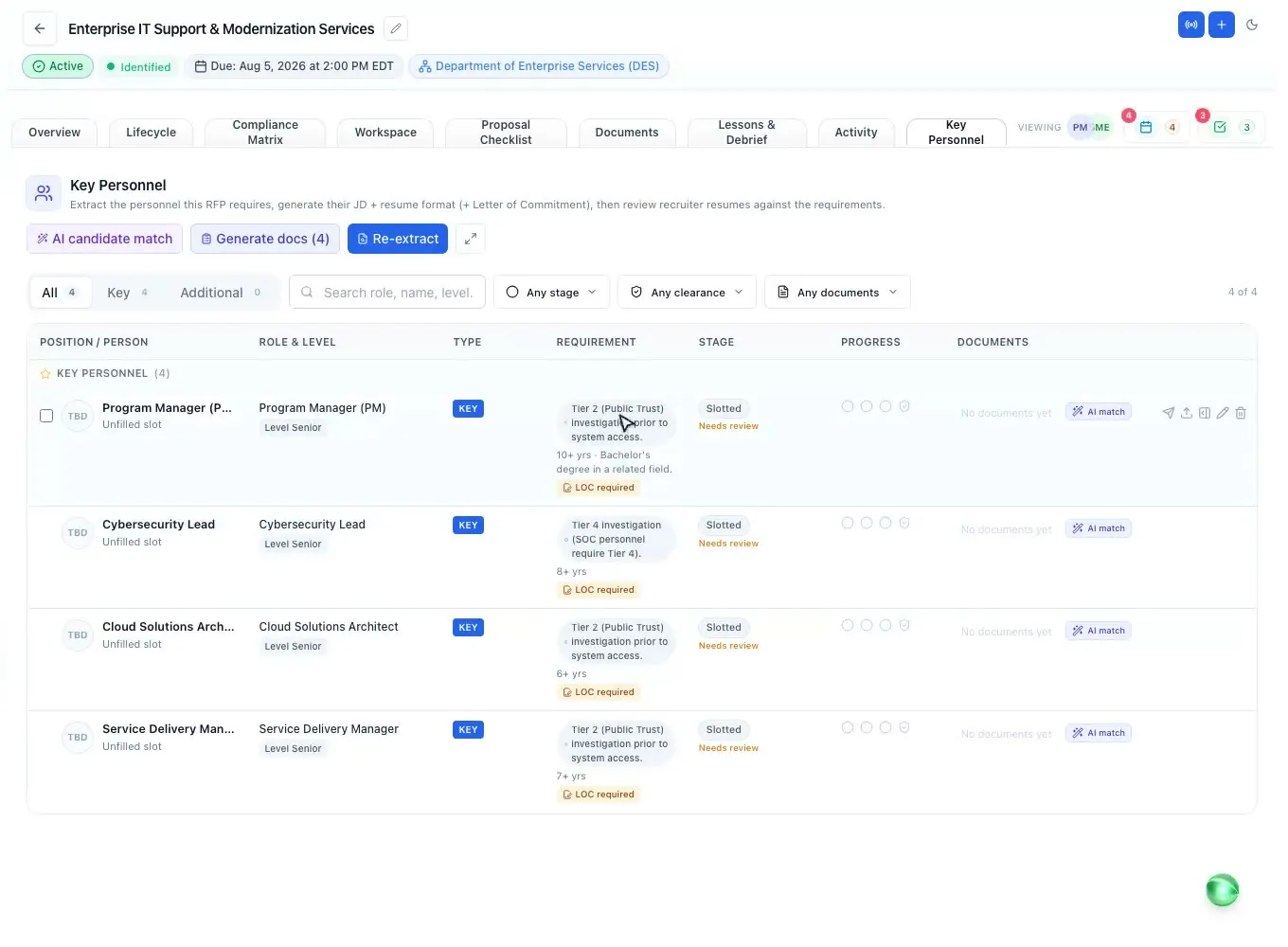
ProposalWorkspace extracts the RFP's required positions with their minimum qualifications, ranks your bench against them with evidence from each person's current resume, reviews a resume against the job description line by line, generates recruiter-ready job descriptions and letter of commitment formats, and checks a signed letter against the RFP's mandatory statements before it ships.
Up next
Past performance write-ups that score: recency, relevance and quality
Past performance is the one evaluation factor where the government checks your claims against its own records. Choose references that match the solicitation's definition of relevant, write each one so the evaluator can verify it, and manage the questionnaires like a deliverable.
6 min
New proposal guides, by email
One email when we publish a new proposal guide for companies that bid to federal and state agencies, and the occasional product update. No drip campaigns, no sharing your address, unsubscribe with one click.
This guide is general information for federal contractors drawn from the FAR and standard capture and proposal practice. It is not legal advice; always read the specific solicitation and consult counsel on protests, contract terms and compliance questions.