What you will learn
- Evaluators score against Section M: understanding, soundness, feasibility and risk. Write to those words, not to "what we do".
- Each scored section follows one pattern: claim, method, proof, result. The first sentence is the claim; the last is the measurable result.
- Restating the PWS earns nothing. Showing what is hard about the PWS and how you handle it earns strengths.
- Name risks and mitigate them. A section with no risks reads as a section that did not understand the work.
- Graphics carry themes and complex approaches; every graphic needs an action caption that states the point.
Chapter 01of 061 min
How the technical approach is scored
Section M tells you the words. Most technical factors are evaluated for some combination of understanding of the requirement, the soundness or merit of the approach, its feasibility and the risk it presents. Agencies convert those into adjectival ratings by counting strengths, weaknesses, significant weaknesses and deficiencies. A strength is an aspect of the proposal that exceeds requirements in a way that benefits the government; a weakness is a flaw that increases the risk of unsuccessful performance; a deficiency is a failure to meet a requirement.
That definition should shape every paragraph. Evaluators are not scoring how impressive your company is; they are looking for specific, verifiable aspects of your approach that will make performance more likely to succeed. Give them those aspects, labeled, with proof, and they will record them as strengths. Give them descriptions of your company and they will record nothing.
Chapter 02of 061 min
The pattern for every scored section
- 1
Claim: answer the factor in the first sentence
"We will operate the service desk 24x7 from our existing cleared facility with a 4.2 FTE per shift model that meets the 85 percent first-contact resolution standard in PWS 3.2.2." The evaluator now knows the section addresses the requirement and what the approach is.
- 2
Method: how, specifically
The steps, tools, standards and people. Specific enough that a reader could tell the difference between your approach and a generic one. Numbers, names of tools, named standards (ITIL 4, NIST SP 800-53), staffing models, schedules.
- 3
Proof: why the evaluator should believe it
The contract where you did this before, the measured result, the certification, the named person. Proof is what converts a claim into a strength.
- 4
Result: what the customer gets
The measurable outcome in the customer's terms, tied to the PWS standard or the evaluation factor: "which sustains the 85 percent standard from day one and, on the referenced contract, reached 92 percent within six months."
2.2 Task 3.2 - Network Operations We will monitor and manage the agency's 40-site network from our existing NOC using the same SolarWinds and ServiceNow toolset the agency already licenses, meeting the 99.9 percent availability standard in PWS 3.2.4. [claim] Our NOC runs three shifts of two network engineers each, with automated alerting mapped to the PWS priority levels, a 15-minute acknowledgement target for Priority 1 events, and a monthly capacity review with the COR. [method] The same model has run the Department of the Interior bureau network (38 sites, contract 140D0421F0123) since 2022 with availability above 99.95 percent in every reported month and Exceptional CPARS for Quality. [proof] The agency gains a network operation that meets its availability standard on day one and a monthly capacity review that has prevented every outage of the kind the PWS cites as its principal risk. [result]
Chapter 03of 061 min
Showing understanding without restating the PWS
The most common weakness in technical volumes is the paraphrase: a section that restates the PWS paragraph in slightly different words and calls it understanding. Evaluators wrote the PWS; they do not need it back. Understanding is shown by naming what is hard, what is at stake and what the environment implies.
- Name the difficulty. "The transition overlaps the fiscal year-end freeze, so cutover must complete before 15 September or wait until October."
- Name the consequence. "A missed availability month under this PWS triggers the deduction schedule in Section H.12; our capacity review exists to prevent that."
- Name the environment. The agency's tools, sites, user population, legacy systems, mandates and prior contract history. Show you know where the work happens.
- Name the interfaces. Who you depend on (the agency's security office, another contractor, a data center) and how you will manage that dependency.
Chapter 04of 061 min
Risks and mitigations
Section M often evaluates risk explicitly, and even when it does not, evaluators assess it. A technical approach that identifies no risks is not reassuring; it signals that the offeror has not thought about performance. Identify the three to six real risks of this work, say how likely and how serious each is, and give the specific mitigation, with an owner. A short risk table at the end of the technical approach is standard and effective.
| Risk | Likelihood | Mitigation |
|---|---|---|
| Incumbent staff decline to transition | Medium | Retention offers extended in week one; two cleared engineers on our bench identified for each critical role (Appendix A). |
| Clearance processing delays new hires | Medium | All proposed key personnel hold active Secret clearances; contingent hires are cleared at proposal. |
| Legacy monitoring tool end-of-life in option year 2 | Low | Migration plan to the agency's enterprise toolset scheduled in year 1 at no additional cost. |
Chapter 05of 061 min
Graphics that score
A graphic earns its page space when it makes a point the text cannot make as fast: a process with hand-offs, an architecture, a schedule, an organization. It wastes space when it decorates. Every graphic needs an action caption, a full sentence that states the point ("Figure 2. Our three-shift NOC model provides continuous coverage with no single point of failure at shift change"), because evaluators read captions even when they skip figures. Keep graphics legible in black and white, count them against the page limit, and reference each one in the text.
Chapter 06of 061 min
Writing habits that earn strengths
- Active voice, present or future tense, named subject. "Our NOC engineers acknowledge Priority 1 alerts within 15 minutes" beats "alerts will be acknowledged".
- Numbers over adjectives. Every "robust", "comprehensive" and "seamless" is a missed number.
- One idea per paragraph, the idea in the first sentence. Evaluators skim; the first sentence is what they read.
- The customer's vocabulary. Use the PWS's terms for tasks, deliverables and roles. Renaming them costs the evaluator effort and can read as misunderstanding.
- Tie to the requirement. Reference the PWS paragraph you are answering; a cross-reference matrix helps, but an in-text reference is what the evaluator sees while scoring.
- Cut what does not score. Company history, mission statements and generic quality philosophy belong nowhere in a page-limited technical volume.
Section review, before Red Team
- First sentence answers the evaluation factor and the PWS requirement.
- Method is specific: tools, standards, numbers, people, schedule.
- At least one proof per section: a contract, a rating, a result with a date, a named person.
- Result stated in the customer's terms and tied to a PWS standard.
- What is hard about the work is named, with how you handle it.
- Risks identified with mitigations and owners.
- Every graphic has an action caption and is referenced in the text.
- No paragraph restates the PWS; no adjective stands where a number could.
Before you go
Questions people ask
- How long should the technical approach be?
- As long as Section L allows, allocated by Section M weight. If Technical Approach is the most important factor, it should hold the most pages, and every page should carry a strength or an answer to a requirement.
- Should we propose more than the PWS requires?
- Only where Section M rewards it and the cost is consistent with your price. In a best value tradeoff, a targeted exceedance that clearly benefits the government can be a strength; in an LPTA evaluation, extras earn nothing and can raise your price.
- How do we write a technical approach for work we have not done at this scale?
- Show understanding of the scale honestly, break the work into parts you have done, prove each part with past performance, and address the scale-up as a named risk with a credible mitigation. Evaluators respect a clear-eyed approach more than a claim of experience they cannot verify.
- Where does the staffing plan go?
- Wherever Section L puts it, usually the management volume. The technical approach should reference the staffing model where it affects feasibility, and the numbers must match across volumes.
- Can AI write the technical approach?
- It can draft structure, enforce the pattern and check compliance quickly, and it is good at removing filler. The claims, methods and proofs have to be yours, because they will be evaluated, verified and then performed.
An editor with federal-proposal presets and an evaluator that scores the draft
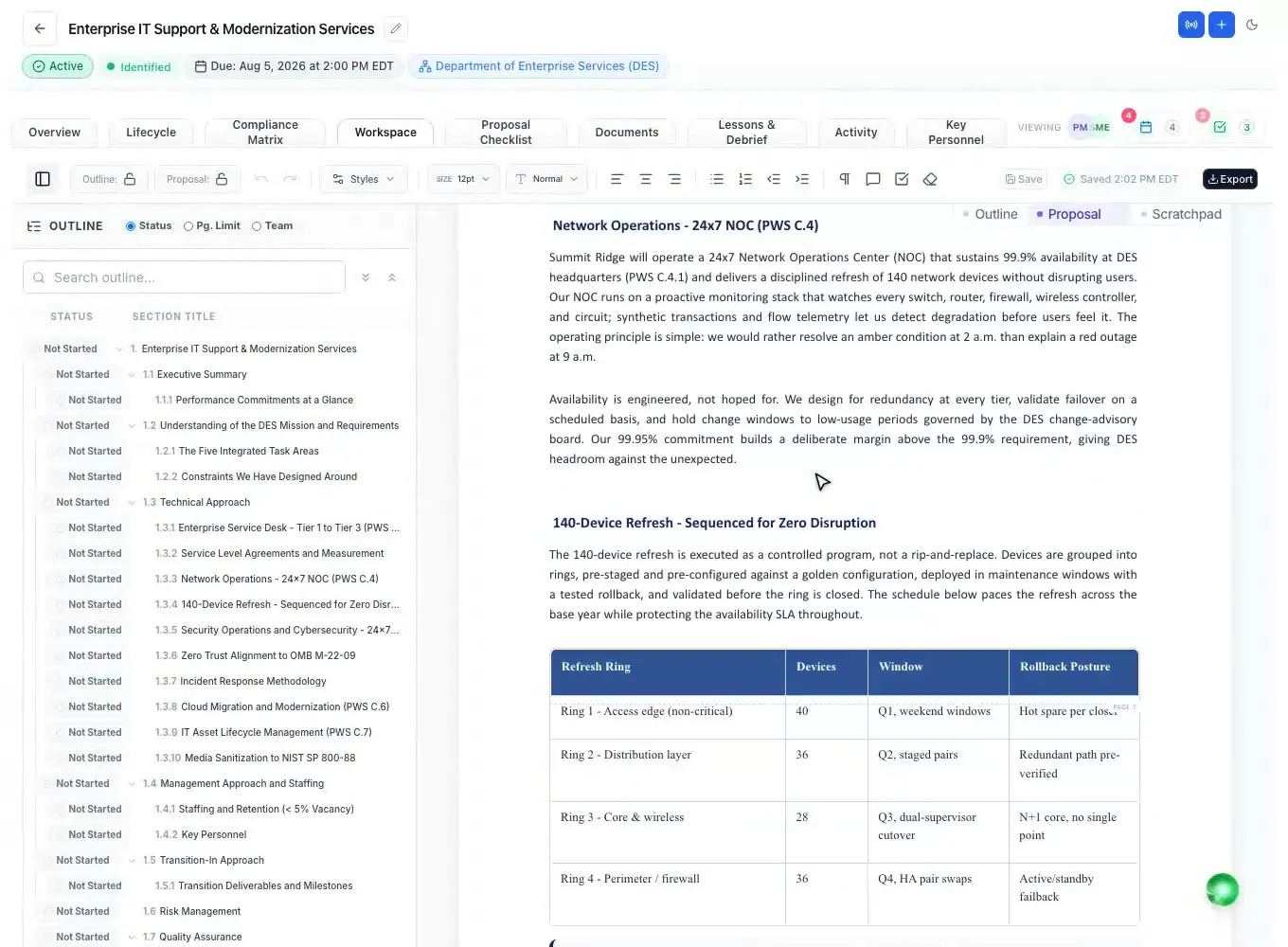
ProposalWorkspace's editor carries the generated outline with writer guidance under every heading, offers Ask-AI presets built for federal proposals (verify Section L and M compliance, active voice, remove weasel words, tighten to a page limit), lands AI edits as tracked suggestions you accept or reject, and can score a drafted section against its compliance row as a Source Selection Board evaluator would.
Up next
Key personnel resumes and letters of commitment for federal proposals
Key personnel are the people the government is really buying. Evaluators check each resume against a list of minimum qualifications, and a single unqualified name can sink an otherwise strong proposal. This guide covers how to find the requirement, prove the match and commit the people.
8 min
New proposal guides, by email
One email when we publish a new proposal guide for companies that bid to federal and state agencies, and the occasional product update. No drip campaigns, no sharing your address, unsubscribe with one click.
This guide is general information for federal contractors drawn from the FAR and standard capture and proposal practice. It is not legal advice; always read the specific solicitation and consult counsel on protests, contract terms and compliance questions.