Compliance matrix
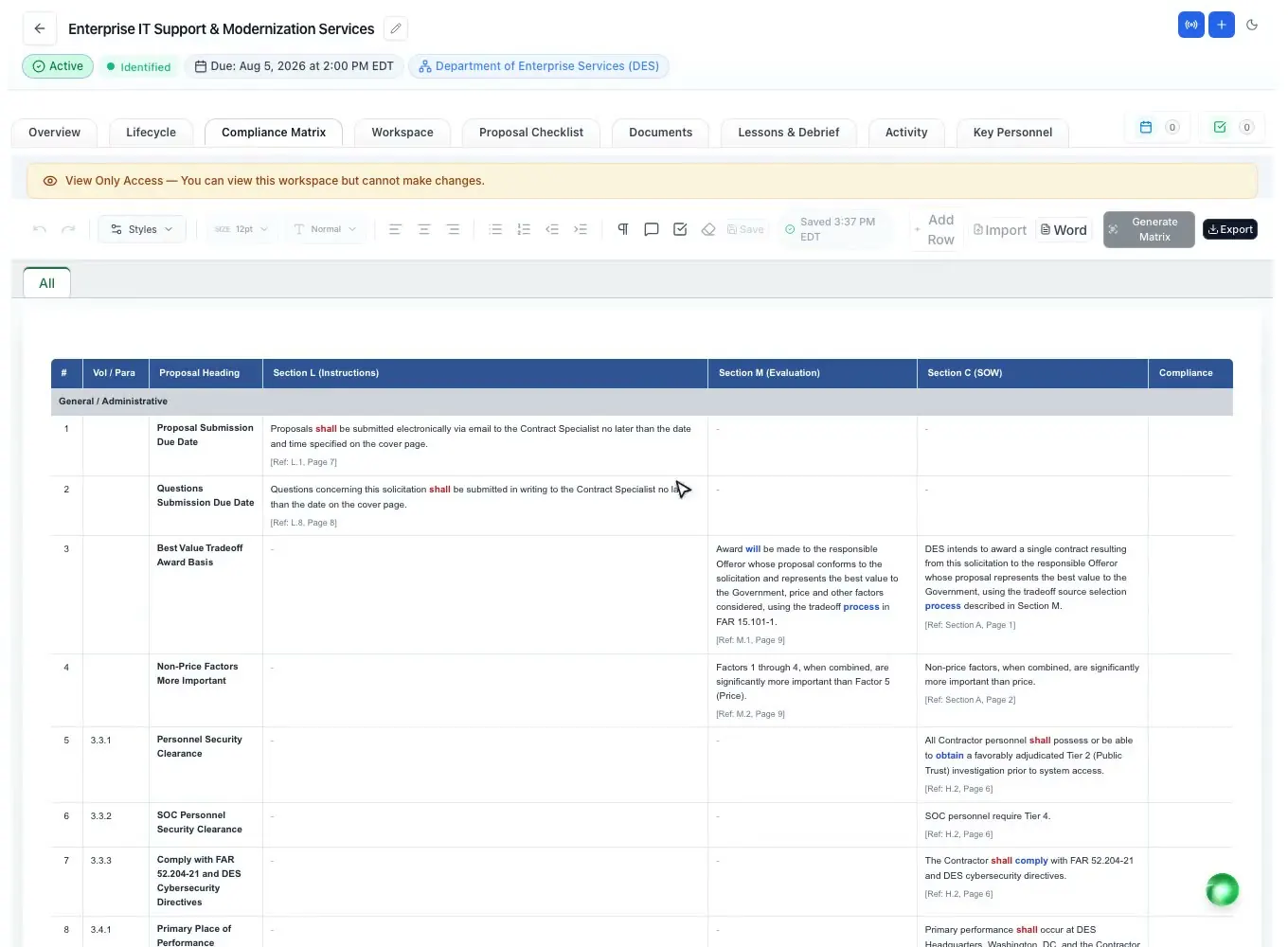
Section L, M and C as rows with a page reference, an owner and a compliance call.
Read moreProposal sample
Updated
This government contract proposal sample walks through short excerpts from a made-up response to a made-up RFP: a cover letter, an executive summary, a technical approach, a staffing plan and a past performance write-up. After each excerpt, plain notes explain why it would score with evaluators, so you can apply the same habits to your own federal, state or local proposal.
Every feature on every plan, from $99 a month billed yearly.
Read this first
Every excerpt on this page answers one invented solicitation. The Department of Example Services is a made-up federal agency, and so is its RFP for IT service desk support: a single-award contract for a help desk that answers about the same calls every month, with a base year and option years. The offeror, Northwind Service Partners, is also made up. No real agency, company, contract or person is described.
Like most federal RFPs written in the uniform contract format, the made-up solicitation tells offerors how to write the proposal in Section L and how it will be scored in Section M, with the work itself in a performance work statement (FAR 15.204-1; 15.109 in the FAR overhaul text). A real proposal answers the real RFP in front of you, in its order and with its words; a sample only shows the habits.
The table below lists the invented instructions and factors the excerpts answer. Keep it in mind as you read: the strongest sample proposals for government contracts are the ones you can trace back to the solicitation line by line.
| Excerpt | Invented Section L instruction | Invented Section M factor |
|---|---|---|
| Cover letter | L.2: a cover letter of no more than two pages, signed by a person authorized to bind the offeror | Not scored; checked for compliance |
| Executive summary | L.4.1: summarize the approach and the benefits to the agency | Factor 1, Technical Approach (summary read first) |
| Technical approach | L.4.2: describe how calls are answered, routed and resolved, including after-hours coverage | Factor 1, Technical Approach: soundness and risk |
| Staffing plan | L.4.3: describe the staffing approach, key personnel and how vacancies are filled | Factor 2, Management and Staffing |
| Past performance | L.5: up to three recent, relevant contracts | Factor 3, Past Performance: recency, relevance and quality |
Excerpts 1 and 2
Cover letter excerpt (fictional): "Northwind Service Partners is pleased to submit this proposal in response to Solicitation EX-0001 for IT Service Desk Support. We acknowledge Amendments 0001 and 0002. Our offer is valid for 120 days from the closing date, as required by the solicitation. Our President, who signs this letter, is authorized to bind the company and is the point of contact for this offer."
Why it works: it names the solicitation and every amendment, restates the offer validity period the RFP asked for, and identifies who can bind the company. A cover letter is rarely scored, but a missing amendment acknowledgment or an unsigned letter can make an offer noncompliant. It also stays short: the place to sell is the volume that evaluators score.
Executive summary excerpt (fictional): "The Department needs a service desk that resolves most issues on the first call and keeps users working after hours. Northwind's approach answers that need in three ways: a single queue staffed by tier 1 and tier 2 analysts on every shift, a knowledge base written from the Department's own most common tickets, and a monthly review with the Contracting Officer's Representative of every ticket that was reopened. On a comparable help desk we run today (Past Performance, Reference 1), the monthly review of reopened tickets is already part of the contract, and the customer's reports show the trend."
Why it works: it starts with the agency's need, not the company's history, then maps three features to that need and backs the claim with a reference the evaluator can check in another volume. The proof points to the offeror's own reference, not to a general claim about the industry. Write your executive summary last, once the rest of the proposal has settled what you can prove.
Excerpt 3
Technical approach excerpt (fictional), answering L.4.2: "Answering calls. Every call, chat and email enters one queue. Tier 1 analysts answer within the time the PWS sets and resolve password, access and device issues on first contact using the knowledge base. Routing. Issues tier 1 cannot resolve within 15 minutes move to tier 2 with the notes attached, so the user never repeats the problem. Resolving. Tier 2 closes the ticket or escalates to the Department's system owners with a documented hand-off. After-hours coverage. Two analysts cover nights and weekends from the same queue; an on-call tier 2 lead is reachable by phone at all times."
Why it works: the instruction asked about answering, routing, resolving and after-hours coverage, so the excerpt uses those four words as its lead-ins, in that order. An evaluator scoring evaluation factors against a checklist finds each answer where the instruction says it should be. It describes how the work happens, step by step, instead of promising that it will be excellent.
It also handles risk, which the invented factor names: the hand-off notes remove the most common failure in a tiered help desk, the user explaining the same issue twice. A strength in an evaluation usually comes from a specific feature like this with a clear benefit, not from adjectives. For more on writing this volume, see how to write the technical approach.
| L.4.2 asks about | Where the excerpt answers it | What the evaluator can score |
|---|---|---|
| Answering calls | "Answering calls" lead-in | One queue; first-contact resolution with a knowledge base |
| Routing | "Routing" lead-in | A time trigger for escalation; notes travel with the ticket |
| Resolving | "Resolving" lead-in | A documented hand-off to system owners |
| After-hours coverage | "After-hours coverage" lead-in | Named night and weekend staffing, an on-call lead |
Excerpts 4 and 5
Staffing excerpt (fictional), answering L.4.3: "The Project Manager, a key personnel position, has run two help desks of similar size and holds the certification the PWS requires; a signed letter of commitment is in Attachment C. Analysts are hired from a bench of pre-screened candidates, so a vacancy is filled within ten business days, and a cross-trained analyst covers the shift in the meantime."
Why it works: it answers the three parts of the instruction (approach, key personnel, vacancies), points to proof (the letter of commitment and the resume) and commits to a measurable vacancy time the agency can hold the contractor to. Only commit to a number you can meet: a promise in the proposal can become a contract term.
Past performance excerpt (fictional), answering L.5: "Reference 1: Service desk support, a fictional state university system, 2024 to present, prime contractor. Scope: a 24-hour help desk for staff and students, similar in volume to the Department's. Relevance: the same tiers, the same after-hours model and the same ticketing approach proposed here. Results: fewer reopened tickets each quarter, as shown in the customer's monthly reviews, which are available on request. Contact: the customer's contract officer, available on request."
Why it works: past performance is judged on recency, relevance and quality, so the write-up states each one directly instead of leaving the evaluator to infer it. It ties the old contract to this RFP's scope in one sentence and offers a reachable contact. Federal evaluators often also check government ratings such as CPARS, so the write-up should never contradict the official record. More examples of the pattern: past performance write-ups.
What not to copy
The biggest mistake is copying the sample's structure instead of the RFP's. Every solicitation sets its own volumes, order, headings and page limits; a proposal that follows a sample instead of Section L is harder to evaluate and can lose points or be found noncompliant. Use samples to learn habits, then build the outline from the RFP in front of you (see the proposal outline template for a starting shape that the RFP always overrides).
The second is generic text. Evaluators read many proposals for the same contract, and a paragraph that could be pasted into any bid scores as a statement of intent, not a strength. Replace every general claim with something specific to this agency: its users, its systems, its stated problems, your proof.
The third is borrowing claims you cannot support. A sample may cite results, certifications or people you do not have; anything you put in a proposal must be true for your company, and a promise can end up in the contract. Other common losses: missing an amendment, exceeding a page limit, answering a "shall" only partly, and submitting late. A late proposal is generally not considered under FAR 15.208.
Beyond federal
State, county, city and school district RFPs do not use the federal Section L and M labels. Instructions and scoring criteria are usually in sections named something like "Proposal Submission Requirements" and "Evaluation Criteria," often with points per criterion. The same habits apply: answer in the order the RFP asks, use its words, and show proof for every claim.
Local bids often add forms that federal proposals do not have: notarized affidavits, a signed price form, a bid bond on construction work, local business or vendor registration, and sometimes a hard copy delivered to an office. A sample from one jurisdiction rarely matches another's forms, so read the checklist in your RFP first.
Past performance in a local bid is often a short list of references with contacts, sometimes on the agency's own form. Keep the same discipline as the federal write-up above: recency, relevance and results in a few lines each. For finding these bids, see state and local proposal software.
In ProposalWorkspace
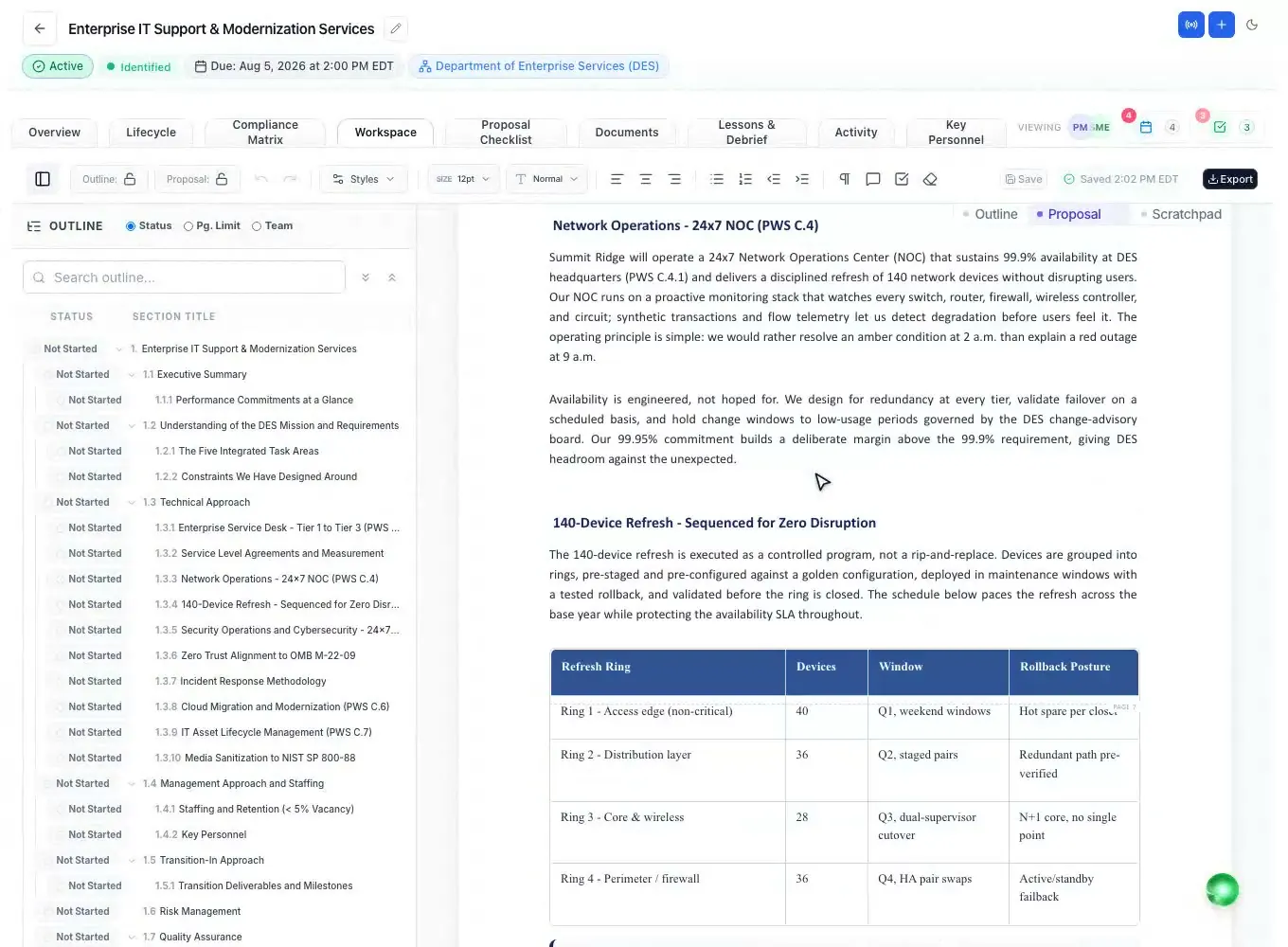
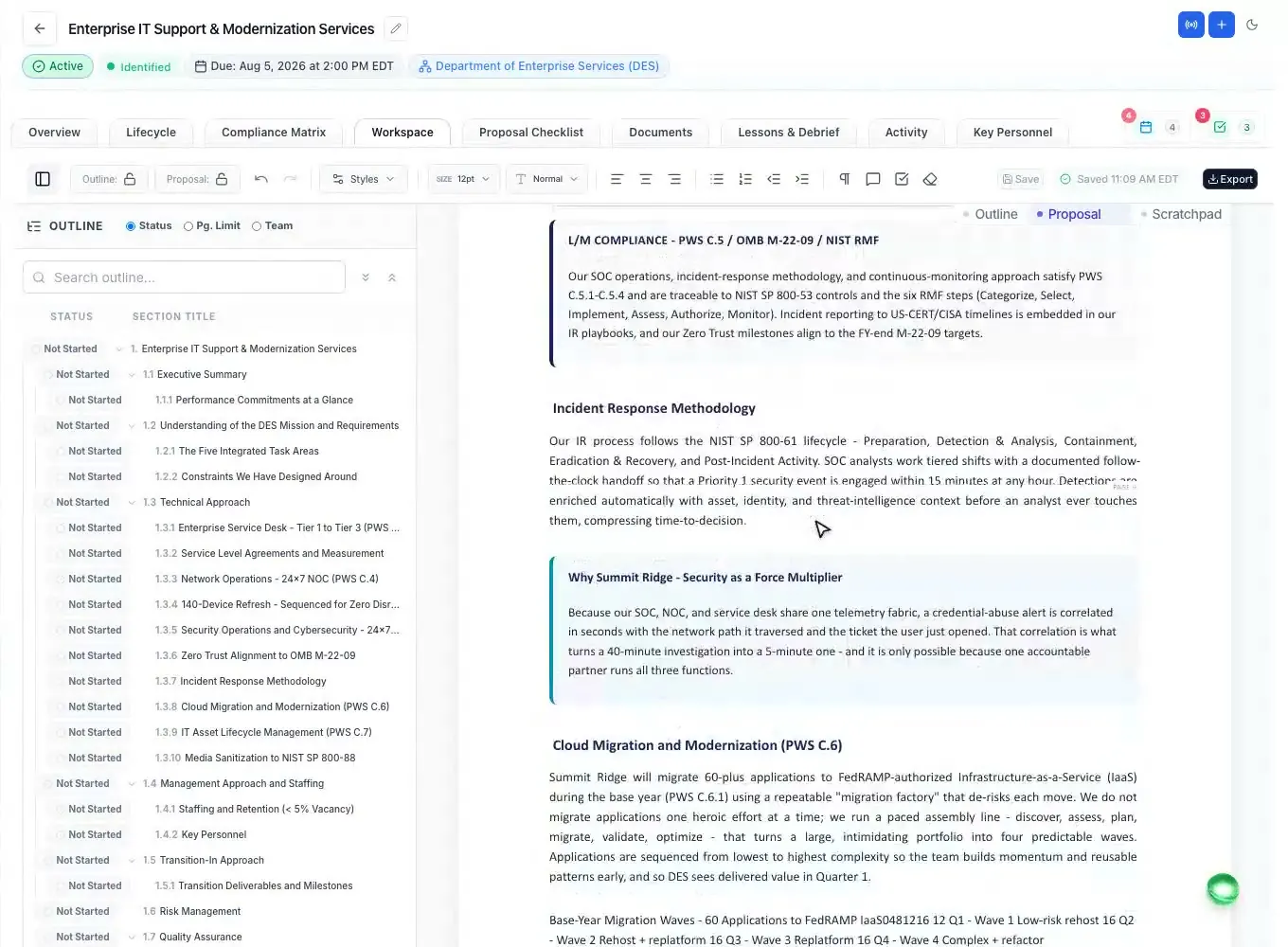
A sample shows the habits; your proposal has to answer your RFP. In ProposalWorkspace the built-in AI reads the solicitation with page citations, builds the Section L, M and C compliance matrix and an outline that follows the RFP's instructions, so the structure comes from the solicitation rather than from a sample.
The built-in AI can then draft a first proposal from that outline and your own Company Library, past performance included, with needs-input markers where your facts are missing instead of invented text. Your team edits in a Word-like editor with tracked changes and comments, and the AI can score a drafted section against its requirement the way an evaluator would, from 0 to 100 with the reason.
Before you submit, the add-in for Word checks the open document against each section's page limit and finds leftover tracked changes, comments and placeholders. For a walk through the whole process, read how to write a government proposal.
How it works
List what Section L asks for and how Section M scores it, or the state or local equivalents.
Use samples to see answer-in-order, the evaluator's words and proof over claims.
Build your structure from the solicitation, never from the sample.
Replace every general claim with a fact, a result or a reference of your own.
Run color team reviews, then check page limits, amendments and forms before you submit.
Every feature is on every plan. Plans start at $99 a month billed annually for Solo with 2 seats ($129 billed monthly). Subscribe today or book a demo with our team. Full pricing
In the product
Section L, M and C as rows with a page reference, an owner and a compliance call.
Read moreA Word-like editor with federal numbering, tracked changes and comments.
Read moreA first draft of every section from the outline and your own records.
Read moreReferences with CPARS ratings, contacts and readiness checks, reused across bids.
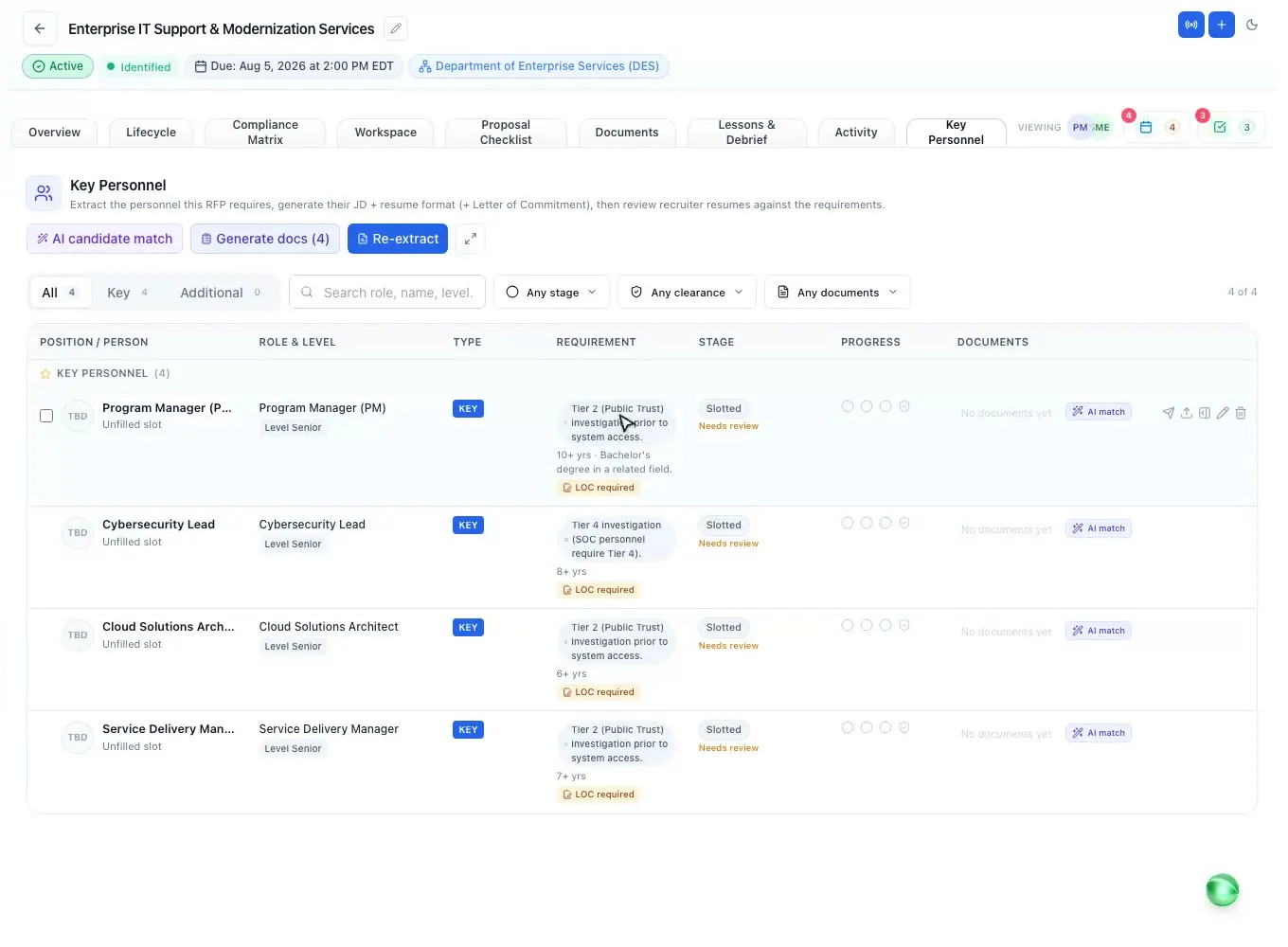
Read moreResumes reviewed against the job description, with letters of commitment checked.
Read morePage limits and leftover comments checked in the document you submit.
Read moreQuestions people ask
Agencies rarely publish winning proposals, because they contain the offeror's proprietary information. Useful sources are your own past proposals, debriefs after an award, annotated examples like the fictional one on this page, and guides that explain each volume. ProposalWorkspace also has work samples of cover pages, outlines, compliance and cross-reference matrices and checklists drawn from awarded responses and reviewed for OPSEC.
It follows the solicitation's structure: usually a cover letter, then separately bound volumes such as technical, management, past performance and price, each answering the RFP's instructions in order. The excerpts above show the habits that score: answering in the order asked, using the evaluator's words, and backing each claim with proof.
Use it to learn, not to copy. Your proposal must follow your RFP's instructions and contain only claims that are true for your company. A copied structure or a borrowed claim is one of the most common reasons proposals lose points.
No. The agency, RFP, company, project and results are all made up, and the excerpts are written in general industry practice to show what evaluators look for.
How each section maps to the instruction it answers and the factor it is scored against. That traceability, more than the wording, is what makes a proposal easy to evaluate. See Section L, M and C explained.
As long as the RFP allows and no longer. Page limits are set in the instructions, often per volume or per section, and pages over the limit may not be evaluated. Short excerpts like the ones above are a good guide to density: every sentence answers something.
The habits are the same, but the labels and forms differ: evaluation criteria often carry points, and local bids add forms such as notarized affidavits, price forms or bid bonds.
ProposalWorkspace starts at $99 a month billed annually ($129 billed monthly) for 2 seats, with every feature on every plan. Subscribe from pricing or book a demo.
 ProposalWorkspace
Set up in minutes
Plans from $99 a month, billed yearly. Subscribe today or book a demo with our team.