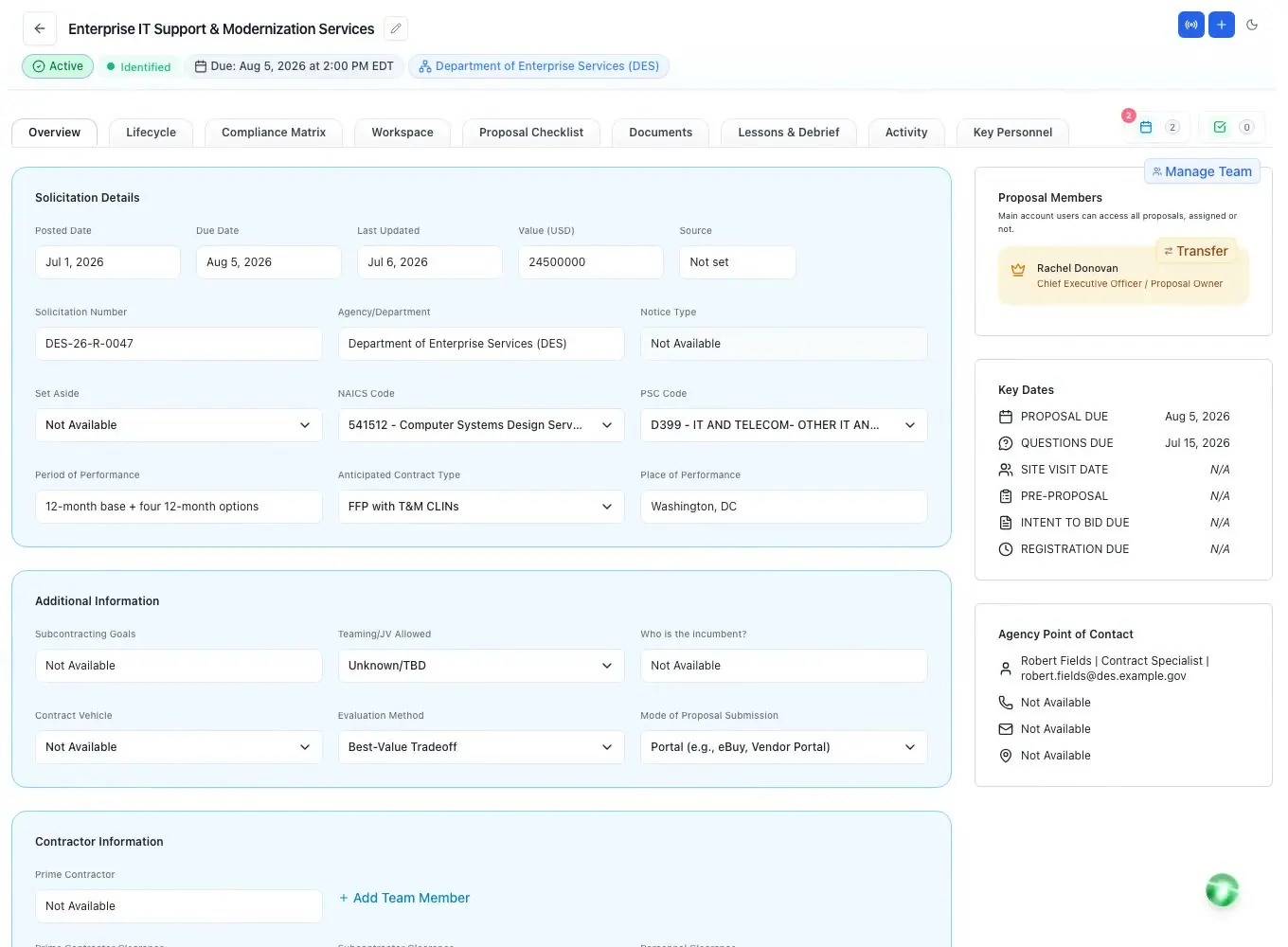
Opportunity discovery
Sources sought notices from the daily SAM.gov feed, scored 0-100 against your profile.
Read moreSources sought response template
Updated
A sources sought response template gives you the shape of a short, complete answer to an agency's market research: your company data and size status, the capabilities the notice asks about, relevant past performance, and answers to every question in the order asked. A good response helps the agency decide how to buy, including whether to set the contract aside for small businesses.
Every feature on every plan, from $99 a month billed yearly.
The basics
A sources sought notice is market research. Before it writes a solicitation, an agency posts a notice on SAM.gov asking which companies can do the work, and how. Market research is required by FAR Part 10, and the answers feed real decisions: the contract type, the vehicle, the NAICS code and whether the work is set aside for small businesses under the "rule of two" in FAR Part 19.
A request for information (RFI) is close kin: the agency asks questions about an approach, a draft statement of work or the market, often with no promise of a contract (FAR 15.201 covers these exchanges with industry). Neither is a proposal, and the agency will not award a contract from your response.
That is exactly why they are worth answering. If two or more capable small businesses respond, the contracting officer has a reason to set the work aside. If nobody responds, the agency may buy another way. And the questions you raise can shape the RFP that follows. Definitions: sources sought and RFI.
The response template
If the notice prescribes a format, follow it exactly: its order, its page limit, its file type and its submission address. If it does not, the structure below covers what contracting officers look for. Keep it short; many notices cap responses at five to ten pages, and a focused response is read more closely than a long one.
| Section | What to put in it | Length tip |
|---|---|---|
| Cover page or letter | The notice number and title, your company name, and one named point of contact with phone and email. | Half a page. |
| Company data | UEI, CAGE code, business size under the notice's NAICS code, socio-economic status (8(a), HUBZone, SDVOSB, WOSB), contract vehicles you hold. | A short table. |
| Capability summary | How your company does the work the notice describes, in the notice's own words and order. | 1-3 pages. |
| Answers to the questions | Each question restated and answered, in the order asked. Nothing skipped. | As the notice allows. |
| Relevant past performance | Two or three similar contracts: customer, scope, size, period and outcome. | One paragraph each. |
| Teaming approach (if any) | If you would team or subcontract, who does what, and the share of work you would perform yourself. | A short paragraph. |
| Recommendations | Respectful suggestions on scope, NAICS code, contract type or set-aside, with your reasons. | A few bullets. |
Writing the response
Answer every question, in order. Contracting officers often compare responses side by side. A response that restates each question and answers it directly is easy to credit; one that offers a general brochure is not. A capability statement can be attached, but it does not replace the answers.
State your size status plainly. The set-aside decision depends on how many capable small businesses respond, so put your business size under the notice's NAICS code and your certifications where they cannot be missed. If you think another NAICS code fits the work better, say so and why.
Show capability, not just interest. The rule of two needs the contracting officer to believe the firms can actually do the work. Specific past performance (customer, scope, value, outcome) makes that case far better than adjectives. Respect the page limit and the deadline; late responses are usually not read.
The full walkthrough is in how to respond to a sources sought notice or RFI.
Shaping the RFP
A sources sought notice or RFI is one of the few moments when the agency invites industry to comment before the requirement is fixed. If the draft scope is unclear, a service level looks unworkable or the evaluation approach seems mismatched to the work, the response is the place to say so, politely and with a reason.
Ask questions that help the agency write a better solicitation, not questions that help only you. A suggestion backed by experience ("on similar help desk contracts, a two-hour response for priority tickets has worked; one hour required round-the-clock staffing") is useful market research, and it is remembered.
In ProposalWorkspace
ProposalWorkspace has a Pre-Award lifecycle for sources sought notices and RFIs, in four phases: Opportunity Overview, Opportunity Analysis with Gate 1 (track it or not), Capture with Gate 2 (prepare a response or not), and Watch & Convert, which keeps the submission record and the check-ins and promotes the pursuit when the RFP is released. It then graduates to the final RFP with nothing re-entered.
The Opportunity Overview summarizes the notice in plain language (who is buying, what, the scope, the dates) with page cites, and the Q&A Center finds the real ambiguities, conflicts and gaps in a solicitation and drafts questions for the contracting officer, each linked to its source. You review every question and send them from your own email. Federal notices come from the daily SAM.gov feed, scored 0-100 against your company profile.
How it works
Read the notice the day it posts and decide whether the work fits.
Use the notice's order, page limit and file type; otherwise use the template above.
Restate each one and answer it, with specific past performance.
Send it on time, record it, and watch for the RFP.
Every feature is on every plan. Plans start at $99 a month billed annually for Solo with 2 seats ($129 billed monthly). Subscribe today or book a demo with our team. Full pricing
In the product
Sources sought notices from the daily SAM.gov feed, scored 0-100 against your profile.
Read moreThe notice read with page cites: dates, scope, evaluation and questions to ask.
Read moreOverview, analysis, capture and watch, then on to the final RFP with nothing re-entered.
Read moreThe six-part template and a filled-in sample to attach to your response.
Read moreA daily email of new notices that match your saved searches.
Read moreTasks, deadlines and team chat around each pursuit.
Read moreQuestions people ask
A market research notice an agency posts before writing a solicitation, asking which companies can do the work. Responses help decide the acquisition approach, including whether to set the work aside for small businesses.
No. The agency will not award a contract from it. It is market research, but it can shape the set-aside decision, the scope and the evaluation approach of the RFP that follows.
As long as the notice allows and no longer. Many notices set a limit of five to ten pages; if none is given, a focused response of a few pages is read more closely than a long one.
Both are market research. A sources sought notice mainly asks who can do the work; an RFI asks questions about an approach, a draft scope or the market. Many agencies use the terms loosely, so answer whatever the notice actually asks.
Yes, if the notice allows attachments, but answer the questions in the response itself. A capability statement does not replace direct answers. See the capability statement template.
Yes. It has a Pre-Award lifecycle (overview, analysis with Gate 1, capture with Gate 2, watch and convert) that graduates to the final RFP with nothing re-entered, and a Q&A Center that drafts questions for the contracting officer.
ProposalWorkspace starts at $99 a month billed annually ($129 billed monthly) for 2 seats, with every feature on every plan. See pricing or book a demo.
 ProposalWorkspace
Set up in minutes
Plans from $99 a month, billed yearly. Subscribe today or book a demo with our team.