RFP analysis
Go/no-go factors with the solicitation fact, why it matters and a page cite.
Read moreBid/no-bid checklist
Updated
A bid/no-bid checklist helps you decide, early and on the record, whether a government opportunity is worth a proposal. It has two parts: eligibility gates that stop a bid outright if any one fails, then weighted factors such as win probability, strategic fit, capability, financials and risk that you score to reach a go, a conditional go or a no-go.
Every feature on every plan, from $99 a month billed yearly.
The decision
Every proposal costs real time; contractors report an average of 84 hours going into one, and more for a large federal bid. A team that bids on everything spreads that effort thin and loses more often. A team that decides with a checklist bids on the work it can win and walks away from the rest without regret.
A checklist also makes the decision defensible. Instead of "it felt right", the record shows which gates were checked, how each factor scored and who made the call, with the reason. When the result comes in, win or lose, the team can see which factors predicted it. What the term means: bid/no-bid.
The checklist below is generic practice that works for federal, state and local bids. Adjust the factors and weights to your company, but keep the structure: gates first, then scored factors, then a recorded human decision.
Part 1: showstoppers
Start with the questions that end the discussion if the answer is no. These are not scored; any one failure is a showstopper. Check them against the solicitation itself, not the notice summary, and note the page where each answer is found.
| Gate | The question | Where to check |
|---|---|---|
| Set-aside eligibility | If the work is set aside (small business, 8(a), HUBZone, SDVOSB, WOSB), do we qualify under the stated NAICS code's size standard? | The notice and SAM.gov registration |
| Registration | Is our SAM.gov registration active, with the right NAICS codes and representations? | SAM.gov |
| Required clearances | Does the work need a facility clearance or cleared staff we do not have and cannot get in time? | Section C, H or the DD 254 |
| Licenses and certifications | Are there required licenses, certifications or quality standards we lack? | Sections C, H and L |
| Contract vehicle | If the order is under a vehicle (GWAC, IDIQ, BPA), are we on it or on a team that is? | The notice |
| Time to respond | Can we write a compliant proposal by the due date with the people we have? | Section L and the schedule |
| Conflicts of interest | Does an organizational conflict of interest rule us out? | Section H and FAR Part 9 |
Part 2: the scorecard
If every gate passes, score the opportunity. Five factors cover what decides most bids. Give each a score from 1 (poor) to 10 (strong), weight the factors that matter most to your company more heavily, and add them up as a percentage of the best possible score.
Be honest about the evidence. "We know the customer" scores high only if you have talked to them; "we can do the work" scores high only if you have recent, relevant past performance to prove it. A factor you cannot support is a low score, not a hopeful one.
| Factor | Questions to ask | Scores high when |
|---|---|---|
| Win probability | Do we know the customer? Is there an incumbent, and how is it doing? How many competitors are likely? | We shaped the requirement and the incumbent is weak or absent. |
| Strategic fit | Does this work grow the business we want? Does it open an agency or a vehicle? | It is core work for a target customer. |
| Capability and resources | Do we have the people, key personnel and past performance this RFP asks for, or a teammate who does? | Every major requirement is covered by our own proof. |
| Financial | Is the value worth the bid cost? Can we price to win and still make a margin? Is cash flow manageable? | Good margin at a competitive price. |
| Risk | Are the terms, schedule, service levels or contract type risky for us? | Familiar terms and a realistic schedule. |
Part 3: the decision
Set your thresholds before you score, so the number cannot be bent to fit a wish. A common pattern is three bands: a clear go, a conditional go that proceeds only if named conditions are met (a teammate signed, a key person committed), and a no-go.
The score recommends; people decide. Record the final call (bid or no bid) with a short rationale, separately from the computed recommendation, and with the names of who decided. If the team bids against a low score, the rationale says why; if it walks away from a high one, the same. Read the full method in the bid/no-bid decision worksheet and what pWin means.
Then revisit the decision at the next milestone. A go at the sources sought stage can become a no-go when the RFP arrives with a requirement you cannot meet.
In ProposalWorkspace
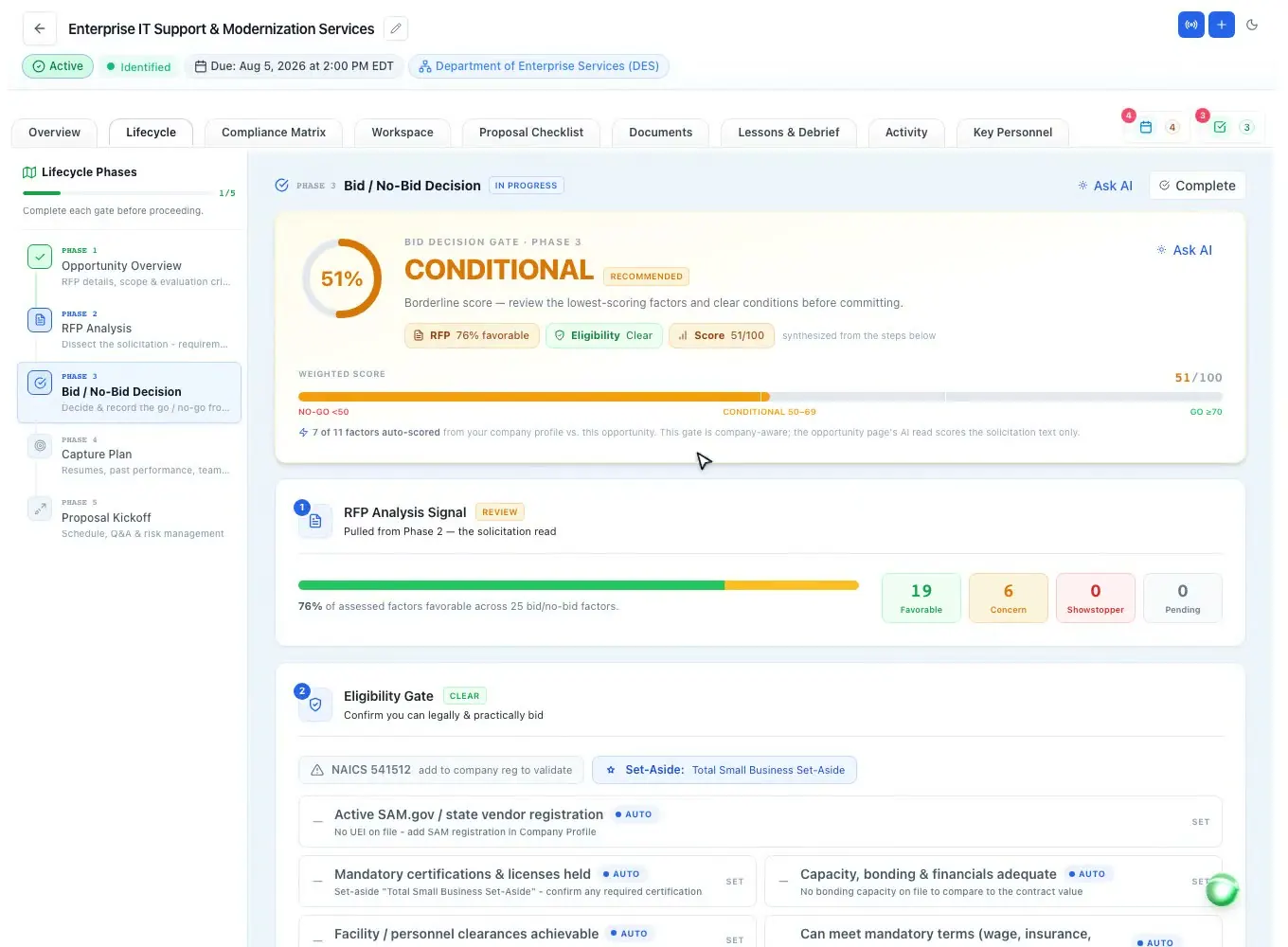
In ProposalWorkspace the built-in AI reads the RFP and returns the go/no-go factors by category (eligibility gates, scope and capability fit, competition and win position, contract value, risk and terms, bid effort and logistics), each with the solicitation fact, why it matters and a page cite, and it surfaces red flags. You mark each factor Favorable, Concern, Showstopper or N/A on a Word-compatible worksheet.
The Capability Matrix then sets every requirement of the RFP against the past performance you choose, row by row (Covered, Partly, Thin or Gap) with the quote that proves it. The Bid / No-Bid Decision is the single gate: any showstopper blocks the bid, and a weighted scorecard (Win Probability, Strategic Fit, Capability & Resources, Financial, Risk; each factor scored 1-10 and weighted x1-x3) recommends GO at 70 or more, CONDITIONAL from 50 to 69 and NO-GO under 50. A person records BID or NO-BID with a rationale, kept separate from the recommendation.
Your past decisions are reusable: the Knowledge File keeps your go/no-go factors, and the AI pre-fills a new worksheet from it only where you have not assessed a factor yet, with a link to the source proposal.
How it works
The real RFP or notice, not a summary, with page numbers noted.
Set-aside, registration, clearances, licenses, vehicle, time, conflicts. Any no stops here.
Win probability, strategic fit, capability, financial and risk, 1-10 each, weighted.
Go, conditional or no-go, with the rationale and who decided.
Every feature is on every plan. Plans start at $99 a month billed annually for Solo with 2 seats ($129 billed monthly). Subscribe today or book a demo with our team. Full pricing
In the product
Go/no-go factors with the solicitation fact, why it matters and a page cite.
Read moreShowstoppers block; a weighted scorecard recommends GO, CONDITIONAL or NO-GO.
Read moreEvery requirement set against your past performance, Covered to Gap, with proof.
Read morePast go/no-go factors reused to pre-fill a new worksheet, never over your own input.
Read moreBids scored 0-100 against your profile by a published formula.
Read moreCustomer, competition, team and win themes after a GO.
Read moreQuestions people ask
A list of questions a contractor answers before deciding to write a proposal: eligibility gates that stop a bid if any fails, then weighted factors such as win probability, strategic fit, capability, financials and risk that are scored to reach a go or no-go.
A condition that rules out a bid regardless of the score, such as a set-aside you do not qualify for, a required clearance you cannot get in time, or a contract vehicle you are not on.
Set the thresholds before scoring. A common pattern is three bands: a clear go, a conditional go with named conditions, and a no-go. ProposalWorkspace recommends GO at 70 or more, CONDITIONAL from 50 to 69 and NO-GO under 50.
The people accountable for the result, usually the capture manager and a business leader, with the proposal manager's view on effort. The score recommends; the decision and its rationale should be recorded by a person.
As early as you can, then again at each milestone: when a sources sought or draft RFP appears, when the final RFP is released, and when an amendment changes something material.
Yes. The built-in AI extracts the go/no-go factors from the RFP with page cites, the Capability Matrix checks your coverage, and the Bid / No-Bid Decision scores five weighted factors; a person records BID or NO-BID with a rationale.
ProposalWorkspace starts at $99 a month billed annually ($129 billed monthly) for 2 seats, with every feature on every plan. See pricing or book a demo.
 ProposalWorkspace
Set up in minutes
Plans from $99 a month, billed yearly. Subscribe today or book a demo with our team.